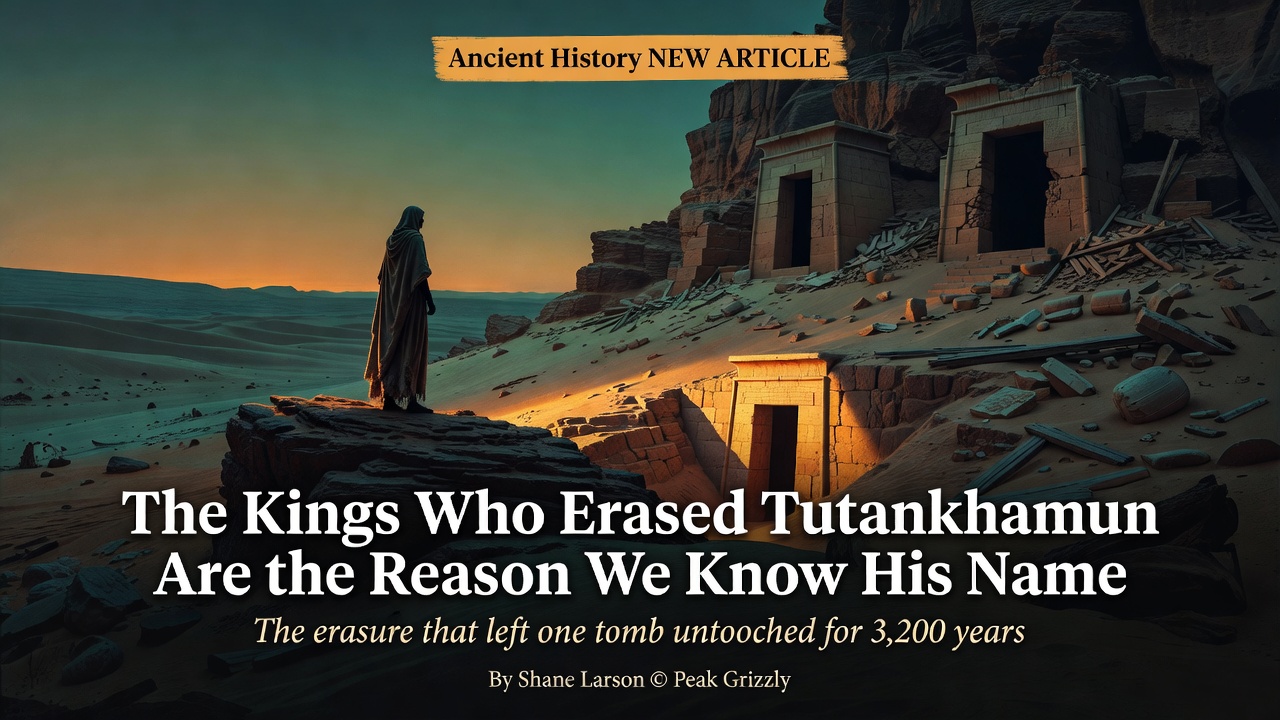
The Kings Who Erased Tutankhamun Are the Reason We Know His Name
July 18, 2026 · 5 min read
Here is a question that doesn't get asked often enough: out of sixty-plus royal tombs cut into the Valley of the Kings across five centuries, why was Tutankhamun's the only one found substantially intact?
Every other pharaoh in that valley — the conquerors, the builders, the greatest names of Egypt's greatest age — was robbed. Most were robbed in antiquity, some within a generation of burial, a few possibly by the very workmen who sealed the doors. We have the receipts, literally: surviving papyri record the tomb-robbery trials of the Twentieth Dynasty, complete with confessions describing how the thieves stripped the gold from royal mummies and burned the coffins for the leaf. By the time archaeology arrived, the Valley of the Kings was a graveyard of empty vaults.
Except one. The smallest, meanest royal tomb in the valley — a cramped, four-room afterthought — slept under the floor of the valley for 3,200 years with five thousand objects and 110 kilograms of gold coffin inside it, until a stubborn, nearly-defunded excavator named Howard Carter found a step in November 1922.
The reason it survived is the best irony in Egyptology, and it's the spine of the book I've just finished: Tutankhamun survived because he was erased.
A King Deleted on Purpose
Tutankhamun was the son of Akhenaten — the heretic pharaoh who abolished Egypt's gods in favor of a single solar disk, built a new capital in the desert, and dragged the empire through a religious revolution that outlived him by only a few years. The boy came to the throne at about nine years old, in the wreckage. His handlers — an old courtier named Ay and a general named Horemheb — used the child's reign to put the old gods back. His own restoration decree (issued at perhaps eleven years old, and certainly not drafted by him) describes temples in ruin and gods who had turned their backs on Egypt. He was, in the propaganda of his own court, the healer of his father's damage.
It didn't save him from the family taint. After the boy died at about nineteen — and after Ay and then Horemheb had each taken turns on his throne — the New Kingdom's official memory-keepers made a decision: the entire Amarna episode had never happened. The king lists carved at Abydos and Saqqara in the following dynasty jump straight from Amenhotep III to Horemheb, as if four reigns — Akhenaten, his shadowy successors, Tutankhamun, Ay — had simply never occurred. Horemheb absorbed their years into his own reign-count. Tutankhamun's restoration monuments got Horemheb's name cut over the boy's cartouches: the eraser took credit for everything the erased had done. Later Ramesside documents refer to Akhenaten only as "the criminal of Akhetaten." It was damnatio memoriae, Egyptian style — not rage, but theology: if cosmic order required that the heresy never happened, then the paperwork had to agree.
Erasure Is the Best Security System Ever Devised
Now consider what deletion did for the boy's tomb.
A famous pharaoh's tomb was a target with a public address. Mortuary cults kept the name alive; administrative records located the burial; long-remembered glory advertised exactly how much gold went into the ground. Tomb robbery in the Valley wasn't random treasure-hunting — it was an informed industry, occasionally with inside help, working from institutional memory.
Tutankhamun
Tutankhamun had no institutional memory. No cult said his name. No king list carried it. Within a few generations, there was no one alive with a reason to know where — or that — he was buried. His tomb was small and low, cut into the valley floor rather than the grand cliff walls, because it was a hasty adaptation of a private tomb for a king who died without a finished royal one. Then the desert finished the job the scribes had started: flash floods sheeted debris across the low entrance and set it like concrete. Two centuries after his death, work gangs cutting the enormous tomb of Ramesses VI directly above built their stone huts right on top of the buried doorway — unknowingly sealing the forgotten king under the construction site of a remembered one.
The tomb wasn't perfectly untouched; it had been breached twice, early, by robbers who got into the outer chambers and were caught or scared off — the resealed holes and hastily re-tidied antechamber were still visible when Carter arrived. But after the floods and the huts, nothing touched it again. Every tomb worth remembering was emptied. The tomb nobody remembered kept everything.
That's the equation that gives me the book's argument: fame was fatal; oblivion preserved. The kings who deleted Tutankhamun from history are precisely why he owns it now — why the least significant ruler of Egypt's most powerful dynasty is the only one whose golden mask you can picture right now, and why we know more about his burial than that of Ramesses the Great.
The Boy Underneath
There's a real person under all this irony, and the tomb — read as evidence rather than spectacle — gives him back to us in a way no other pharaoh gets. The wine jars are labeled with vintages and vineyards, dating the burial season. More than 130 walking sticks, many worn from use, sit oddly beside the heroic chariot-hunting imagery — modern CT scans found a deformed foot with bone necrosis, and the most athletic-looking king in Egyptian art may have needed a cane to stand. Two tiny coffins held his stillborn daughters. The forensics of his own death — a century-long parade of murder theories, killed off by the 2005 CT scans and complicated by 2010 DNA work showing an unhealed leg fracture, malaria, and parents who were full siblings — get an honest chapter in the book, including the part most tellings skip: where certainty actually ends.
And then there's the discovery itself — Carter's sixteen steps, the candle in the escaping ancient air, the decade of meticulous cataloguing, and the newspaper-rights deal that accidentally manufactured the "curse of the pharaohs" (a myth with a business model; the people most exposed to the tomb conspicuously lived to old age). The life and the discovery braid together naturally, because every object Carter numbered is a clue to the boy the erasers tried to delete.
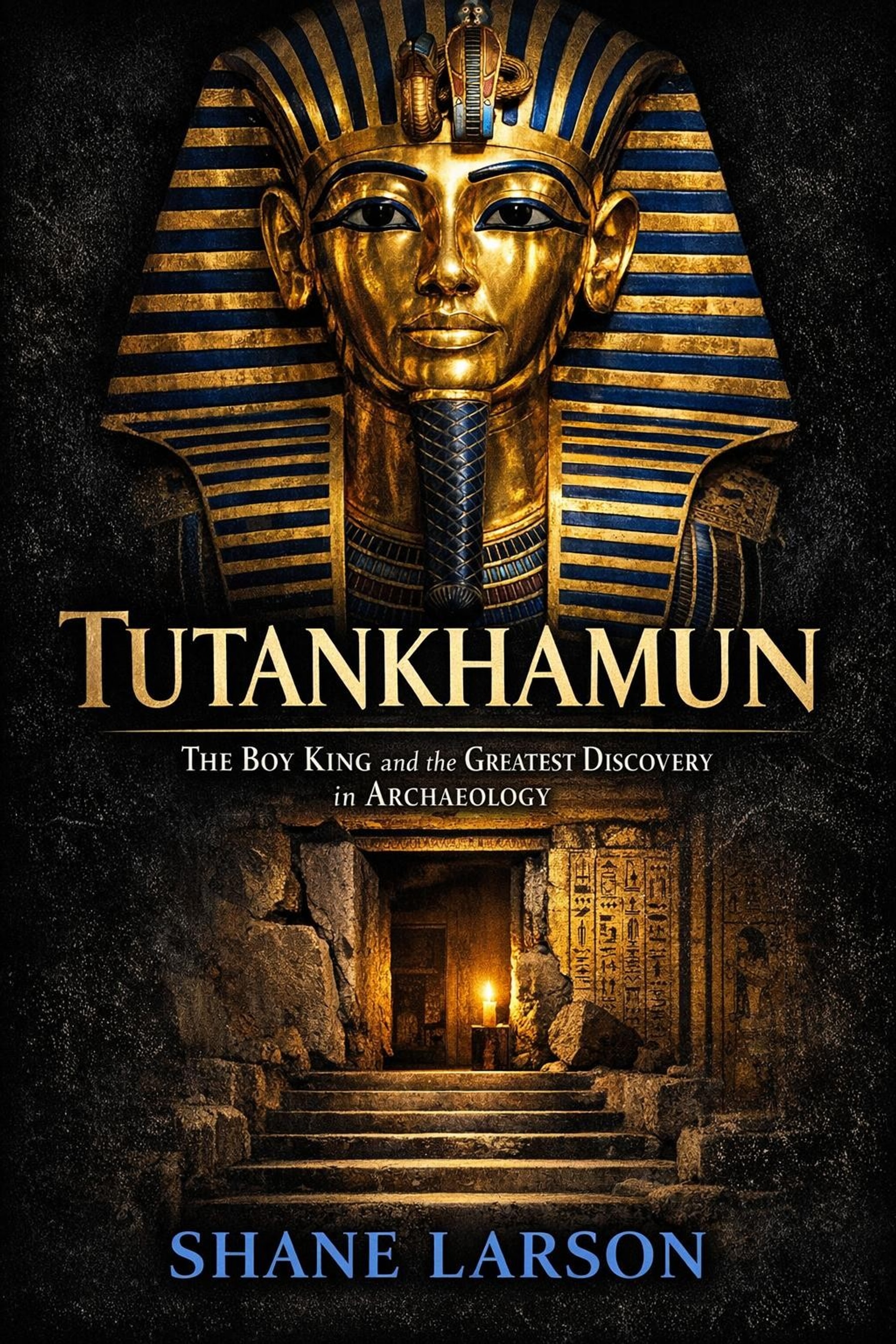
My new book, Tutankhamun: The Boy King and the Greatest Discovery in Archaeology, tells both stories in counterpoint — Amarna's collapse, the child on the throne, the restoration, the hasty burial, the widow's desperate letter to Egypt's enemies, the erasure, and the sixteen steps that undid it all. It's the sequel to my book on his father, Akhenaten — the revolution and the restoration, father and son.
Tutankhamun
New posts and releases, straight to your inbox. No spam, unsubscribe anytime.