The Only City That Left a Record of Its Own Death
July 19, 2026 · 6 min read
Here is a strange thing about the end of the world.
We talk about the collapse of the Late Bronze Age — the roughly one-generation window around 1200 BC when the Hittite Empire, Mycenaean Greece, and the great cities of the eastern Mediterranean all fell, nearly at once — as one of history's largest catastrophes. And it was. But it is also one of history's quietest, because almost nobody who lived through it left us a word about it.
That's not unusual for the ancient world. Most catastrophes are reconstructed from silence. An archaeologist digs down through a floor, hits a band of burned debris and toppled walls, and infers a disaster. What happened, who came, what the people felt as it arrived — these are read backward out of the wreckage, guessed at, argued over for decades. The event is enormous and the testimony is almost nonexistent.
There is exactly one exception. One major city of the Bronze Age collapse died with its correspondence still on the desk. Its name was Ugarit, and it is the reason we can hear the catastrophe in a human voice instead of only diagramming it from ash layers.
A City That Died With Its Mail Unsent
Ugarit was a port on the coast of what is now Syria, and in its golden age it was one of the richest places on earth. It managed this without an empire and without much of an army. What it had was position. It sat at the one point on the map where the Egyptian, Hittite, Mesopotamian, and Aegean worlds all met, by sea and by road. Cypriot copper came ashore in its harbor. Tin arrived overland from somewhere far to the east. Grain moved north to feed the Hittites. Out went the city's own products: olive oil, wine, timber, and — its signature luxury — purple dye, extracted drop by expensive drop from murex sea snails.
Ugarit got rich, in other words, by being useful to everyone who passed through. It was the indispensable middleman of a globalized Bronze Age economy, and for a couple of centuries that turned out to be a very good business to be in.
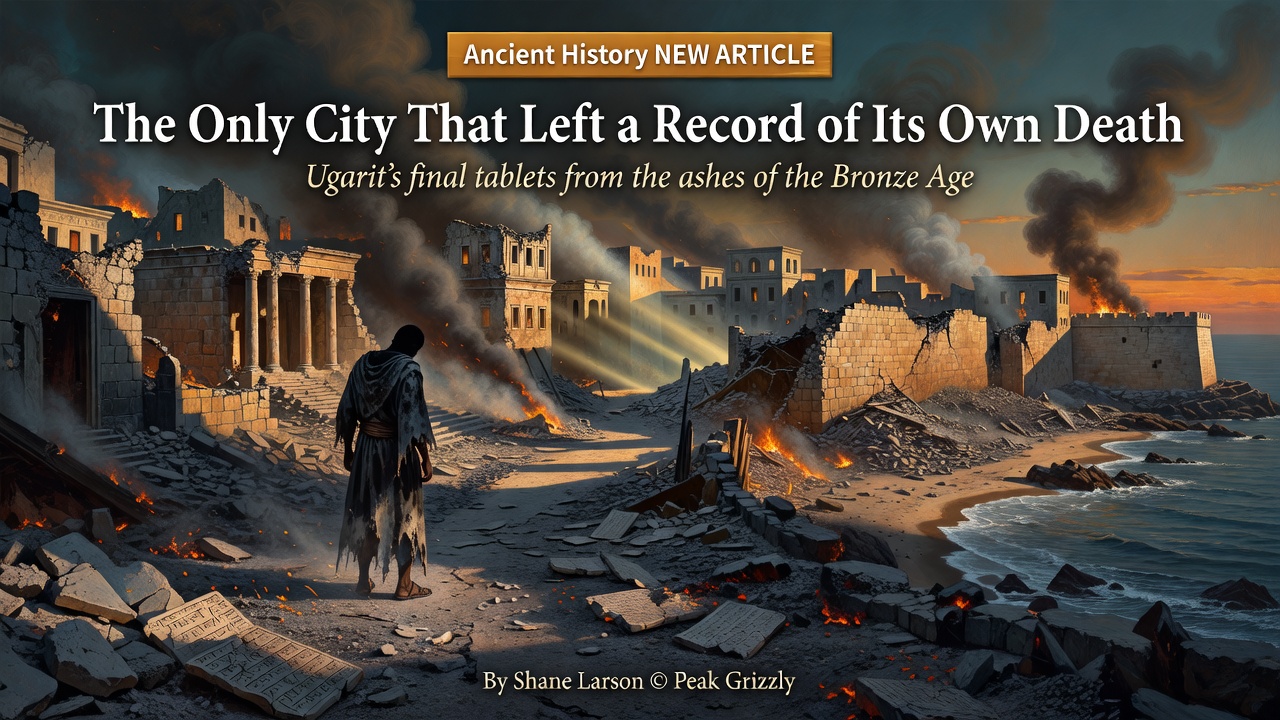
Then, sometime around 1185 BC, it burned.
We know a fair amount about the final months, because — and this is the extraordinary part — the city's archives survived. In the ruined last layer of Ugarit, in the palace and the temples and the private houses of named citizens, excavators found the correspondence of a dying state. Reports of enemy ships sighted off the coast. Pleas for grain. Requests for reinforcements. And a letter from the king himself, writing to a fellow monarch across the water, not troubling to hide his fear: the ships have come, the towns are burning, my army is away, my fleet is away, the country is defenseless.
Some of these tablets were found where they had been set aside — unsent — when the end arrived. The courier never left. The city burned first.
Here is the detail I cannot get out of my head. These were clay tablets, and wet clay is fragile; normally it has to be deliberately baked in a kiln to last. The fire that destroyed Ugarit did that baking by accident. The catastrophe that killed the city is the exact reason its final words survived for us to read three thousand years later. The disaster was its own archivist.
Why One Small City Explains a Whole Collapse
It would be enough if Ugarit were just a haunting story. But it's more useful than that, because a single well-documented city can teach you things about a systemic collapse that the big aerial view cannot.

Ugarit
For years, scholars argued about the cause of the Bronze Age collapse as though there had to be one — the Sea Peoples, or an earthquake storm, or drought, or internal rebellion, take your pick. The more convincing modern picture, associated with Eric Cline's 1177 B.C., is that there was no single cause. There was a cascade: a multi-decade drought that crippled harvests across several regions at once, famine, the breakdown of the specialized trade networks that tied everything together, raiders taking advantage of the disorder, and the domino effect of complex, interdependent states failing one after another because each depended on the others.
Ugarit lets you watch that cascade at street level. In its late tablets you can see the grain crisis arriving as a business problem before it arrives as an army — the Hittite overlords sending increasingly urgent demands for emergency food shipments, the city stretched thin between feeding itself and feeding its protector. You can see the military obligations of a small vassal state turn lethal, as the overlord summons Ugarit's army and fleet away to fight elsewhere at precisely the moment enemy ships gather off its undefended coast. You can see, in short, how the very connectedness that made the city rich became the delivery system for its destruction.
That last point is why Ugarit feels so modern. It was a highly optimized node in a tightly coupled network — the kind of arrangement that is wonderfully efficient right up until a shock propagates through it faster than anyone can respond. A poor, isolated village in the mountains might have survived the collapse by being too marginal to bother destroying. Ugarit had no such option. It had made itself central to a whole world, and when that world came apart, the most connected city came apart with it.
I'll leave the modern parallels to you. I try not to bang the reader over the head with them in the book. But I won't pretend they aren't there.
The Voice From the Ground
The last piece of the story is how any of this came back to us at all, and it's the part that reads most like a novel.
By the modern era, Ugarit was so thoroughly forgotten that its very name had dropped out of human memory. The Greeks and Romans don't mention it. It appears in no later history. It was simply gone — a great city erased so completely that no one knew to look for it.
Then, in the spring of 1928, a farmer plowing a field near the Syrian coast felt his blade catch on stone and uncovered a vaulted tomb. Word reached the authorities; French archaeologists began digging at the nearby mound; and almost immediately they started pulling up clay tablets written in a script no one had ever seen — a cuneiform unlike the Mesopotamian kind, using only about thirty signs. Within roughly a year, three scholars working half in competition and half in collaboration had cracked it. It turned out to be an alphabet — one of the oldest in the world, complete with surviving practice tablets that preserve the order the signs were taught in.
So the same city that gives us the only eyewitness account of the Bronze Age collapse also handed us a lost chapter in the history of writing itself. A forgotten port, dug out of a Syrian field, spoke again after thirty-two centuries — first to tell us how it died, and then to remind us that the alphabet you are reading these words in has ancestors far stranger and older than most people ever learn.
That combination — the eyewitness catastrophe, the invention of the alphabet, the resurrection by plow — is why Ugarit haunted me through every other book I wrote about this period, always showing up for a few unforgettable pages and then being left behind. This time I stayed. If any of this resonated, the book goes much, much deeper: the merchants and their contracts, the gods of Canaan and the world behind the Bible, the diplomats keeping a small kingdom alive among giants, and the final letters, tablet by tablet, as the ships appeared.
Ugarit
New posts and releases, straight to your inbox. No spam, unsubscribe anytime.