In 921 a Village in South India Chose Its Council by Drawing Names From a Pot
November 24, 2026 · 5 min read
About fifty-five miles south-west of Chennai there is a small town called Uttaramerur, and in it a temple to Vishnu whose stone base is covered in writing. Two of the inscriptions there are among the most quoted documents in Indian history. They were cut in 919 and 921, in the twelfth and fourteenth years of a king named Parantaka, and they record how the village decided to choose the men who ran its affairs.
The method was a lottery. Names went into a pot, a child drew them out, and the men whose names came up served for a year. The Tamil word for it, kudavolai, means "pot-leaf", after the palm-leaf tickets the names were written on.
The inscriptions are often described as proof of democracy in medieval India. They are more interesting than that, and more specific.
Thirty wards, one ticket each
The village was divided into thirty wards. When the time came, the residents of each ward wrote the names of their eligible men on palm-leaf tickets. The tickets from a ward were tied into a bundle, and the thirty bundles were put in a pot.
The draw was held in front of the full assembly, with the temple priests present. A young boy, chosen because he could not know what he was picking, took one ticket from each ward's bundle. The ticket was handed to an arbitrator, who read the name aloud, and then it was read again by the priests so that nobody could claim it had been misread. Thirty men were chosen this way, one for every ward.
Those thirty were then sorted into committees. Twelve formed the annual committee, the senior body. Twelve looked after the gardens. Six looked after the tank, the reservoir on which the village's rice depended. Separate draws filled two more committees, one of which handled gold. Every term lasted one year.
Who was allowed in the pot
The rules for getting a ticket are the heart of the document. A candidate had to own more than a quarter of a veli of taxable land, something over an acre and a half. He had to live in a house built on his own plot. He had to be over thirty-five and under seventy. And he had to know a specified body of Vedic texts. A man with deeper learning, who could teach one of the Vedas with its commentaries, was let in with half as much land.
So this was an assembly of landowning, educated, middle-aged men. Uttaramerur was also a particular kind of village: a settlement granted to Brahmins, with an assembly, the sabha, made up of the Brahmin landholders. Most villages in the Chola kingdom were not like this. An ordinary farming village had a different body, the ur, about which the inscriptions tell us far less, because it had less reason to carve its procedures on a temple.
The women of Uttaramerur, the tenants who worked its fields, the craftsmen and the labourers had no ticket.
Who was thrown out of it
The list of disqualifications is longer than the list of qualifications, and it reads like the work of people who had been burned before.
The Chola Empire
Anyone who had served on a committee in the past three years was barred, which kept the same faces from coming round every year. Anyone who had served and failed to hand in his accounts was barred, and here the drafters went further. They also barred his relatives, and they listed them: his father's brothers and his mother's brothers, his sons, his brothers-in-law, his sons-in-law, and on through the family. A man who had mishandled village money could not simply put his nephew forward.
Thieves were out. So were men guilty of the gravest religious offences, and men who had eaten forbidden food, even if they had gone through the ceremonies meant to cleanse them.
The second inscription, of 921, replaces the first after only two years. Nobody recorded what went wrong with the earlier version. But a village that rewrites its election rules two years after writing them has run into a problem it did not foresee.
What the stone can prove
An inscription like this records a decision. It tells us what the assembly resolved to do, in the presence of a royal officer, on a certain day. It does not tell us whether the draw was held honestly the following year, or for how many years it went on, or how the men of Uttaramerur dealt with the neighbour everyone knew was dishonest but who had never been caught.
It does show a community that thought hard about procedure. Choosing by lot from a qualified pool, limiting terms to a year, forcing a gap before anyone could serve again, auditing accounts and punishing a defaulter's whole family: these are answers to real problems of running anything, and a tenth-century village arrived at them without help from any outside theory.
Whether that is democracy depends on what the word is being asked to do. If it means every adult has a say, the answer is no. If it means that office was filled by an open, rule-bound process that no single powerful man controlled, then Uttaramerur has a claim. Both statements are true together.
Why the Cholas wrote it down
Uttaramerur lay in the kingdom of the Cholas, the dynasty that would go on, a century later, to conquer Sri Lanka and send a fleet across the Bay of Bengal. They are remembered as conquerors. But the bulk of what they left behind looks like this: more than ten thousand inscriptions on temple walls, most of them recording sales, endowments, tax arrangements and the decisions of local bodies.
It is an unusual thing to know about a medieval state. For most kingdoms of the period we have the chronicle of the court and almost nothing of the village. For the Cholas it is the other way round. No court history survives at all, while the business of a single village assembly in the year 921 can be followed almost clause by clause.
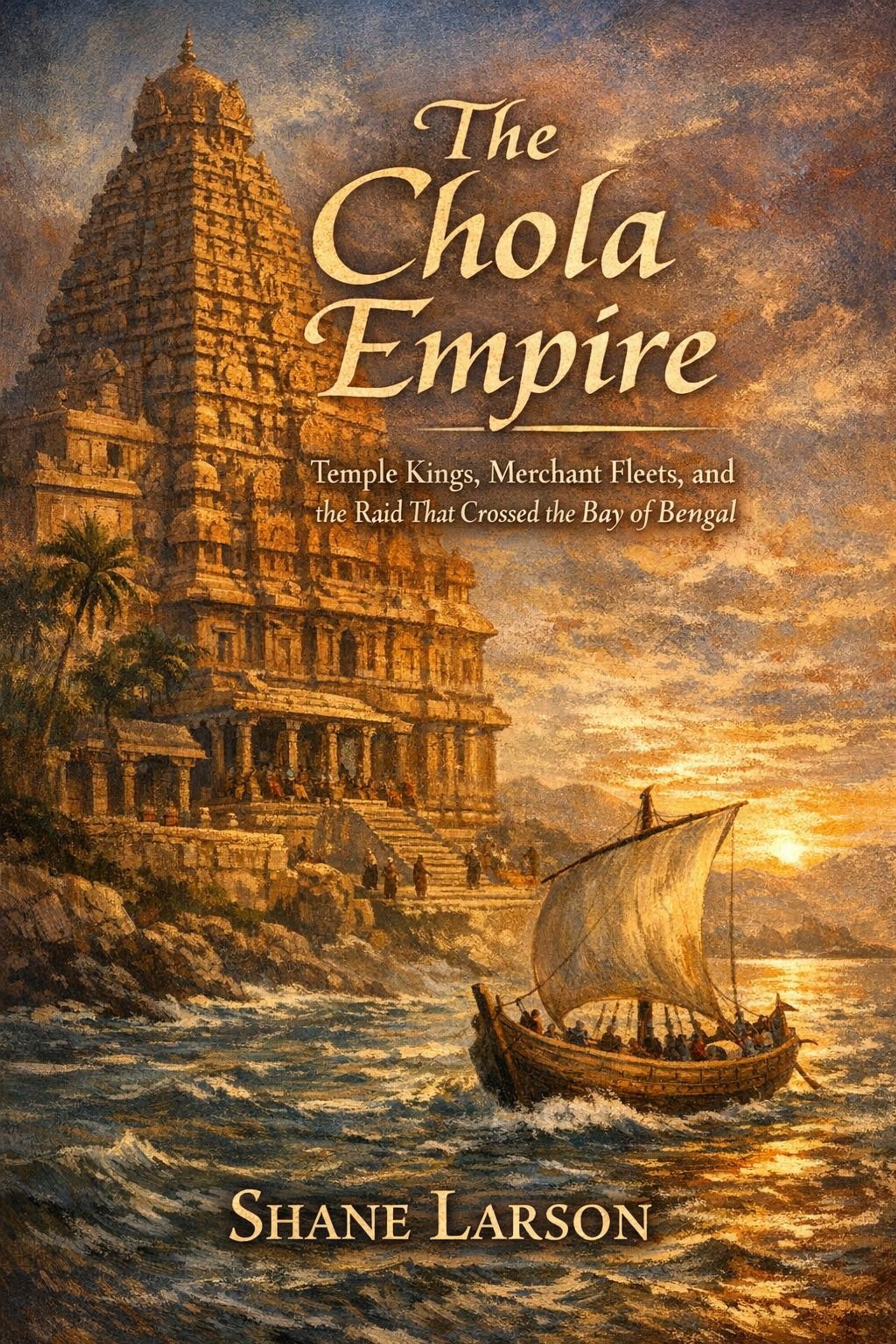
That is the starting point of *The Chola Empire: Temple Kings, Merchant Fleets, and the Raid That Crossed the Bay of Bengal*, which tells the story of the dynasty from the documents it left, with a chapter on Uttaramerur and what its famous pot can and cannot bear.
The Chola Empire
New posts and releases, straight to your inbox. No spam, unsubscribe anytime.