"Kill Them All, God Will Know His Own": Who Actually Said It?
November 24, 2026 · 6 min read
On 22 July 1209 a crusading army stood outside Béziers, a walled town on a hill above the river Orb in southern France. The army had been raised by Pope Innocent III to destroy heresy in the lands of the count of Toulouse and his neighbours. By evening the town had been stormed, looted and set on fire, and a large part of its population was dead.
One sentence from that day has outlived everything else about it. The story goes that the soldiers asked the papal legate, Abbot Arnaud Amalric of Cîteaux, how they were to tell the heretics from the good Catholics inside. He is supposed to have answered: kill them all, God will know his own. In modern English it has been sharpened into "Kill them all and let God sort them out", and it has been printed on T-shirts, unit patches and album covers.
It is worth asking where the sentence comes from, because the answer says a good deal about how medieval history reaches us.
The source is a book of miracle stories
The line appears in exactly one medieval text. Caesarius was a monk, and later prior, of the Cistercian abbey of Heisterbach, near Bonn in the Rhineland. Around 1220 he compiled the Dialogus Miraculorum, the Dialogue on Miracles, a large collection of edifying stories arranged as a conversation between a monk and a novice. It was written to train young Cistercians, and it is full of visions, demons, punished sinners and rewarded saints.
In the section on heresy Caesarius tells the story of Béziers. In his account the crusaders, having learned from captured townspeople that Catholics and heretics were mixed together inside, put their question to the abbot. The abbot, fearing that heretics would pretend to be Catholics to save themselves and go back to their errors afterwards, is said to have replied in these words: Caedite eos. Novit enim Dominus qui sunt eius. Kill them. For the Lord knows who are his.
Three things about this passage matter.
First, the date. Caesarius was writing about a decade after the event, and possibly more.
Second, the distance. Heisterbach is several hundred miles from Béziers. Caesarius was not there, and he does not name anyone who was. His order had many houses and a steady traffic of abbots between them, so a story could well have travelled north along Cistercian channels, but he does not say that it did.
Third, his own wording. Caesarius does not write that the abbot said it. He writes that the abbot is reported to have said it. The Latin verb is fertur, "it is said". The one man who preserves the sentence marks it as hearsay.
The second half is a Bible verse
The reply is not original to anyone at Béziers. Its second sentence is taken from the Second Epistle to Timothy, chapter 2, verse 19, which in the King James Version reads, "The Lord knoweth them that are his." An abbot of Cîteaux would have known the verse by heart. So would a monk of Heisterbach composing a story in which an abbot needed something to say. The quotation fits the speaker too well to prove anything in either direction.
What the chroniclers on the spot say
Three narrative accounts of the crusade were written by men much closer to it than Caesarius. William of Tudela, a cleric from Navarre living in the south, began his verse history of the war around 1210 and was broadly on the crusaders' side. Peter of Les Vaux-de-Cernay was a young Cistercian from the Paris region whose uncle was one of the crusade's abbots, and he admired its commander. William of Puylaurens was a southern churchman who wrote decades later.
The Cathars
None of them reports the order. That silence is not decisive, since two of the three had reason to protect the abbot's reputation. But William of Tudela does say something else that deserves attention. In his account the leaders of the army had agreed, before they ever reached Béziers, that any fortified place which refused to surrender would be taken by storm and its people put to the sword, so that the terror would open the gates of the towns further on. On that telling no one needed to give an order on the day. The policy had already been set.
The same writer describes how the town actually fell. The defenders came out to skirmish, the army's camp followers chased them back and got in through a gate, and the sack began before the knights were fully armed. That is a picture of a town taken in a rush by the least disciplined part of an army, which is not the kind of moment in which soldiers stop to put a theological question to an abbot.
What Arnaud Amalric wrote himself
Here is the part that the famous sentence tends to hide. We do not need Caesarius to know what the abbot thought of the day's work, because he told the pope.
In August 1209 Arnaud Amalric and his fellow legate sent Innocent III a report on the campaign. It survives among the pope's correspondence. In it they describe the fall of Béziers as something close to a miracle: while the barons were still discussing terms, the common soldiers attacked without waiting for orders and took the city in a matter of hours. The legates then state, without any sign of regret, that their men spared no one, whatever their rank, sex or age, and that nearly twenty thousand people were killed. They call it divine vengeance.
Modern historians think the figure is too high. Béziers was a prosperous town, but its whole population is usually estimated well below twenty thousand, and some people certainly survived, because the town was functioning again within a few years. Medieval commanders were not careful with numbers, and a large round figure made a better report. What the letter establishes is the attitude. The men in charge believed that a great many people had died without distinction, and they presented that to the pope as good news.
So did he say it?
Nobody can know. The honest position is this. The sentence rests on a single source, written far away and years afterwards, by an author who collected moral tales and who flagged this one as something he had heard. It cannot be confirmed. It also cannot be dismissed as slander, because it comes from a member of the abbot's own order who seems to have thought the reply rather a good one, and because it agrees in spirit with what the abbot put in writing.
The better conclusion is that the question matters less than it seems. The fame of the line suggests that the massacre at Béziers needs a villain's quotation to explain it. It does not. The documented record, written by the commanders themselves, already says that no distinction was made and that they were satisfied with the result.
Why the gap matters
The whole history of the Albigensian Crusade is like this. The best-known facts are often the most weakly attested, and the well-attested ones are less quotable. The word "Cathar" itself was almost never used by the people it describes. The castle on the peak at Montségur, which visitors climb the mountain to see, was built after the people it is famous for were dead. Even the question of what the heretics believed, and whether they formed an organized church at all, is still argued over by the historians who know the records best.
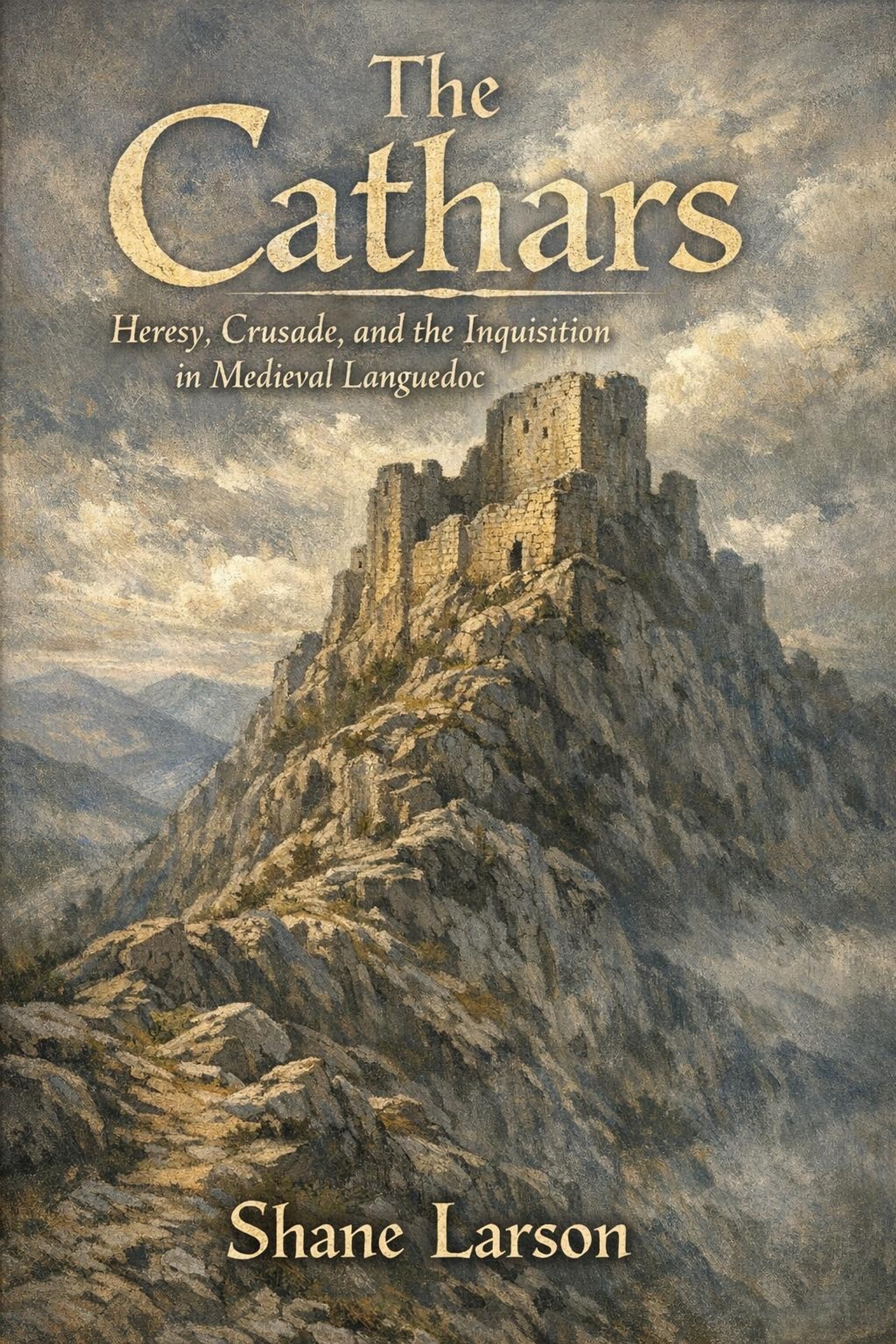
*The Cathars: Heresy, Crusade, and the Inquisition in Medieval Languedoc* is built around that gap. It tells the story of the crusade and of the tribunal that followed it, from the first preaching missions to the last burning in 1321, and at each step it says who wrote the evidence down and whose side they were on. Béziers is where it starts.
The Cathars
New posts and releases, straight to your inbox. No spam, unsubscribe anytime.