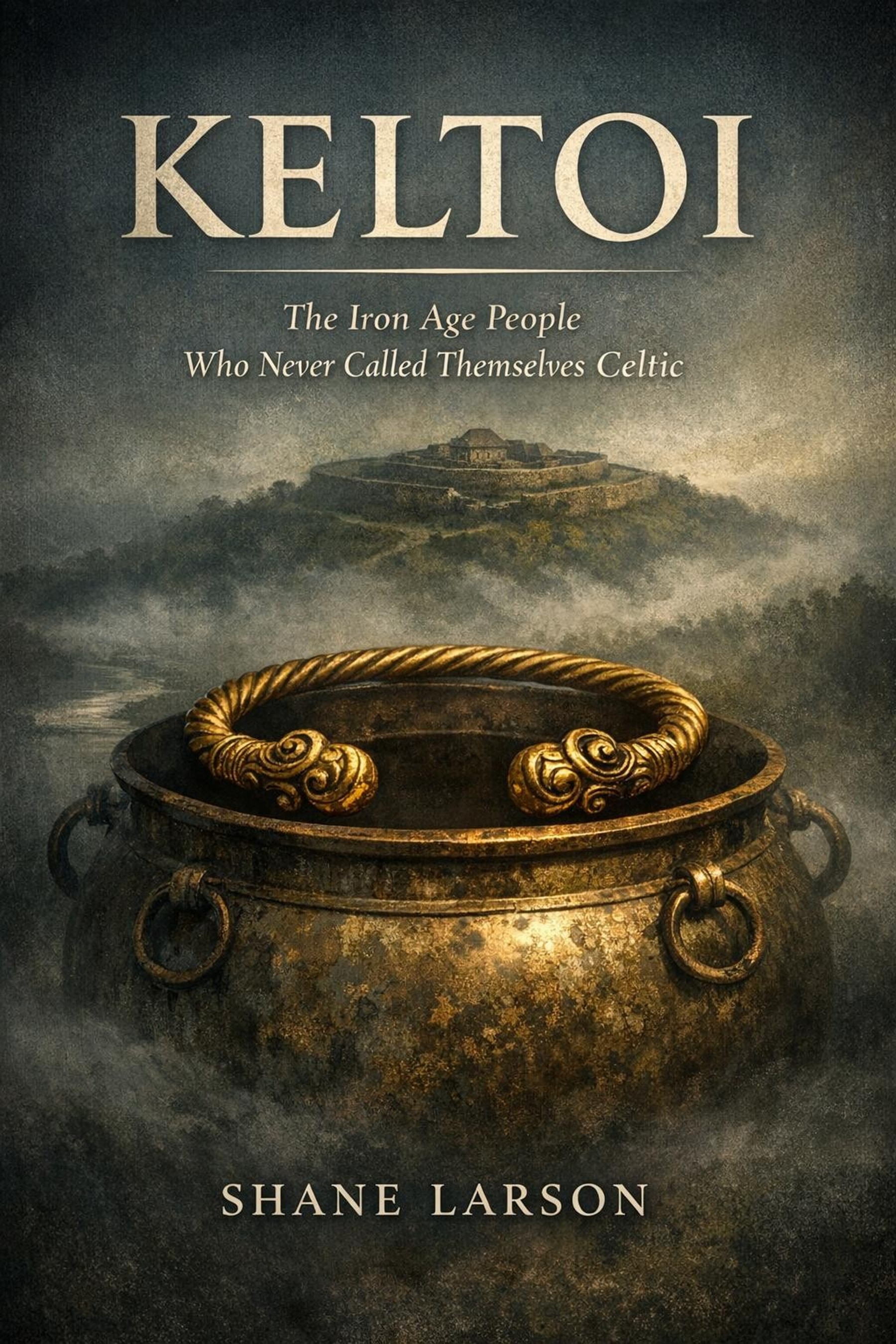
Keltoi
The Iron Age People Who Never Called Themselves Celtic
By Shane Larson
About This Book
In January 1953, in a field below a hill called Mont Lassois in Burgundy, a farm worker helping a local archaeologist uncovered the rim of a bronze vessel. It took days to free. When it was upright it stood 1.64 metres tall and weighed about 208 kilograms, and it could hold some 1,100 litres of wine. Greek craftsmen made it around 530 BC. No larger metal vessel survives from the ancient world.
It had been buried with a woman. She lay on the box of a dismantled wagon, wearing a gold neck ring of nearly half a kilogram, and she had been in the ground for about two and a half thousand years. She left no name, and her people, who held the point where the Seine stops being navigable, never wrote a word.
A Greek writing a generation or two after her death had a name for the people of that country. He called them Keltoi. Whether she would have recognised the word is one of the things nobody knows.
A Word Looking for a People
The history of the Celts is usually told as if the word explained itself. It does not. Greek geographers used it for peoples somewhere north and west of their colonies. Julius Caesar applied the Latin form to the inhabitants of central Gaul, and said it was their own name for themselves, which is the only time any ancient writer says so. No Greek or Roman author ever used it of anyone in Britain or Ireland. The islands acquired it in 1707, when the Welsh scholar Edward Lhuyd demonstrated that Welsh, Breton, Cornish, Irish and Scottish Gaelic were related to one another and to ancient Gaulish, and called the family Celtic.
Keltoi: The Iron Age People Who Never Called Themselves Celtic takes that awkward fact as its starting point and does not treat it as the end of the matter. The languages really are related. A distinctive art of spirals and half-hidden faces really did spread from the Rhine to the Irish Sea. Greek and Roman observers really did find druids, war bands and hilltop towns among peoples a thousand miles apart. The trouble is that these things have different maps. The language was written in northern Italy before the art existed. The Galatians of central Turkey spoke Celtic for six centuries and left almost none of the art. Ireland has the language and very little else.
The book follows the story in order and keeps those maps separate as it goes: the salt miners and wagon graves of the early Iron Age, the migrations that carried Gaulish armies to Rome, Delphi and Anatolia, the long collision with Rome in Spain, Gaul and Britain, and the Ireland that Rome looked at and left alone. Its last chapter is the history of the idea itself, from Lhuyd's word lists through forged epics and invented bards to the sceptics of the 1990s and the ancient DNA results of 2022.
Why I Wrote This
I have written about Boudica, about Caesar in Gaul and about the Germans who stopped Rome at the Rhine, and each time I used the word "Celtic" as if I knew what it meant. Then I went looking for the first time anyone in ancient Ireland or Britain was called a Celt, and found there wasn't one. That bothered me enough to keep reading.
What I found was not a hoax. It was more interesting than that: a real family of languages, a real art, a real set of customs, and a name that fits none of them exactly. The scholars who study this have been arguing about it in print for thirty years, mostly in books priced for libraries. I wanted to write the version an ordinary reader could follow, with the history told properly and the argument left visible. I have tried to be fair to both sides, and to the people for whom being Celtic is not an academic question.
Frequently Asked Questions
Did the ancient Irish and Britons call themselves Celts?
There is no evidence that they did, and no ancient writer calls them Celts. The Britons appear in Greek and Roman sources under names related to "Britanni", and the Irish as Hiberni or Scotti. The word Celtic was first applied to the island languages by Edward Lhuyd in 1707.
Is this book saying the Celts never existed?
No. It argues that "Celt" covers several real things, a name, a language family, an archaeological style and, lately, ancestry, which do not share one map. The peoples were real and so are the connections among them. What did not exist was a single nation that thought of itself as Celtic.
Does the book cover Celtic mythology and the Irish sagas?
It covers the gods known from inscriptions and Roman writers, and it has a chapter on Ireland that discusses the Ulster Cycle and the cattle raid of Cooley as historical evidence. It does not retell the myths. Readers who want the stories themselves will need a different book.
How much of it is about Britain and Ireland?
Two of fourteen chapters, plus much of the final chapter on the modern Celtic revival. The rest ranges across Austria, Germany, France, Italy, the Balkans, Turkey and Spain, because that is where most of the ancient evidence is.
What does the book say about DNA and Celtic ancestry?
It reports the main ancient DNA findings up to 2022 and is careful about their limits. DNA can show that people moved and roughly when. It cannot show what language they spoke or what they called themselves, and it has nothing to say about who counts as Celtic today.
If You Liked This, You Might Like
- Boudica — takes the two or three pages this book gives the Iceni revolt and tells the whole of it, from the client kingdom to the ash layer under London.
- Julius Caesar — the conquest of Gaul from the conqueror's side, by way of the man whose opening sentence is the best ancient evidence for the name.
- Teutoburg Forest — the neighbours across the Rhine, whom Caesar was the first to separate firmly from the Gauls, and the frontier that followed.
- The Scythians — another people with no writing of their own, known through Greek stereotypes and spectacular graves, and a case where the spade could check the stories.
A Greek word for strangers, a family of languages and an art style became, over twenty-five centuries, one of the best-known identities in the world. This is the history underneath it, with each part given its own date and place.
What You'll Learn
- Hallstatt. A salt mine in the Austrian Alps that preserved leather caps, dyed cloth and pine torches, and a cemetery of about a thousand graves recorded in watercolour in the 1840s and 1850s. The place gave its name to a period, and the book explains why a period is not a people.
- The Hochdorf burial. An unrobbed grave of about 530 BC near Stuttgart: a man six feet tall on a wheeled bronze couch, with gold fittings made for the funeral and a Greek cauldron that had held some 350 litres of mead.
- Galatia. Three tribes invited across the Bosporus as hired soldiers in 278 BC, who stayed, settled around what is now Ankara, and were still speaking their language in the fourth century AD.
- Numantia. A Celtiberian hill town that defeated Roman armies for twenty years until Scipio Aemilianus walled it in and waited.
- Gaul before Caesar. Fortified towns of over a hundred hectares, coinage, a bronze calendar that reconciled the moon with the sun, and an appetite for Italian wine measured in hundreds of thousands of amphorae.
- Druids. Everything the ancient sources say, which is not much, set beside what Rome stood to gain from saying it and what the archaeology can and cannot confirm.
- Britain's ancient DNA. A 2022 study found a large movement of people into southern Britain around 1000 to 875 BC. The chapter sets out what that shows about ancestry and why it cannot settle a question about language.
- Ossian and Iolo. A Scottish poet's "translations" of a bard who never wrote them and a Welsh stonemason's invented order of bards, both of which outlived their exposure.
New Ancient History releases and free chapters — no spam, unsubscribe anytime.