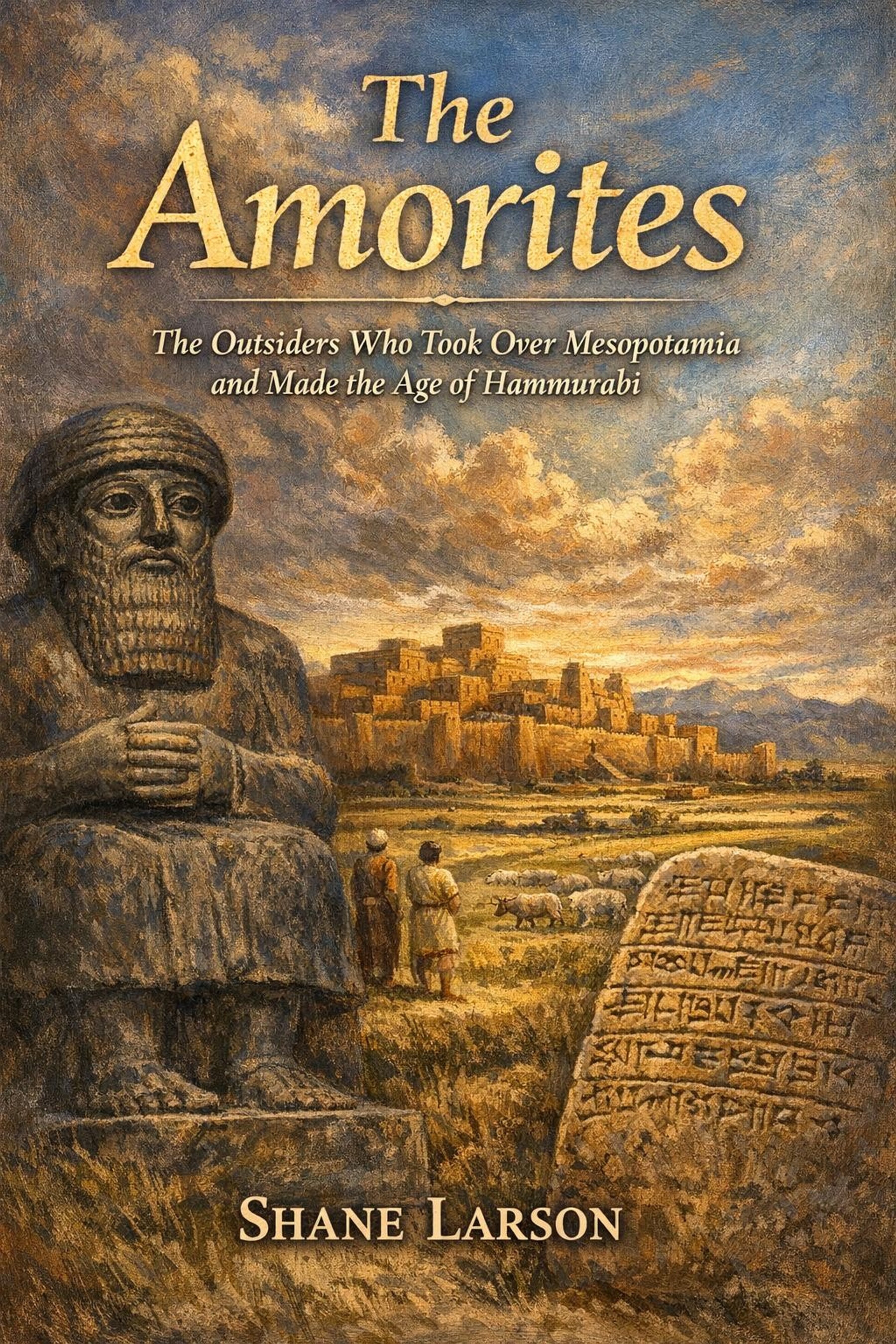
The Amorites
The Outsiders Who Took Over Mesopotamia and Made the Age of Hammurabi
By Shane Larson
About This Book
Somewhere in a Babylonian city, in the age of Hammurabi or near it, a scribe took a lump of damp clay and laid out two columns: Amorite on the left, Akkadian on the right. He began with the names of gods, then everyday words, and worked up to whole phrases. A second tablet holds phrases for ordinary social exchange. Neither was a monument. Nobody knows who wrote them or why, and nothing about them was meant to last.
They lasted. In 2022, Andrew George and Manfred Krebernik published both tablets, one now in the Rosen Cuneiform Collection and the other in a private collection, and for the first time Amorite could be read as phrases rather than as names. The tablets have no findspot and the field is right to be careful with them. But they prove one thing: in Hammurabi's Mesopotamia, Amorite was worth setting down beside the language of the state.
From a sneer to a pedigree
Three centuries earlier, the view from the cities was very different. Sumerian scribes wrote the Amorites with a sign that meant simply "the west," and a Sumerian poem about the god who personified them describes a man who lives in a tent, digs truffles out of the hills, eats his meat raw, and is never brought to burial. Shu-Sin of Ur, around 2034 BC, gave a frontier wall a name meaning the one that keeps the Tidnum away. It is the clearest statement Mesopotamia ever made about who belonged.
The same state's account books tell a different story. In the Ur III ration lists Amorites turn up as soldiers, messengers and labourers, paid in sheep and silver. The government that built the wall was employing the people it was built against. When Ur fell in 2004 BC, an Elamite army took the city, and the laments blame the gods and the Elamites far more than the westerners. The Amorites did not storm the gates. They were already inside, and in the vacuum that followed they took what was lying loose, one city at a time.
Within a century the first Amorite dynasties held Larsa and Babylon, their kings ruling cities while still styling themselves chiefs of tribes. For two hundred years after that they were the whole political world from Aleppo to the Gulf: fighting one another, marrying one another, swearing alliances over a slaughtered donkey foal, and reciting, in Babylon and in Assur alike, the same tent-dwelling ancestors over their dead. Then Hammurabi swallowed the rest, and when Mursili I of Hatti sacked Babylon in 1595 BC it is a real question whether anyone in the city still called himself an Amorite.
The Amorites: The Outsiders Who Took Over Mesopotamia and Made the Age of Hammurabi follows that arc as one story, and puts the contested parts, invasion or integration above all, to the evidence without pretending the evidence settles them.
Why I Wrote This
I kept running into the Amorites sideways. They were the cause of Ur's fall in one book, a footnote on Shamshi-Adad in another, a word in Hammurabi's titles in a third, a people of Canaan in the Bible. Nobody treated them as the subject. Then I read about the two tablets George and Krebernik published in 2022, and what stopped me was not what they said but what they implied: the most powerful people in the most literate civilization on earth had gone four thousand years without a single phrase of their own on record. Everything we knew about them, someone else had written. That seemed to me the whole story in miniature. A people despised by the poets, employed by the bureaucrats, feared by the kings, and then simply in charge, so completely that they stopped needing to be anything but Babylonians. I wanted to follow that from one end to the other, and no book for a general reader did.
Frequently Asked Questions
Do I need to read Hammurabi first?
No, and this book deliberately stops where that one begins. Hammurabi gets one chapter here, told as the culmination of an Amorite story rather than a biography: his tribal genealogy, the power politics of the 1760s, and what changed when one Amorite kingdom absorbed the rest. The law code and the campaigns are left to the other book.
Were the Amorites of the Bible the same people?
The name is the same, and the final chapter traces how it travelled from a Bronze Age people to the "Amorites" of Genesis, Numbers, Deuteronomy and Joshua. Whether the patriarchal narratives preserve any memory of Middle Bronze migrations was argued for by W. F. Albright and against by Thomas L. Thompson and John Van Seters in the 1970s. The chapter sets out both positions and the evidence each rests on. It does not claim the Bible is confirmed or refuted, because the evidence allows neither.
Does it explain what the 2022 Amorite tablets actually say?
In broad terms only. The book describes them as what they are: two unprovenanced Old Babylonian bilingual tablets pairing Amorite with Akkadian line by line. One opens with word lists, gods first and then everyday vocabulary, and goes on to longer phrases; the other is phrases for ordinary social exchange. They are a beginning, the book says plainly, not a grammar. For the contents, George and Krebernik's edition is the place to go.
Why do the dates differ from other books on Mesopotamia?
There are no absolute dates for this period, and scholars use competing chronologies. This book uses the middle chronology throughout, in which Hammurabi reigns 1792 to 1750 BC and Babylon falls in 1595. In the low chronology every date is about sixty-four years later, in the ultra-low about ninety-six. The order of events is the same in all of them.
How long is the book, and is it part of a series?
About 72,000 words, 229 pages in the 6x9 paperback: an Introduction, thirteen chapters in four parts, a Conclusion and three appendices. It stands alone, and it is the connecting volume of the catalog's Mesopotamian shelf.
If You Liked This, You Might Like
- Hammurabi — the reign this book stops short of, told in full: the law code, the campaigns and the administration of the most famous Amorite of all.
- Twilight of the Ziggurats: The Rise and Fall of Ancient Sumer — the fall of Ur from inside the dying state; this book tells it from the Amorite side.
- The Mongol Storm — the same shape three thousand years later: a steppe people despised by the literate centre, who took it and then governed in its forms.
- The Hyksos — the Delta kingdom Chapter 12 can only glance at, and the other half of the question of whether its rulers were Amorites at all.
The Amorites spent four thousand years being described by other people: a Sumerian poet, a king of Ur with a wall to name, an Assyrian clerk, a biblical writer, a century of scholars reading labels on jars. This is the story of how the people on the wrong side of that wall became the civilization that built it.
What You'll Learn
- The climate argument, both sides of it: Harvey Weiss's model of abrupt drying around 2200 BC and the emptying of the Khabur plain, and the critics who find the proxies uneven and the abandonment overstated.
- The seventeen kings who lived in tents at the head of the Assyrian King List, and J. J. Finkelstein's 1966 discovery that the dynasty of Babylon claimed some of the same ancestors.
- The western great powers that Mesopotamia-centred histories leave out: Yamhad at Aleppo, Qatna and its royal tomb found intact in 2002, and Leonard Woolley's Alalakh.
- Shamshi-Adad's rise and fall: Ekallatum, Assur and Mari taken in turn, two sons installed to hold them, and an empire that did not survive its maker.
- How Amorite kings governed: tribal overseers alongside palace bureaucrats, debt-release edicts, and the law collections of Isin and Eshnunna that preceded Hammurabi's.
- A language reconstructed from names: what thousands of Amorite personal names reveal about verbs, gods and kinship, and what the 2022 bilinguals add.
- Three appendices: a gazetteer of the Amorite kingdoms with sites and excavators, a reader's guide to Amorite names and their meanings, and a timeline and glossary for 2300 to 1595 BC.
New Ancient History releases and free chapters — no spam, unsubscribe anytime.
More in This Genre
View all →