Henry VIII Had Six Wives. He Chose to Be Buried Beside the One He Was Married to for Seventeen Months.
October 28, 2026 · 8 min read
Walk up the choir of St George's Chapel at Windsor and you will cross a slab of black marble set into the floor. It was laid in 1837, nearly three centuries after the people under it died, and most visitors step over it on the way to the altar without reading it. Beneath it is a vault, and in the vault are Henry VIII, Charles I, who was put there quietly in 1649, and a woman who was Queen of England for seventeen months, was never crowned, and left so little behind her that historians cannot agree on what she was like.
Henry married six women. He was married to the first for twenty-four years and broke with Rome to be rid of her. He beheaded the second. He divorced the fourth inside six months, beheaded the fifth, and left the sixth a widow. The one he chose to lie beside was the third, Jane Seymour, whom he had known for perhaps two years and been married to from 30 May 1536 until her death on 24 October 1537, twelve days after she gave birth to his son.
The popular answer to why is that she was the one he loved. I spent a book on Jane and the family that rose and fell with her, and I want to set out what the evidence for that answer actually is, because it is thinner and more interesting than the phrase "true love" suggests.
What the will said
Henry's last will is dated 30 December 1546, at Westminster, and he did not sign it with his own hand. His signature was applied with the dry stamp, an impression of the royal signature pressed into the paper for a clerk to ink over, and which clauses the king had actually read became a live question within weeks of his death. The burial clause has never been in doubt. He directed that his body be laid at Windsor, in the choir, midway between the stalls and the high altar, in a tomb he described as already well advanced. Masses were to be said for his soul there, in his own phrase, while the world should endure. And the bones of the woman he called "our true and loving wife Queen Jane" were to be brought into the same tomb and laid with him.
He had been a widower of hers for nine years when that was dictated. He had married three more women since. One of them, Catherine Parr, was in the palace, provided for in the same document, and would outlive him. On 16 February 1547, after two days of procession from Westminster and a night's halt at Syon, his enormous coffin went down into the vault beside the much smaller one that had been there since November 1537.
Five wives he could not have chosen
Before asking what the choice tells us, it is worth noticing how little choice there was.
By Henry's own law, and the judgement of his own archbishop, he had never been married to Catherine of Aragon at all. She had been his brother's widow, and the marriage was void from the start. Anne Boleyn's marriage had also been annulled, by Cranmer at Lambeth two days before her execution, and she had died a convicted traitor. Anne of Cleves was alive, her marriage dissolved as unconsummated. Catherine Howard had been beheaded and attainted. Catherine Parr was alive, and would in fact be buried within two years at Sudeley by her next husband, who happened to be Jane's brother Thomas.
That leaves one. Of the six women Henry married, Jane was the only one who died as his wife with the marriage intact. Every other marriage he had dissolved himself, or ended with an axe, or both, or it had not ended at all. She was also the only one who had given him what the whole sequence had been for. The Act of Succession of 1536 had settled the crown on her children before she had any. The child had come, and in December 1546 he was nine years old and about to be king.
A tomb at Windsor with Henry on it and Jane beside him was the only tomb that made the succession look like a plan rather than a run of disasters. That is the honest minimum, and it is an answer by elimination. It still tells us something about Henry worth having: the man who had unmade four marriages did not, at the end, want to lie beside a woman he had unmade. He wanted the record consistent. He had spent twenty years making it consistent by force, and Jane was the one place in it where no force had been needed.
The case for more
The case that it was love rather than bookkeeping rests on a small number of facts, and they are all there is.
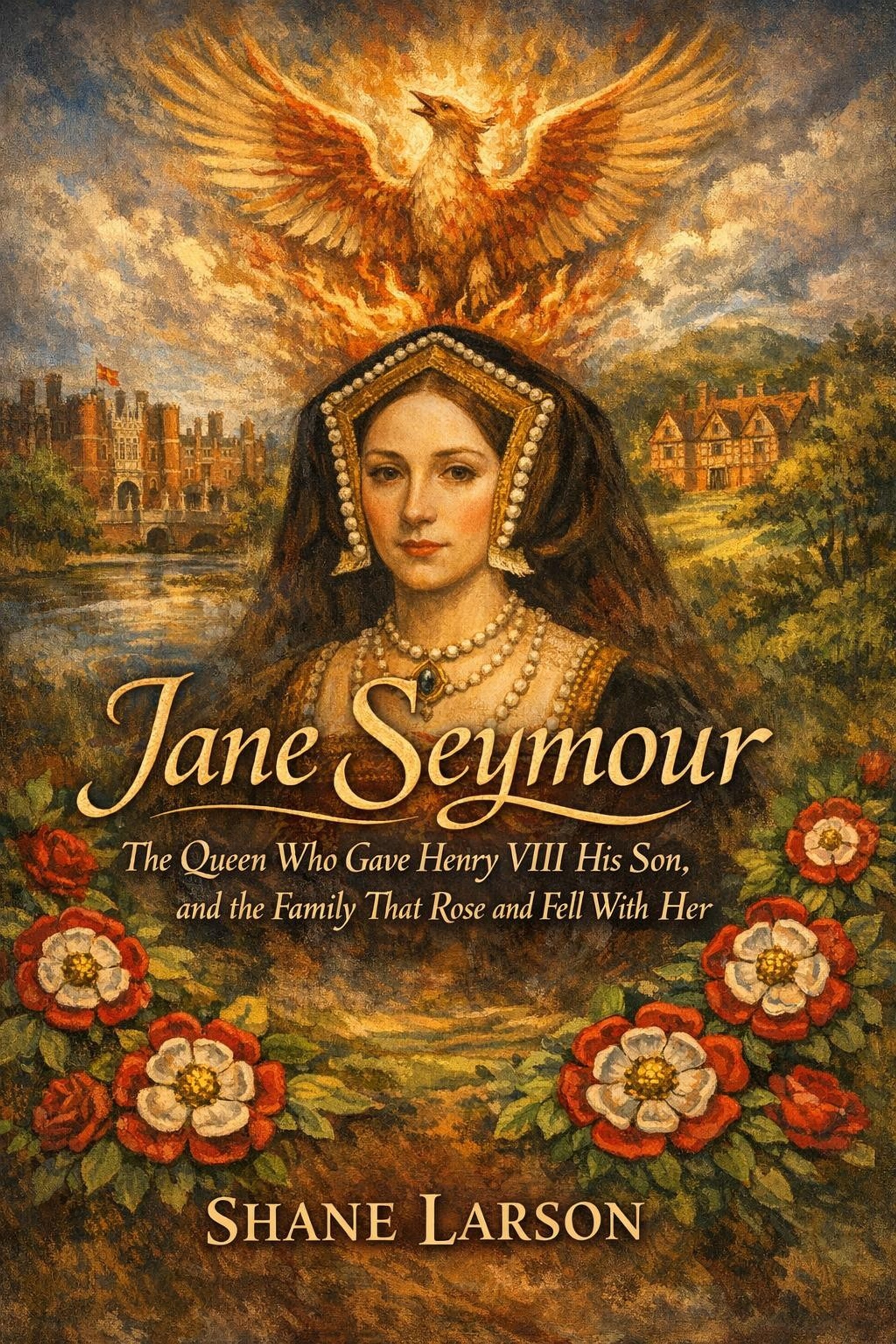
Jane Seymour
He mourned her. The court went into black in October 1537 and stayed in it for months, longer than Henry kept mourning for anyone else in his life. But Cromwell was writing to ambassadors about a fourth marriage within weeks, and in November he told two of the king's envoys that Henry had little wish to marry again but had framed his mind to it for the sake of the realm. Those are the words of a minister managing a king, and they can be read as grief, or as policy, or as both. Henry stayed unmarried until January 1540.
He kept her in the picture. Holbein painted her beside him on the wall of the privy chamber at Whitehall in 1537. More telling is a painting of about 1545, eight years after her death and two years into his marriage to Catherine Parr. It shows the king enthroned under a canopy, Edward beside him, Mary and Elizabeth at either side, and on the throne with him not the living queen but Jane. Catherine Parr does not appear. Whether a man who has his dead wife painted into his family in place of his living one is grieving or governing is not a question a painting can answer.
He never had cause to turn on her. This is the point the "true love" reading leans on hardest, and it needs turning over. Jane was queen for seventeen months, pregnant for nine of them, and dead before her son was a fortnight old. The one occasion on which she is reported to have crossed her husband, a plea on her knees in the autumn of 1536 for the suppressed abbeys, drew, by the same report, a warning to remember what had happened to the last queen who meddled. The source is a single ambassador's letter, at one remove, and it may not be true. But if it is, it is the only recorded test of Henry's affection for Jane, and the affection did not pass it with much grace. She did not fail him, and she did not have time to, and the evidence cannot separate those two things.
The reading that calls her nothing but the mother of the heir has the same problem from the other side. It has to explain the painting, where no dynastic purpose required leaving Catherine Parr out, and the word "loving" in a will that needed to say no more than "wife". What survives shows that Henry's affection and Henry's interest pointed at the same woman and never had to be told apart. Nobody at the time was asked to tell them apart, and nobody wrote down the answer.
The question nobody can ask
There is a second question hiding behind the first, and it is the one the evidence refuses outright. It is possible to ask whether Henry loved Jane, lay out what survives, and conclude that it is compatible with love and does not require it. It is not possible, from anything that exists, to ask whether Jane loved Henry. She left a handful of formal letters, the best known drafted by a clerk; two Holbein likenesses; a motto, Bound to obey and serve, which may or may not have been her own choice; and a few remarks, nearly all reported at second hand by an ambassador who wanted her to succeed. Nothing in her own voice addresses her husband at all. The historians who have made her Henry's true love, and the ones who have made her a shrewd operator reading from her brothers' script, are working from the same few pages, and the pages will fit almost anything.
What was built, and what was not
The grand tomb was never finished. Henry had planned it around a black marble sarcophagus that Cardinal Wolsey had commissioned for himself and never got to use. It sat at Windsor for the better part of three centuries and now holds Nelson, in the crypt of St Paul's. The vault was opened in 1813, when the Prince Regent had the coffins uncovered and looked at, and the slab went down in 1837. That is the whole monument.
What Henry got in the end was what Jane got: a vault under the choir, a slab in the floor, and each other. For a king who had spent his reign deciding which of his marriages had been real, it was the one verdict he never revised.
*Jane Seymour: The Queen Who Gave Henry VIII His Son, and the Family That Rose and Fell With Her* is the third volume of a series on the six queens of Henry VIII, each written to the same scale. It opens on 20 May 1536, the morning after Anne Boleyn's execution, and because Jane's own life will not fill a book honestly, it widens to the Seymours: the Wiltshire house whose fame now comes from a novel, the Pilgrimage of Grace that rose in her first autumn as queen, the birth at Hampton Court, and the two brothers who governed England for her son and went to the block within three years of each other. The book is available in ebook, paperback and audiobook from Apple Books, Kobo, Barnes & Noble and other retailers.
Jane Seymour
New posts and releases, straight to your inbox. No spam, unsubscribe anytime.