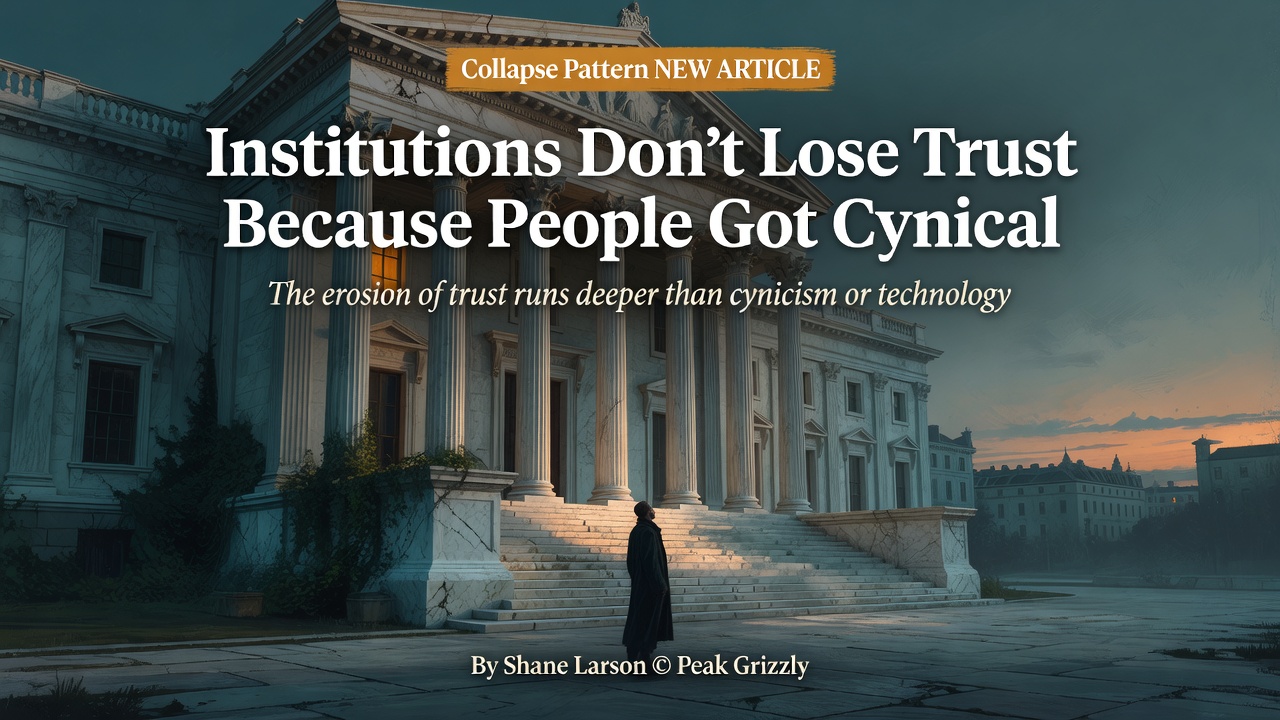
Institutions Don't Lose Trust Because People Got Cynical
August 5, 2026 · 6 min read
Measured confidence in most major institutions has declined more or less continuously for about fifty years. Not one institution — nearly all of them, across sectors that have almost nothing to do with each other, in a pattern that shows up in multiple countries.
The usual explanations do not survive contact with that shape. Social media cannot account for a decline that was well underway by 1980. Polarisation is partly a consequence rather than a cause. "People became cynical" is a description of the outcome dressed up as its explanation.
Something structural is happening, and the useful move is to stop asking why people stopped trusting and start asking what changed about the institutions.
Trust Is a Track Record, Not a Feeling
An institution earns trust by making implicit promises and keeping them, repeatedly, in public, over time.
A hospital promises that its clinical decisions are driven by your medical interest. A university promises that its credential means you learned something. A regulator promises that it is evaluating an industry rather than serving it. A news organisation promises that its selection of what to report is not determined by who is paying.
None of these are enforceable. All of them are verifiable over time, in aggregate, by people who deal with the institution repeatedly. Trust is the accumulated result of those verifications going well — which is why it takes decades to build and can be spent very quickly, and why the reasonable response to a track record of broken promises is not cynicism. It is accuracy.
That distinction matters enormously. If declining trust is a psychological problem, the fix is communications. If it is an accuracy problem, the fix is behaviour, and no amount of messaging touches it.
The Five Mechanisms
Institutions almost never collapse from outside attack. They decay internally, and the gates are opened from within. Five patterns recur, and they compound.
Mission drift. Every institution begins with a purpose and gradually redirects its energy toward objectives that serve the institution itself. It never happens as a decision. No hospital administrator concludes that patients no longer matter. It happens through thousands of individually defensible steps: we need revenue to fund the mission, so we favour higher-margin procedures; we need talent, so we invest in the brand; we need to manage risk, so we add administrative layers. The mission statement never changes. The budget does. When an organisation spends more on marketing than on the thing it exists to do, the drift has already happened.
Accountability gaps. Failure stops producing consequences for the people responsible for it. Not through corruption, usually, but through diffusion — responsibility spread across enough committees, layers, and processes that no individual is ever the one who decided. The institution can apologise, commission a review, and update its procedures indefinitely, and nobody's career is affected. People notice this faster than institutions expect, because they are watching what happens after the failure, not during it.
Capture. The entity an institution is meant to oversee acquires effective influence over it. The classic mechanism is not bribery but expertise and employment: the only people who genuinely understand an industry work in it, so the regulator hires from it and its staff leave to join it. The revolving door does not require anyone to act in bad faith. It requires only that the regulator's professional community, career prospects, and sense of what is reasonable all come from the regulated party.
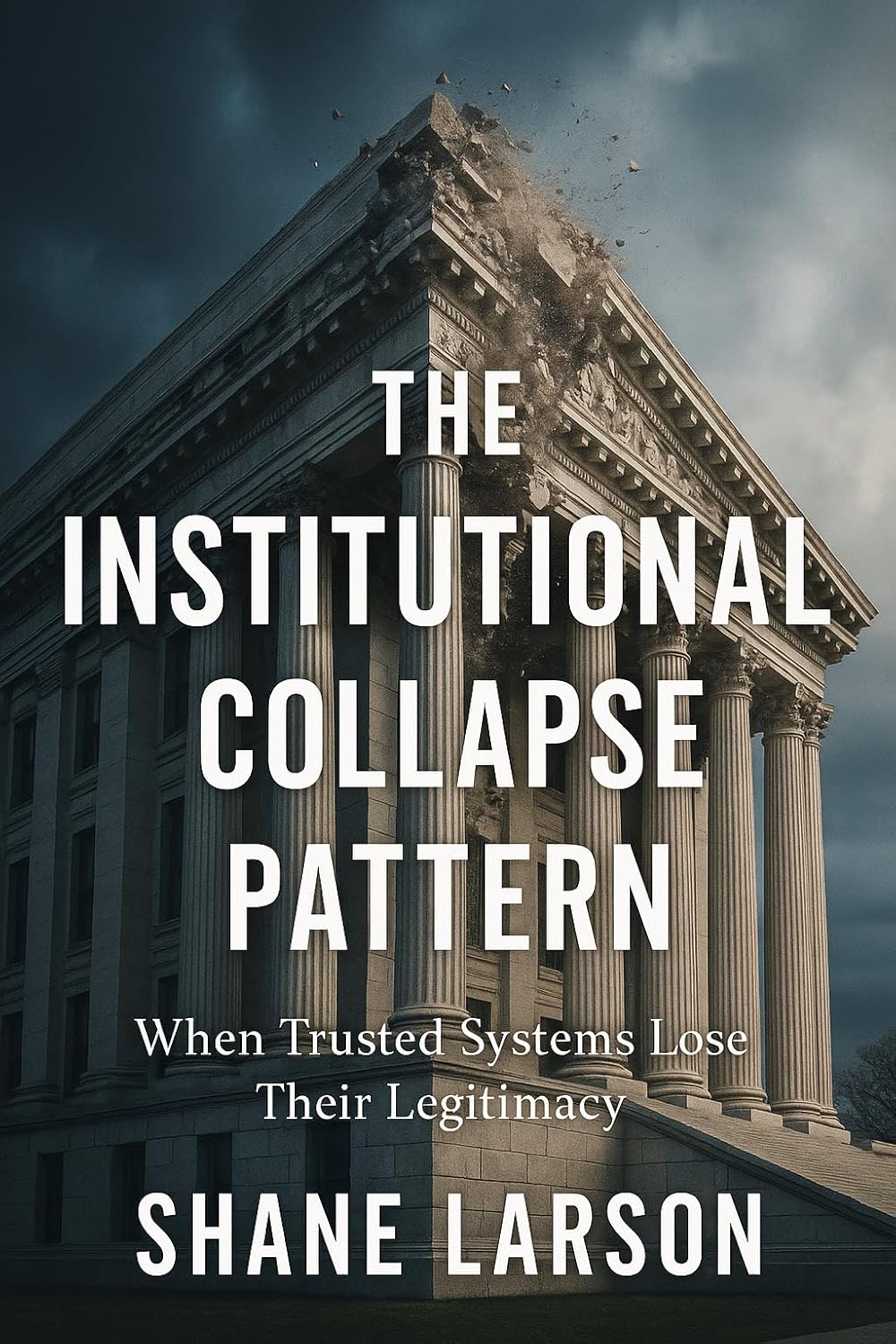
The Institutional Collapse Pattern
Self-dealing. The people running the institution capture a growing share of its resources. Administrative headcount and compensation rising faster than the delivery of the actual service. This is the most legible failure from outside — it shows up in public filings — and the most corrosive, because it converts a question of competence into a question of motive.
Rigidity. Procedures written for conditions that no longer exist, defended because they are the procedures. Every institution accumulates rules faster than it removes them, since adding one is a visible response to a problem and removing one is an unforced risk. Eventually the institution cannot respond to circumstances its rules did not anticipate, and its own staff spend more effort navigating it than doing the work.
Any one of these is recoverable. All five together generally are not, because they reinforce each other: capture prevents accountability, self-dealing accelerates mission drift, and rigidity blocks the reform that would address any of it.
The Warning Signs
Some tells are visible from outside long before a crisis.
Administrative growth outpacing service delivery. Metrics that measure activity rather than outcomes — cases processed, papers published, reports filed. Internal critics reclassified as personnel problems. A widening gap between what the institution says about itself and what people who use it report. Communications budgets growing during periods of declining performance. And the near-universal one: the failure of a review or reform process to produce any change in who holds power.
The last is the strongest signal available. Institutions under pressure reliably produce investigations, reports, and restructurings. The question is not whether one occurred. It is whether anyone with authority lost any.
Why Reform Is Hard
Because the people who would carry out the reform are, structurally, the people who benefit from the current arrangement.
An institution that has drifted has a leadership selected for success under the drifted mission. The accountability gap protects the people who would be held accountable. Capture means the outside pressure that might force change comes from a party with no interest in change. And genuine reform means someone visible gives something up while the institution still appears, on paper, to be functioning.
This is the same paradox that governs empires and large companies, applied at a smaller scale, and it fails for the same reason: reform requires the current beneficiaries to act against their own position, voluntarily, in advance of an obvious crisis.
What Actually Restores Trust
The record here is thin but not empty, and everything on the short list is behavioural.
Visible consequences for failure, applied to people with power rather than to whoever was closest to the incident. Transparency about the things an institution would prefer to hide, particularly its own errors — an institution that publishes its failure rate is making a costly signal that a press release cannot fake. Structural separation between an overseer and the overseen, which is the only real answer to capture. Narrowing scope back toward the founding mission, which requires giving up revenue. And measuring outcomes that the people served would recognise as the point.
None of that is a communications strategy, which is why it is so rarely what gets tried. The first instinct of a distrusted institution is to explain itself better. That instinct is exactly backwards, and each failed round of it costs credibility that was already short.
Trust is not a mood the public is in. It is a running assessment, and it has mostly been correct.
The Institutional Collapse Pattern: When Trusted Systems Lose Their Legitimacy examines the decline across media, religion, political parties, higher education, healthcare, law enforcement and financial regulation — the five mechanisms, the seven warning signs, and what rebuilding actually requires.
The Institutional Collapse Pattern
New posts and releases, straight to your inbox. No spam, unsubscribe anytime.