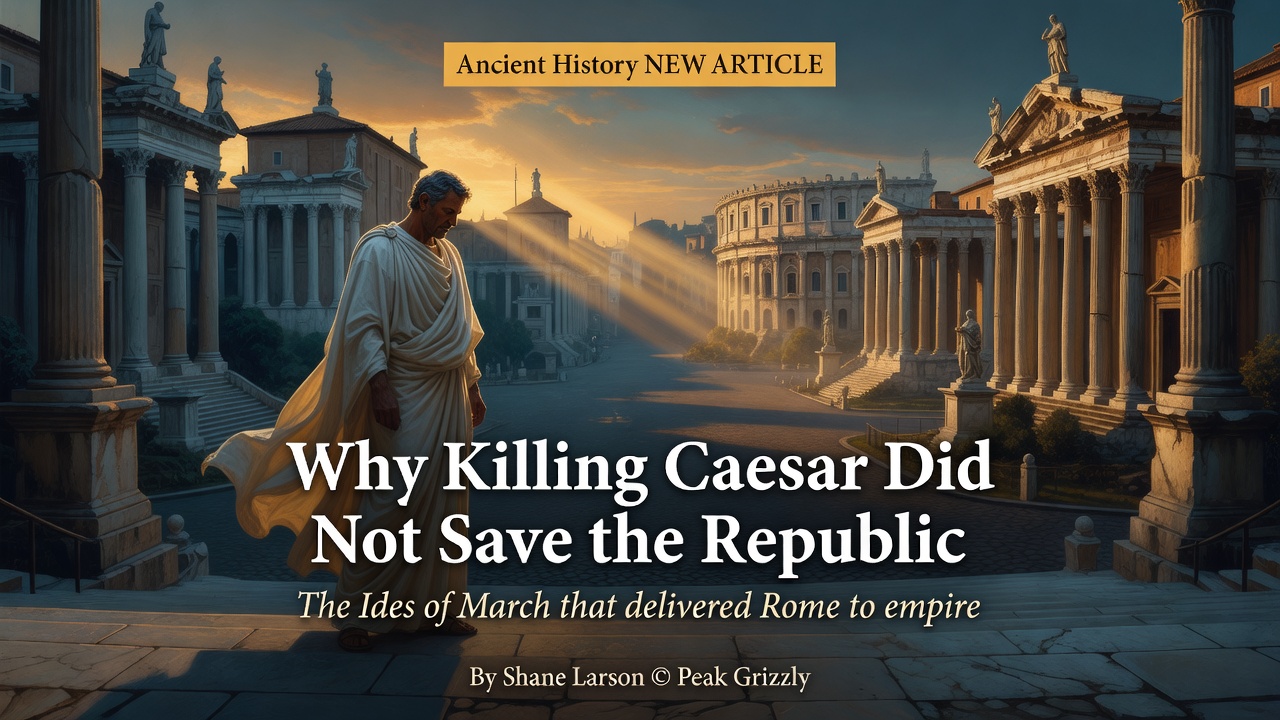
Why Killing Caesar Did Not Save the Republic
April 27, 2026 · 5 min read
The most famous political assassination in Western history happened on a clear morning in March, 44 BCE, in a temporary meeting hall of the Roman Senate housed inside the Theatre of Pompey. Sixty senators surrounded one man, and twenty-three blades came down. The body was left at the foot of a statue of his old colleague and former son-in-law. The killers walked out, climbed to the Capitoline Hill, and waited for the city to thank them.
The city did not thank them.
Within forty-eight hours they were on the run. Within a year, most of them were dead — killed in proscriptions ordered by men they had thought their political allies. Within fifteen years, every meaningful piece of the Roman Republic that they had killed Caesar to defend was either openly extinct or quietly subsumed into the personal rule of his eighteen-year-old great-nephew Octavian, who took the name Augustus and presided over a constitutional fiction in which the Senate still met and the assemblies still voted but a single man decided everything that mattered. The Roman Republic, in any meaningful operational sense, was over.
This is the central historical question that hangs over Caesar's life, and it is the question most popular biographies of him do not properly pose. Why did killing him not bring back what they thought he had taken?
The conspirators had read their Plutarch. The story they had in their heads was the founding story of the Republic itself — of Brutus the Elder, in the late sixth century BCE, who had led the expulsion of the last king Tarquin the Proud after Tarquin's son raped the noblewoman Lucretia. The killing of the king restored the city. Five hundred years later, the descendants of that Brutus and the men around him were betting that the logic would hold a second time. Marcus Junius Brutus — the lead conspirator, the man whose ancestor had founded the Republic — was relying on a kind of historical recurrence. Strike down the man who would be king, and the city will resume.
It did not resume. The reason is the central insight the book builds toward, and it is worth stating plainly: the institutions that had supported the early Republic no longer existed in 44 BCE in any operational form. They existed as memory, as language, as legal procedure, as buildings, as titles. They did not exist as the kind of body that could govern a Mediterranean empire on its own.
The Senate of 44 BCE was not the Senate of 509 BCE. Caesar himself had enlarged it from about six hundred members to nine hundred, packing it with his own appointees — former centurions, freedmen, equestrians, provincials, men from his Gallic legions. These men did not look like the descendants of the early Republican aristocracy. They looked, to the old families, like an army roster. After Caesar's death, the new senators had no constitutional reason to defer to the old families' authority. Their political loyalty had been to Caesar. They were the ones who would back the men who came to be Caesar's heirs.
The armies of 44 BCE were not the citizen militias of the early Republic either. The Marian reforms a generation before Caesar's birth had created a professional army loyal to commanders rather than to the state. By 44 BCE, every Roman general in the field had soldiers who would follow him into civil war if asked. The Republican institutions of the early city had assumed that soldiers were citizens-on-temporary-deployment. Caesar's army had assumed for fifteen years that they were Caesar's men, and after his death they remained the men of his lieutenants — Antony, Lepidus, eventually Octavian.
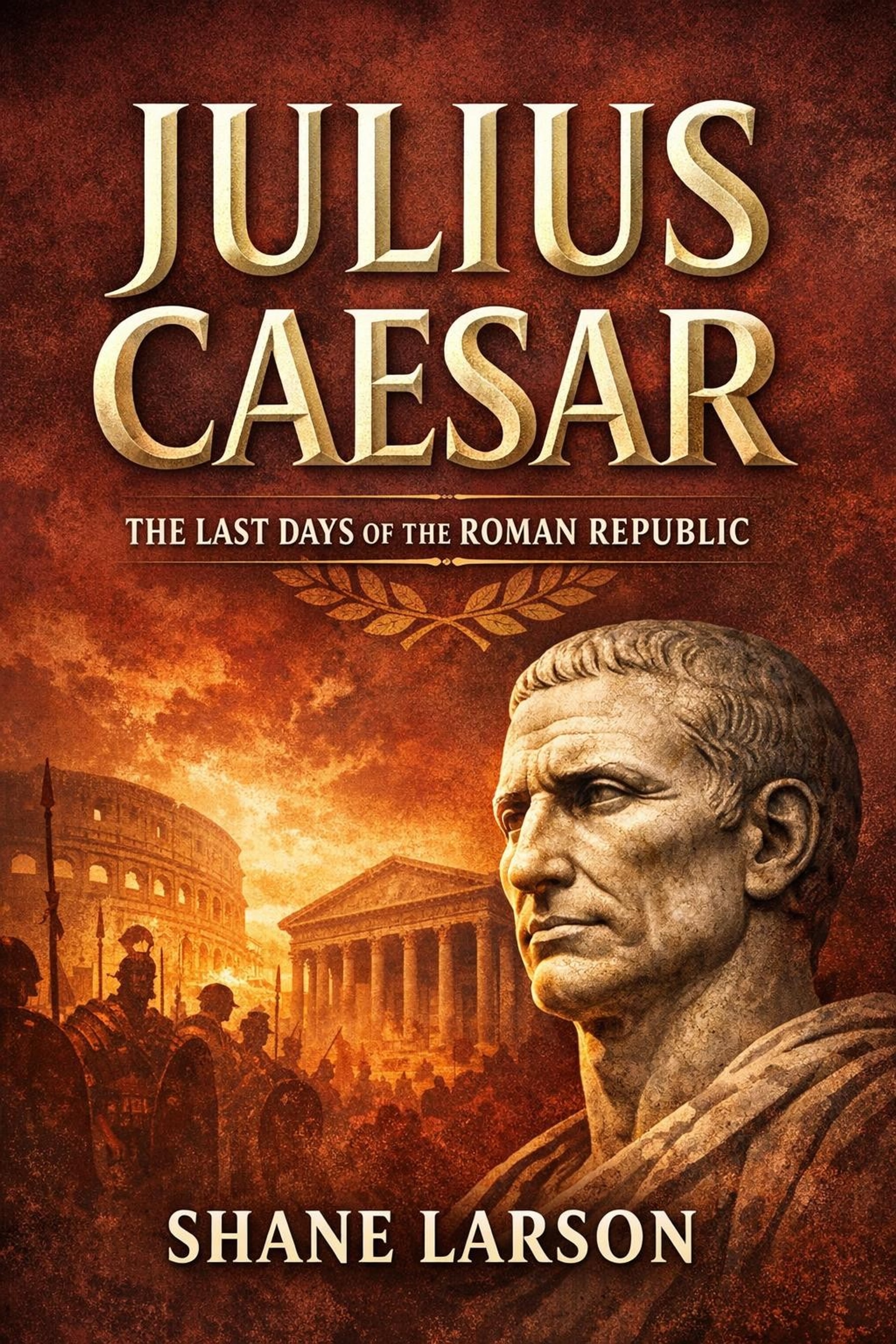
Julius Caesar
The provinces were not governed by men who reported to the city in any meaningful way. Provincial governors had become local autocrats, with personal armies and personal client networks. The old logic — that a governor returning to Rome submitted to senatorial review and could be tried for misgovernment — had broken down so completely that Cicero, in his speeches against Verres a generation earlier, had been writing about it as a scandal. By 44, it was simply the system. Whoever Caesar's heir turned out to be would inherit a network of governors who already operated more or less independently. Their loyalty was a question of patronage, not of constitutional obligation.
So the assassins, walking out of the Theatre of Pompey with bloody daggers, were defending an institution that already had no functional content. The Republic was a vocabulary. They thought killing the man who threatened it would restore the substance the words used to describe. There was no substance left to restore. The vocabulary continued. Augustus was scrupulous, in his decades of rule, to use only Republican titles — princeps, first citizen; tribunician power; consular imperium. He never called himself king. He never wore a crown. He preserved every form of the Republic with the precision of an embalmer. The body had been dead for years.
This is the harder, more uncomfortable lesson Caesar's life offers, and it is the one that has made the story so durable in political imagination ever since. Institutions are only as strong as the human commitments that sustain them. When a republic's senators no longer act like senators, when its soldiers no longer act like citizen-soldiers, when its governors no longer act like accountable officers of the state, the words are still there. But the thing the words used to describe is already gone. Killing the individual who appears to be the threat does not restore the institution. The institution had to have been restored already, and it had not been. Caesar identified the terminal fractures in a dying system. His killers did not understand that those fractures had not closed.
The new book — Julius Caesar: The Last Days of the Roman Republic — tells the full story. The boy who survived Sulla's proscriptions. The young politician who borrowed himself nearly to ruin and outspent his rivals on games and bribes. The proconsul who conquered Gaul and killed perhaps a million people in the process. The general who crossed the Rubicon. The dictator who pardoned his enemies as a calculated political instrument. The man who, on the Ides of March, walked into a room where sixty of his colleagues were waiting with concealed daggers. And the failure that followed — the failure of the men who had read their Plutarch and believed that the old logic still applied. The afterlife of the name — Kaiser, Tsar — that outlived the empire he had inadvertently founded. And the question that has hung over every republic since: what does it actually take to keep the institutions alive long enough that no individual is more important than the system?
Out now on Kindle.
Julius Caesar
New posts and releases, straight to your inbox. No spam, unsubscribe anytime.