General Winter Didn't Defeat the German Army in 1941. The Railway Gauge Did.
September 11, 2026 · 7 min read
Ask why the German invasion of the Soviet Union failed and you will usually get a one-word answer: winter. The picture comes ready-made — men in summer uniforms in the snow outside Moscow, engines that would not start, weapons that seized in the cold. The picture is real. The frostbite casualties ran into six figures on the German army's own medical returns, and the winter of 1941–42 was genuinely severe. And yet the campaign was not lost in December, in the snow. It was lost in August, in warm weather, on dry roads, with the panzer divisions ahead of schedule and the largest encirclement victories of the war still to come. The snow arrived afterwards and took the blame.
That claim sounds like revisionist showmanship until you follow the supply columns instead of the tanks. Then it becomes arithmetic.
An alibi with a date of manufacture
The "General Winter" explanation did not form on its own, the way folk memory forms. It was constructed, and it can be given an approximate date of manufacture: the late 1940s and the 1950s, in the memoirs and staff studies of the surviving German commanders, written for a Western audience in the opening years of the Cold War.
Franz Halder, chief of the German general staff during the invasion, spent those years directing the German section of the United States Army's historical programme, employing hundreds of former Wehrmacht officers to write the campaign studies from which the English-speaking world took its first detailed account of the eastern war. Heinz Guderian's memoir appeared in the same decade, and Erich von Manstein's. The account those works converged on was remarkably consistent: a brilliant military instrument, a winnable campaign, an amateur supreme command that interfered, and a winter no one could have foreseen. Every author had a reputation that required exactly that story, and the new audience had its own reasons to accept it.
No conspiracy is needed to explain any of this — only self-interest, plus the one property every durable alibi shares, which is that it is partly true. But the alibi has a structural problem that no memoir ever addresses. Winter comes to Russia every year. Every German planning document knew the date. A thing that arrives on schedule cannot be the thing that needed foreseeing. What needed foreseeing was something else entirely, and the men who failed to foresee it did so in the summer, in the sunshine.
The estimate everything rested on
German planning for the invasion, drawn up from the summer of 1940, counted roughly two hundred Soviet divisions and timetabled the campaign at ten weeks. That number was built once, from thin sources and congenial assumptions, and it was never re-tested as evidence piled up against it — because it was not treated as a forecast subject to error but as the premise on which the whole operation already rested.
By 11 August 1941, the count of identified Soviet divisions stood past three hundred and sixty, with the Red Army still forming new ones. On that day Halder recorded in his war diary — the entry survives, and is paraphrased here because its published English text is a modern edited translation — that the Soviet colossus had been consistently underestimated, and that the enemy could lose a dozen divisions destroyed and simply put another dozen in the field. The premise of the entire operation, that the Red Army was a finite quantity that could be destroyed in a single season, was written off by the man who had built the plan. He wrote it six weeks before the autumn mud and four months before serious snow.
That is one half of the case. The other half is what was happening behind the German spearheads while he wrote.
Six hundred thousand horses
The invasion force of June 1941 lives in popular memory as the height of mechanised warfare. It was, mostly, a marching army. Something over six hundred thousand horses moved its guns and supplies, and every one of them had to be fed every day — on the order of six thousand tonnes of fodder daily, competing with fuel, ammunition and food for space on the same overloaded supply lines.
The motor transport that did exist was a pool requisitioned from half of occupied Europe: dozens of incompatible vehicle types, each with its own spare parts or none. On Russian roads that no one had surveyed, the truck pool lost roughly a third of its strength within months. This was the transport network expected to bridge the growing gap between the railheads and the front.
Three Million Men
A railway that had to be rebuilt mile by mile
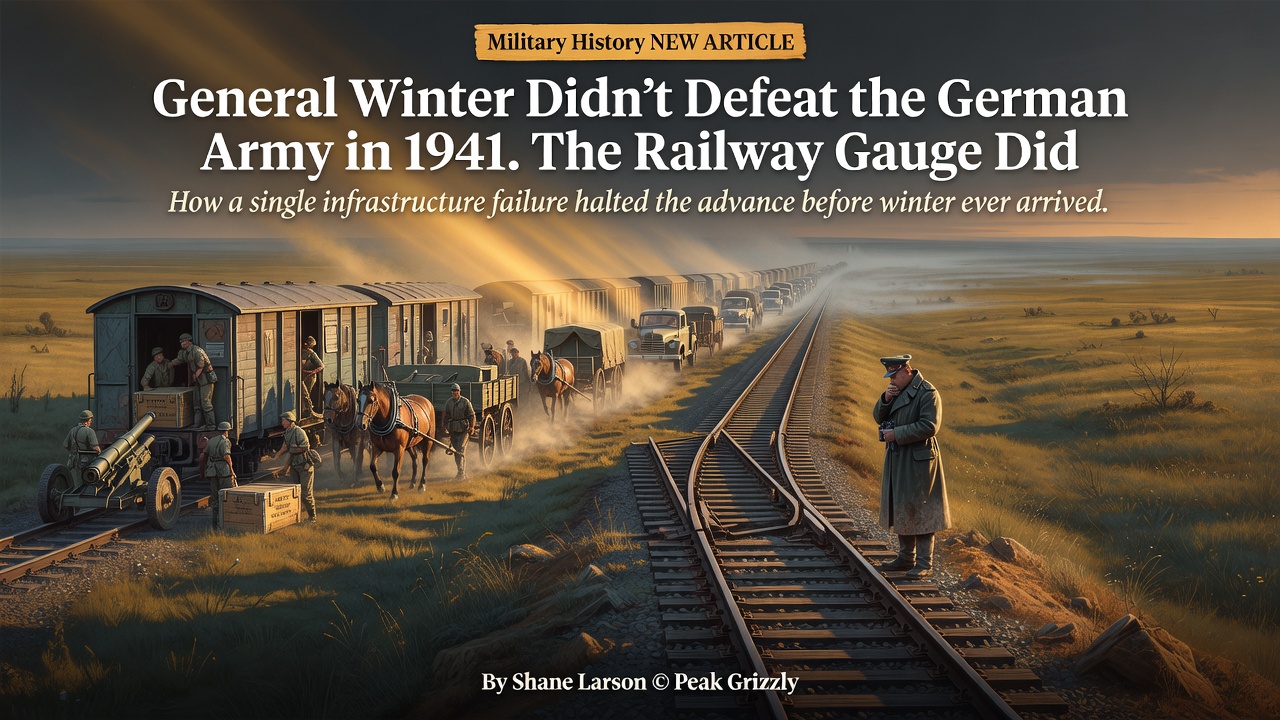
And the railheads had a problem of their own, and it is the single most decisive fact of the campaign. Soviet railways ran on a broader gauge than German rolling stock could use. Every mile of track behind the advance had to be physically relaid — rails lifted and re-spiked to the German gauge — before a single German supply train could follow the tanks.
The railway engineers relaid track at an impressive rate. The rate was never enough, because the army was advancing faster than the railhead could pursue it. By late summer the railheads sat some two hundred miles behind the spearheads, with the converted lines running at a fraction of their theoretical capacity, and fuel, ammunition and six thousand tonnes of daily fodder all bidding for the same trains.
The culminating point: Smolensk, in July
Military theory has a name for the depth at which this catches up with an army: the culminating point — the point beyond which a force can still move, and still win engagements, but can no longer be supplied in the strength required to turn victories into a decision. Every offensive has one. This campaign's culminating point sat somewhere around Smolensk, and it was passed in the middle of July 1941, five months before the first serious snow.
Smolensk itself is where the ledger turned over in plain sight: a battle budgeted at two weeks consumed two months, against Soviet counter-attacks of a persistence nobody in Berlin had forecast. After July the German army could still attack, and still win battles of an outward size no army had ever won — Kiev in September was the largest encirclement in the history of warfare. What it could no longer do, ever again, was arrive at a decisive place with the strength and the supply to make a victory final. That is what a lost campaign looks like from the inside, in the months before it looks like losing.
Why the winter clothing sat in Poland
Seen from this angle, the famous missing winter equipment reads very differently. The clothing was not, for the most part, unmade; much of it sat in depots in Poland, because the supply lines that should have carried it forward had already collapsed under fuel, ammunition and fodder. And the deeper reason ran further back still: the army was not equipped for a winter campaign because the plan had assumed there would be no winter campaign, and the plan had assumed that because of an intelligence estimate that was wrong by nearly half. The winter did not cause the failure. The failure caused the winter crisis.
One thing must be said before the arithmetic is allowed to stand as the whole story. The campaign this logistics argument describes was also, by written orders issued before the frontier was crossed, a war of extermination — the Commissar Order, the Hunger Plan, the killing squads that followed the armies, and a captivity in which more than three million Soviet prisoners of war died. Any account of why the operation failed sits beside that record, not above it.
What the snow actually revealed
By the time the ground froze, the campaign's outcome was being decided by a capacity that had appeared in no German estimate. While the encirclement battles were still being fought, the Soviet state dismantled well over fifteen hundred major industrial plants, hauled them east of the Urals by rail, and restarted them — some within weeks of the machinery coming off the trains — so that Soviet tank factories were out-producing Germany's before the end of 1941. On 5 December, reserve armies that German intelligence had not known existed came out of the snow in front of Moscow. The winter was the stage on which the failure finally became visible. It was never the cause. The cause was written into a diary in August, by the man who had built the plan, while the weather was still fine.
I make this argument at full length — with the railway conversion rates, the fodder arithmetic, and the week-by-week supply figures laid out in the open — in Three Million Men: The Invasion of the Soviet Union, 1941, the fourth volume of my Second World War Chronicles. It covers the campaign from the last warnings Stalin dismissed to the counter-offensive of 5 December, and the criminal dimension of the invasion in the weeks where it happened. If the version of 1941 you learned ends with a snowflake, the documents tell a different story.
Three Million Men
New posts and releases, straight to your inbox. No spam, unsubscribe anytime.