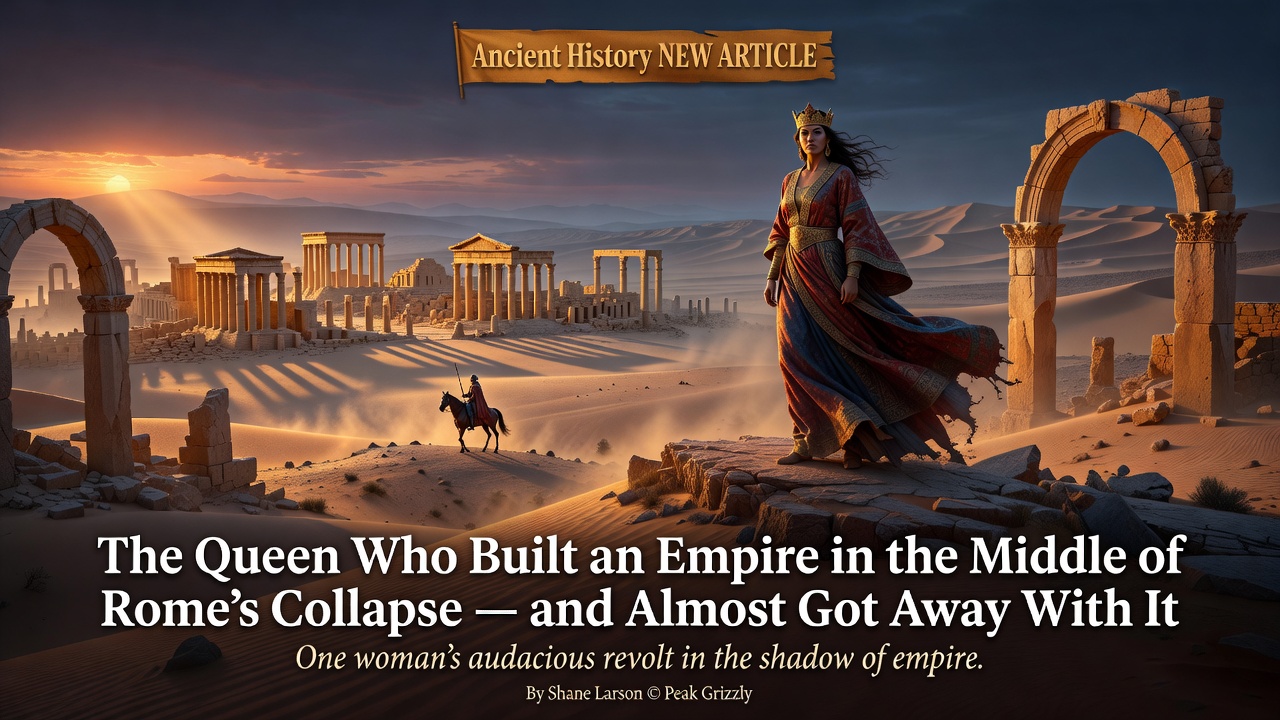
The Queen Who Built an Empire in the Middle of Rome's Collapse — and Almost Got Away With It
May 25, 2026 · 9 min read
The most consequential thing about empires is not how they fall but how they almost fall and don't. Rome is a master class in this. The textbook chapters about its decline tend to skip ahead to Constantine, or Diocletian if the writer is feeling ambitious, but the actual interesting moment — the one where the whole structure should have come apart — happened a century earlier, between roughly 235 and 284 CE, in a fifty-year stretch that historians now call the Crisis of the Third Century.
In that crisis, the Roman Empire genuinely broke. Emperors were murdered at a rate of one every couple of years. The currency lost most of its silver content. Plague rolled through the cities. The frontiers caved in. In 260 CE the emperor Valerian was captured alive by the Persians and died in captivity — the first Roman emperor in history to suffer that humiliation. By 270 CE the empire had effectively split into three pieces: a rump Roman state in the middle, a breakaway Gallic Empire in the west, and an eastern empire ruled from a desert city most Romans had never visited.
That eastern empire was ruled by a woman named Zenobia.
A Trading Town That Should Not Have Mattered
Palmyra sat in the Syrian desert, four days' camel ride from the Euphrates and five from the Mediterranean coast. It existed because of a spring — the Efqa, sulphur-tinged, drinkable in a pinch, sufficient to support a substantial population — and because of geography. The shortest land route between the Roman world and the Persian world passed through the desert between Damascus and the Euphrates, and Palmyra sat exactly where caravans needed a halfway point. Silk from China, spices from India, incense from southern Arabia: all of it moved through Palmyra, paid tariffs to Palmyra, enriched Palmyra. By the second century CE the city had grown wealthy enough to line its main street with limestone columns, build a temple to its chief god Bel on a scale to rival anything in Antioch, and bury its dead in elaborate tomb towers visible from miles out in the desert.
What it had not done, before 260 CE, was matter politically. Palmyra was a Roman client. It paid its taxes and provided its archers and kept the trade flowing and was tolerated. As long as it stayed in its lane, no one in Rome had any particular reason to think about it.
Then Valerian was captured at Edessa, and the entire Roman east lost its commander, its army, and its center of gravity in a single afternoon.
What happened next is one of the strangest improvisations in ancient history. A Palmyrene noble named Odaenathus — a man who held the Roman senatorial titles his family had been given for cooperative service, but who was first and foremost a desert warlord with a private army — rode east, gathered the surviving Roman forces in Syria, and counterattacked the Persians. Within a few years he had driven Shapur I back across the Euphrates and twice taken his armies all the way to the gates of the Persian capital at Ctesiphon. He took the title "King of Kings" — a deliberate Persian provocation, claiming the same dignity Shapur claimed for himself. He was recognized, more or less, by the embattled emperor Gallienus, who had no real alternative. Odaenathus had become, in effect, the de facto Roman commander of everything east of Anatolia.
Then, in 267 or 268 CE, he was assassinated.
His older son Hairan was killed alongside him. A cousin named Maeonius was implicated. The ancient sources hint, without ever quite saying, that Odaenathus's second wife may have known about the plot — or even helped arrange it. We cannot prove this. We cannot disprove it either. What we can prove is that within months of Odaenathus's death, his second wife had assumed the regency on behalf of their young son Vaballathus, had consolidated control over the army and the merchant aristocracy, and had begun to behave less like a Roman client and more like an independent ruler.
Her name was Zenobia. The Romans called her that. Her own people called her Bat-Zabbai. And what she did over the next five years was, by any honest reading of the evidence, almost impossible.
What She Actually Pulled Off
In 270 CE, Zenobia sent her general Zabdas south into Egypt. The pretext was that the Egyptian frontier was under threat from the Blemmyes raiding up from Nubia and Palmyra was helpfully intervening to stabilize the situation. The real purpose was conquest. Zabdas defeated the Roman prefect Tenagino Probus, who reportedly committed suicide rather than surrender. Alexandria fell — the second city of the Roman world, the source of Rome's grain supply, the gateway to the Indian Ocean trade. Egypt was now under Palmyrene control.
In 271 CE, Palmyrene forces pushed north and west into Anatolia. They captured Antioch, the eastern administrative capital of the Roman Empire. They moved through Cilicia and Cappadocia. They reached as far as Ankyra (modern Ankara), with raiding columns possibly extending toward the Bosporus itself. Zenobia's empire now ran continuously from the Nile delta in Egypt up through Syria into central Anatolia — a swath of the Mediterranean world larger than modern France and Spain combined.
In 272 CE she made her last move. The coins minted in her name in Antioch and Alexandria had, up to this point, carefully shown her son Vaballathus alongside the legitimate emperor Aurelian — the suggestion being that the Palmyrenes were loyal regents administering the east on Rome's behalf. In spring 272, the coins changed. Aurelian's name disappeared. Vaballathus was now sole Augustus. Zenobia herself took the title Augusta. There was now no pretense at all. The east had seceded.
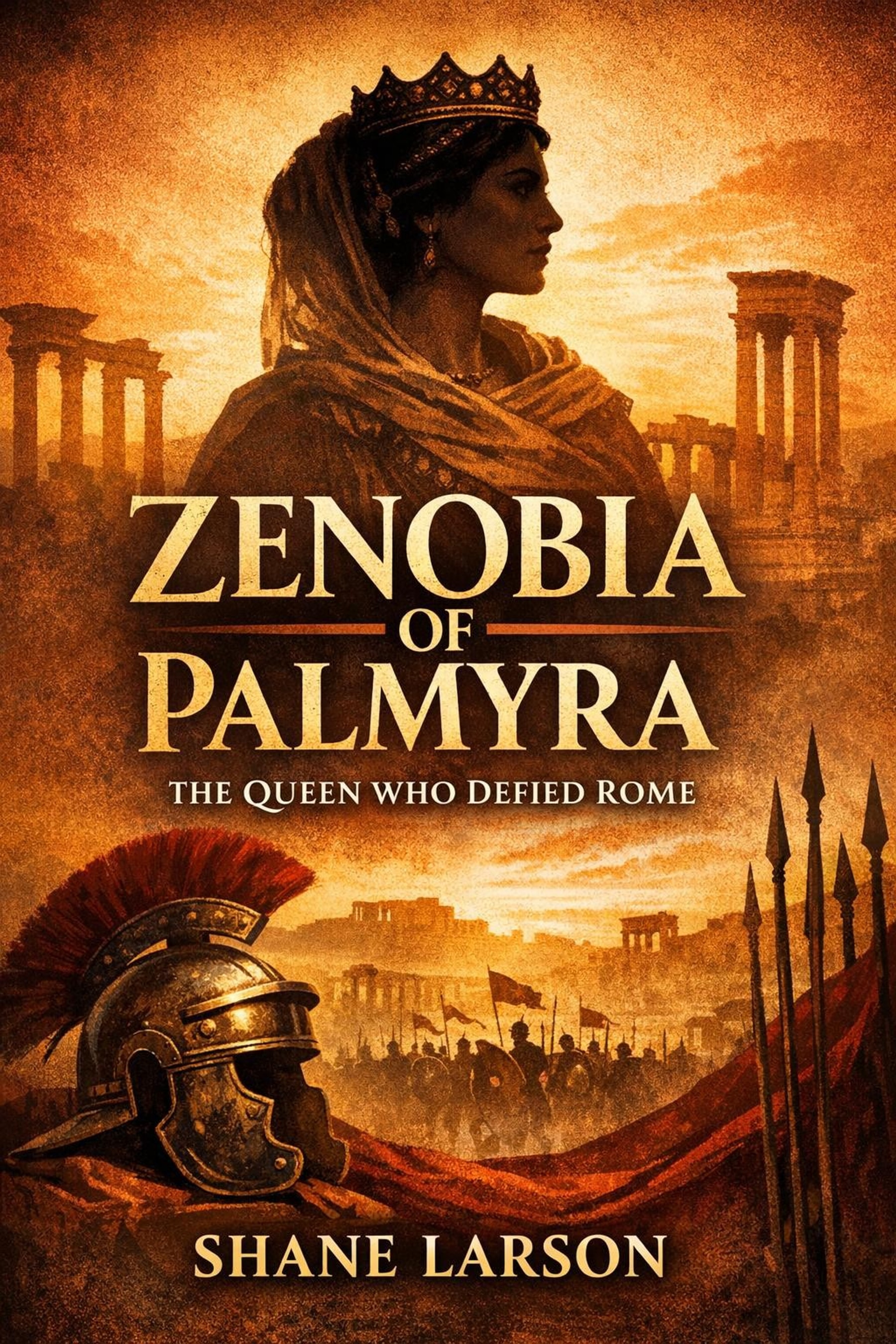
Zenobia of Palmyra
Why did she do it then? The most likely answer is that she had run out of room to keep pretending. Either she had to fold and accept demotion back to client-king status — which, given everything she had done, probably meant her death and certainly meant the end of her son's career — or she had to commit. She committed.
The Brilliant Five-Year Roman Comeback
The reason almost no one has heard of Zenobia is that on the other side of the chessboard, by improbable luck, the Roman Empire had produced one of the most effective soldier-emperors in its history. Lucius Domitius Aurelianus, born around 214 CE in the Balkans to a humble military family, had been acclaimed emperor in 270 — a cavalry officer hardened by twenty years of frontier campaigning, ruthlessly disciplined, religiously devoted to the cult of the unconquered sun, allergic to indecision. He spent his first eighteen months putting out fires in Italy, building the great defensive walls around Rome that still bear his name, and breaking up barbarian incursions on the Danube. Then he turned west and, in a single campaign of 273, brought the Gallic Empire back into Roman hands without significant bloodshed.
Then he turned east.
What happened next is the part of the story I find most genuinely impressive, because it shows ancient military command at a level we rarely get to see clearly. At the Battle of Immae, fought on the Orontes outside Antioch in the summer of 272, Aurelian deliberately gave ground against Zenobia's heavy cavalry — the clibanarii, men in head-to-foot armor on armored horses, the eastern equivalent of medieval knights. He ordered his own lighter cavalry to feign retreat. The Palmyrenes pursued. In the Syrian summer heat, with the sun directly overhead, the men inside the iron baked. By the time they realized they were being drawn into a trap, Aurelian's infantry had wheeled around their flanks. The clibanarii — slow, exhausted, and now isolated — were destroyed.
He did it again, on a larger scale, at Emesa a few weeks later. The Palmyrene army never recovered. Zenobia withdrew with what was left of her forces into the desert, back to Palmyra itself.
The siege of Palmyra lasted only a few months. The desert that had protected the city against casual attackers could not stop a Roman army with proper logistics. Zenobia made a final attempt to break out — riding east on a camel, in the company of a small mounted party, hoping to reach the Persian frontier and beg asylum from the Sasanian king Hormizd I. Roman cavalry caught her at the Euphrates, just short of safety. By the time she was brought back to Aurelian's camp, the city had already surrendered.
In 274, Aurelian celebrated his triumph in Rome. The captured queen walked in the procession. The Historia Augusta says she was loaded with so much jewelry and so many golden chains that attendants had to support her under the weight. We do not know for certain what happened to her after the triumph. The Greek sources say she was executed or died on the road. The Latin sources say she was given a villa at Tibur (modern Tivoli), retired into a comfortable Roman matronhood, and her daughters married into Roman senatorial families. The truth is unknowable.
The Roman Empire, against every reasonable prediction, had been put back together. Within a decade Diocletian would formalize the recovery into a new administrative system that would carry Rome through another two centuries. Zenobia and her experiment vanished into footnotes.
Why This Story Still Matters
The reason I wrote a book about her is not nostalgia for lost queens or admiration for the underdog, though both of those are present. It is that the Crisis of the Third Century is the cleanest available case study of a phenomenon that recurs constantly in human history: a system that looks permanent and then, very briefly, isn't.
When systems look permanent, the people who matter most are the people in charge of the system. When they stop looking permanent — for a year, a decade, half a century — a different population suddenly becomes consequential. People who would have lived ordinary lives inside the structure of the working order become, for as long as the disorder lasts, the load-bearing walls of whatever comes next. Some of them become the founders of whatever replaces the old structure. Some of them, like Zenobia, briefly become something that almost replaces it and then doesn't, and disappear when the old structure finds its feet again.
We are, in our own century, probably not at a Crisis-of-the-Third-Century moment. The institutions of our world are not collapsing at the rate Roman institutions were in 250 CE. But we are in a moment of unusual instability, and the question of who becomes consequential when the rules go slack is not a purely historical one.
Zenobia is interesting because she should not have been able to do what she did. A woman, from a peripheral city, in a culture that did not expect women to rule, briefly became one of the most powerful people in the Mediterranean world. She lost. The losers usually do not get the long histories. But she was real, the empire she built was real, and the story of how she nearly got away with it is one of the great untold stories of the ancient world.
It is also a story that, until very recently, you mostly had to read in academic monographs to find. That gap is what my new book is trying to fill.
Zenobia of Palmyra
New posts and releases, straight to your inbox. No spam, unsubscribe anytime.