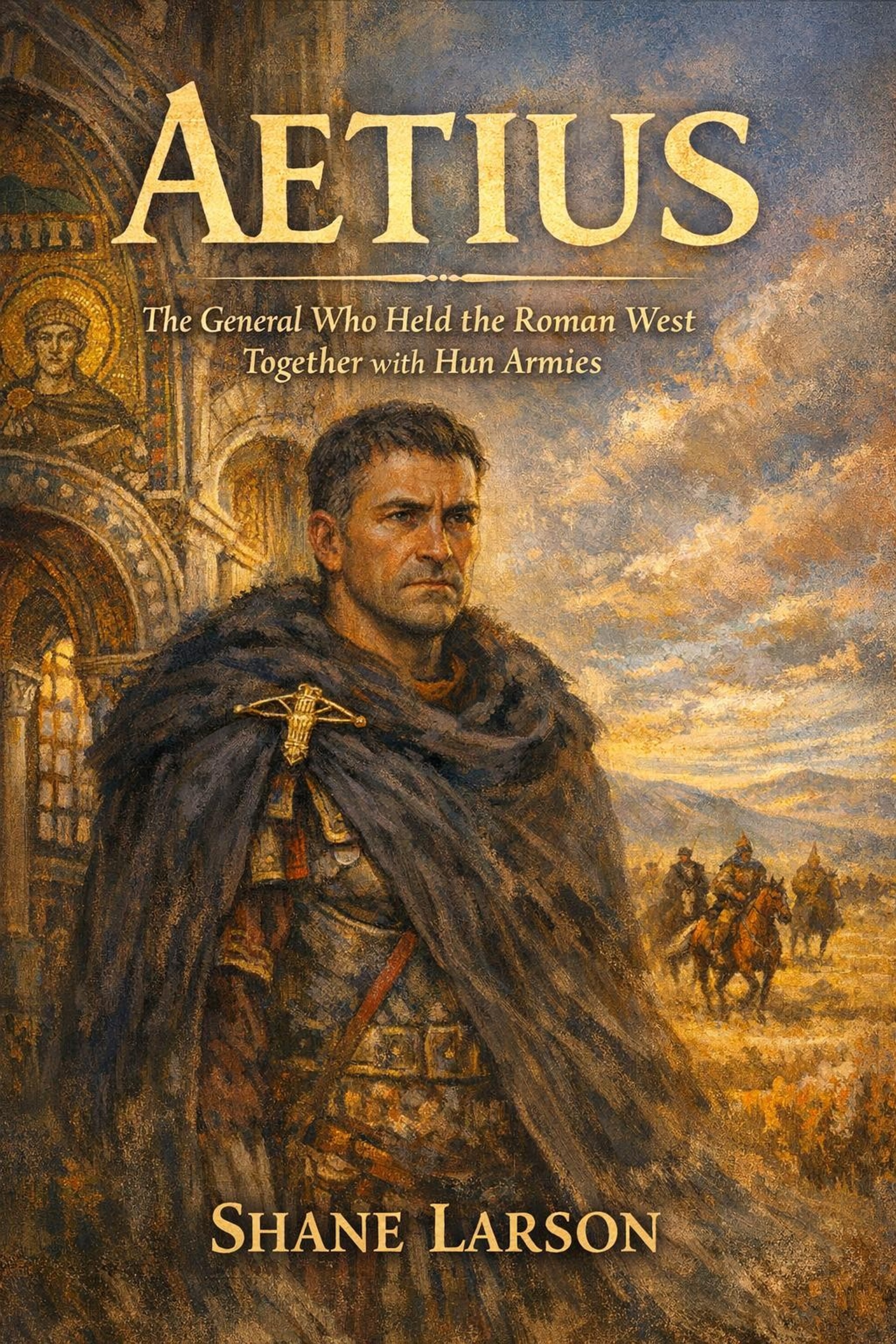
Aetius
The General Who Held the Roman West Together with Hun Armies
By Shane Larson
About This Book
In 1823 a German scholar in the monastery library at St. Gall noticed faint lettering beneath the text of a manuscript, where an older book had been scraped away to make room for a newer one. What had been scraped off was praise poetry: panegyrics composed in the 440s for the most powerful man in the Western Roman Empire, read aloud in his presence. The monks had not thought them worth keeping. Nearly everything written about Flavius Aetius in his lifetime met the same fate.
No ancient biography of him exists. His name appears in no dated document before he was in his thirties. What survives is a scattering of chronicle entries a sentence long, a portrait copied by Gregory of Tours from a lost historian, the fragments under the St. Gall text, and three anecdotes from Procopius written a century later. That is the whole dossier on the general who ran the Roman West for twenty-one years and stopped Attila on the Catalaunian Plains.
Out of that thin record, this book builds a life: not the single scene every Attila book gives him, but the thirty years before it, when the Huns were not his enemy but his army.
Aetius was born around 391 at Durostorum on the lower Danube and spent his teens as a hostage, first with Alaric's Goths and then with the Huns. That gave him something no other Roman officer of his generation possessed: he knew the peoples beyond the frontier by name, and they knew him. When a usurper seized Ravenna in 423, Aetius was sent to the Huns to buy an army. He arrived too late, the usurper already beheaded, fought the Eastern force that had done it to a standstill, and was paid off with a command in Gaul by Galla Placidia, the regent whose son he had marched to depose.
From there the book follows him to the top of the Western army by way of two rivals. The second was Boniface, count of Africa and the one general in the West who was his equal. Placidia put Boniface over Aetius's head; the two met in battle outside Rimini in 432; Aetius lost, escaped to Rua, the Hun king, and returned in 433 with enough Hun force behind him that the court yielded. Boniface died of his wound; Aetius married his widow.
Then comes the patrician at work: Gaul held with Hun auxiliaries and barbarian settlements, the Visigoths pushed back from Arles and Narbonne, the Burgundian kingdom wiped out in 436 and 437 in a slaughter German poets were still singing seven centuries later as the Nibelungenlied. And set against it, what was lost while he won: Carthage to the Vandals in 439, with the grain and taxes that paid the soldiers; Britain's last appeal, unanswered; most of Spain. The book keeps both ledgers open and does not pretend they balance.
It ends where the Hun card ran out. Once Attila ruled alone and had no further use for a Roman friend, the Huns turned on the West, and Aetius met them with Visigoths, Alans, Franks and Burgundians because the army his career had rested on was now riding against him. Two and a half years later, with no Huns left to bring or to fear, the emperor in whose name he had governed for two decades drew a sword on him in the palace and struck him down himself.
Why I Wrote This
What hooked me was a sentence in Procopius. Introducing the Roman generals of the 420s to readers who had never heard of them, he wrote that either of two men, Aetius or Boniface, could rightly be called "the last of the Romans." Then he went on to describe them destroying each other.
That phrase has been hung on Aetius alone ever since, and the sentence does not support it. Procopius gave the title to two men, at the moment they were about to fight a civil war while the Vandals took the empire's richest province. Read that way it stops being a compliment and becomes an obituary for a kind of man, and the loss was both of them.
I also wanted the thirty years every Attila book skips. The man who stopped the Huns in 451 had spent most of his life as their friend, their guest and their employer. That is not a contradiction to be explained away. It is the whole story.
Frequently Asked Questions
Who was Flavius Aetius and what is he known for?
He was the senior general of the Western Roman Empire from 433 until his murder in 454, and in practice its ruler in the name of the emperor Valentinian III. He is remembered for the coalition that stopped Attila on the Catalaunian Plains in 451. This book argues that the quarter-century before that, when Hun troops were the basis of his power, is the more revealing part of his career.
Did Aetius really know Attila when they were boys?
Nobody knows. Aetius lived among the Huns in the 410s, when Attila was a child, so they may have met. No source says they did, and the book flags the idea as unprovable and builds nothing on it.
How is this different from the Attila book?
Attila tells 450 to 453 from the Hun camp. This book spends three-quarters of its length on 391 to 449, which Attila barely touches, and tells 451 as a problem of command and coalition rather than as a second battle narrative; the Italian invasion of 452 is routed to the other book.
Is the "Agitius" in Gildas really Aetius?
Most historians think so. Gildas writes that the Britons appealed to "Agitius, three times consul," and Aetius held his third consulship in 446, which fits. The dating has been argued over for a century and other candidates proposed; the book sets out the argument and says where the weight of opinion sits.
Do I need to know late Roman history to follow it?
No. The introduction explains what survives and how the gaps are handled, Latin titles are glossed, and the appendices supply a timeline with uncertain dates marked, a guide to the sources, and a who's who of the Western command.
If You Liked This, You Might Like
- Attila: The Scourge of God — the same years from the other side of the field; this book is the Roman half of that one.
- The Fall of Rome — the long arc these three decades sit inside, and where Aetius's Gaul fits in the whole collapse.
- Roman Britain — ends where this book's eleventh chapter pauses, on the island's last appeal to a Roman general who did not answer.
- Justinian and Theodora — the East's attempt to win back the Africa that fell on Aetius's watch, told by the same Procopius who named him the last of the Romans.
He was the best general the West had left, and the empire shrank under him anyway. Aetius: The General Who Held the Roman West Together with Hun Armies holds both of those facts in view at once and lets the reader weigh them.
What You'll Learn
- A portrait by a lost historian. The one physical and moral description of Aetius that exists, preserved by Gregory of Tours from a writer whose history is otherwise gone, with a note on what in it can be trusted.
- The forged letters. Procopius's story that Aetius set Placidia and Boniface against each other by forgery, and that Boniface then invited the Vandals into Africa, told in full and taken apart.
- Worms to the Nibelungenlied. How a Burgundian king named Gundahar became Gunther, how Attila became Etzel, and how a treaty resettlement in 443 turned the survivors into a Roman client state.
- Agitius, three times consul. Gildas's record of Britain's last appeal to Rome, the argument over its date, and whether the man it was addressed to is Aetius at all.
- Coalition-building as a command problem. How Visigoths, Alans and Franks lately at war with Rome were brought to one field in 451, and why the casualty figures in Jordanes cannot be believed.
- Six months from murder to murder. The marriage proposal behind the killing in September 454, the two steppe guardsmen who avenged it on the Campus Martius, and the Vandal fleet that followed.
New Ancient History releases and free chapters — no spam, unsubscribe anytime.
More in This Genre
View all →