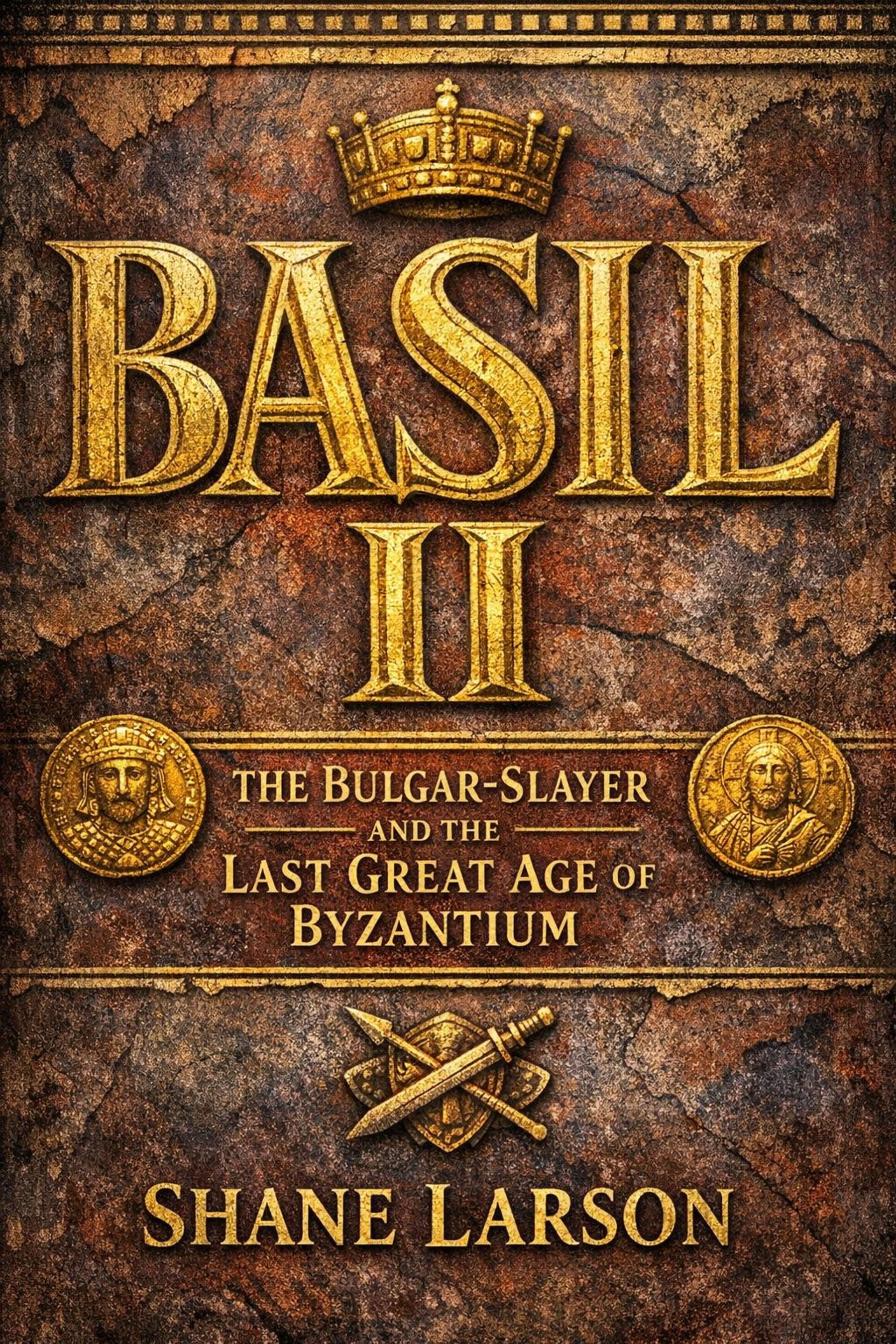
Basil II
The Bulgar-Slayer and the Last Great Age of Byzantium
By Shane Larson
About This Book
In the year 1260, soldiers of the emperor Michael VIII were camped outside Constantinople, near a ruined church in the suburb called the Hebdomon. Inside it they found an old tomb broken open and a body propped in a corner. Someone had set a reed pipe in its mouth as a joke. An inscription told the soldiers who it was. The body was Basil II, dead for two hundred and thirty-five years, who had left the empire at its greatest extent since the Arab conquests.
That is an odd end for a man with one of the most fearsome names in medieval history. Basil is the Bulgar-Slayer, the emperor who is said to have blinded an entire captured army and sent it home to break its king's heart.
The name was not his. No writer who knew him used it, and neither did the generation after. It turns up more than a century and a half after his death, when the empire was at war with Bulgaria again and wanted a hero.
The Story
Basil was born in 958 in the purple chamber of the Great Palace, the son and grandson of emperors, and crowned co-emperor at two. His father died when he was five. For the next quarter of a century he was an emperor in name only: two successful generals in turn took the throne and married into his family, and after them his great-uncle, a eunuch chamberlain, ran the state while Basil signed what he was given.
When he finally dismissed the chamberlain and led an army himself, he was ambushed in a Balkan pass and lost his baggage, his tent and very nearly his life. Within a year the greatest military families of Asia Minor had risen against him, and their army was camped across the water from his capital. He had almost no soldiers he could trust. So he made a bargain that broke his own dynasty's stated rules: his sister Anna, born in the purple like him, would go north to marry Vladimir, the pagan prince of Kyiv, in exchange for six thousand Norse warriors and Vladimir's baptism. The Norsemen won him the civil war and stayed, as the Varangian Guard.
The Basil who came out of those years is the one the sources describe: plainly dressed, unmarried, uninterested in ceremony or literature, with the army for most of every year. He fought Tsar Samuel of Bulgaria for the better part of three decades. He crossed Asia Minor in about sixteen days to save Aleppo. He passed laws against the great landowning families and made them answer for their poorer neighbours' unpaid taxes. When he died in December 1025 the treasury was full.
He had no children and had made no arrangements. His brother, co-emperor for sixty-three years and idle for all of them, succeeded him at about sixty-five. Fifty years on, the army lost at Manzikert and Asia Minor went with it.
Why I Wrote This
I came to Basil through the number. Fifteen thousand blinded men is the kind of figure that gets repeated because it is hard to forget, and I had repeated it myself. Then I looked for where it came from and found a single chronicler writing about seventy years after the event, a second who gives a different number, and two writers much closer to Basil's time who do not mention it.
That did not make the story false, but it made it a question, and not the most interesting one. I had not known that he lost his first battle, or that he spent his twenties as a figurehead, or that the conversion of the Rus began as a troop requisition.
Most of all I wanted to understand how a ruler that capable could leave so little behind him that worked without him. The book is my attempt at an answer, and I have tried to mark every place where the sources do not give one.
Frequently Asked Questions
Did Basil II really blind 15,000 Bulgarian prisoners?
The claim comes from John Skylitzes, who wrote in the later eleventh century, roughly seventy years after the battle of Kleidion in 1014. A second writer of the same period, Kekaumenos, gives fourteen thousand. Writers closer to the event do not mention it, and some modern historians argue the real number was far smaller, partly because Samuel's forces were still in the field weeks later. Others accept a large figure. The book sets out both cases.
Why is Basil II called the Bulgar-Slayer?
Not because anyone called him that in his lifetime. The name first appears in the later twelfth century, after a new Bulgarian state had broken away from the empire and the two were at war again. Its modern fame owes much to the early 1900s and a popular children's novel of 1911.
How did Basil II get the Varangian Guard?
In 987 and 988 he was losing a civil war and asked Vladimir of Kyiv for soldiers. Vladimir sent about six thousand, in return for marriage to Basil's sister Anna, and accepted baptism as a condition of the match. The troops defeated the rebels and stayed on as a permanent guard.
Why did Basil II never marry?
No source gives a reason. Historians have suggested policy, temperament, a religious vow and a life spent on campaign. The book surveys the suggestions without adopting one.
Did the Byzantine Empire decline because of Basil II?
That is argued both ways. He left no heir and trained no successor, and much of his system depended on his personal attention. He also left a full treasury, secure frontiers and fifty years in which those who followed him could have governed better than they did. The last chapters weigh the two cases.
If You Liked This, You Might Like
- The Rus — the bargain of 988 from the other end: the traders and princes of Kyiv who supplied Basil's six thousand soldiers.
- The Fall of Constantinople — the same city four centuries later, on the morning the empire Basil enlarged came to its end.
- Justinian and Theodora — the last emperor before Basil to rule so much territory, and what it cost him to win it.
- The Viking Expansion — how Norsemen came to be on the road to Constantinople in the first place.
A soldier who ruled for half a century, a nickname he never heard, and a state that worked only while he was watching it: the record is thinner than the legend, and more interesting.
What You'll Learn
- The legend first, then the evidence. The book opens with the blinding as the chronicler John Skylitzes tells it, names what is wrong with the account, and then sets it aside until the reader has enough context to judge it.
- Twenty-five years as a spare emperor. The murder of Nikephoros Phokas in his bedchamber, the reign of John Tzimiskes, and the eunuch great-uncle who ran the state for nine years after them.
- The bargain with Kyiv, seen from Constantinople. What Basil needed, what he gave up, and why the accounts of where and when Vladimir was baptized do not agree.
- Samuel as a ruler, not a foil. His family, his court at Prespa and Ohrid, his victories, and an even-handed account of the modern Bulgarian and North Macedonian claims on his state.
- Kleidion examined. Fifteen thousand in one source, fourteen thousand in another, silence in two more; the practical arguments for a much smaller number; the reasons some historians still accept a large one. The debate is laid out and left open.
- The settlement after the conquest. A Bulgarian archbishop kept at Ohrid, taxes still paid in kind, Samuel's nobles given titles and marriages in imperial service.
- How the state actually ran. The land law of 996, the tax liability imposed on the rich, and the argument over how much of it was plan and how much improvisation.
- The fifty years after. What his successors did with the treasury, the laws and the armies, and how much of the collapse is fairly his.
- Three appendices: a year-by-year timeline from 958 to 1071, a who's who of the families and commanders, and a guide to the sources that says who wrote when and how far each can be trusted.
New Medieval History releases and free chapters — no spam, unsubscribe anytime.
More in This Genre
View all →