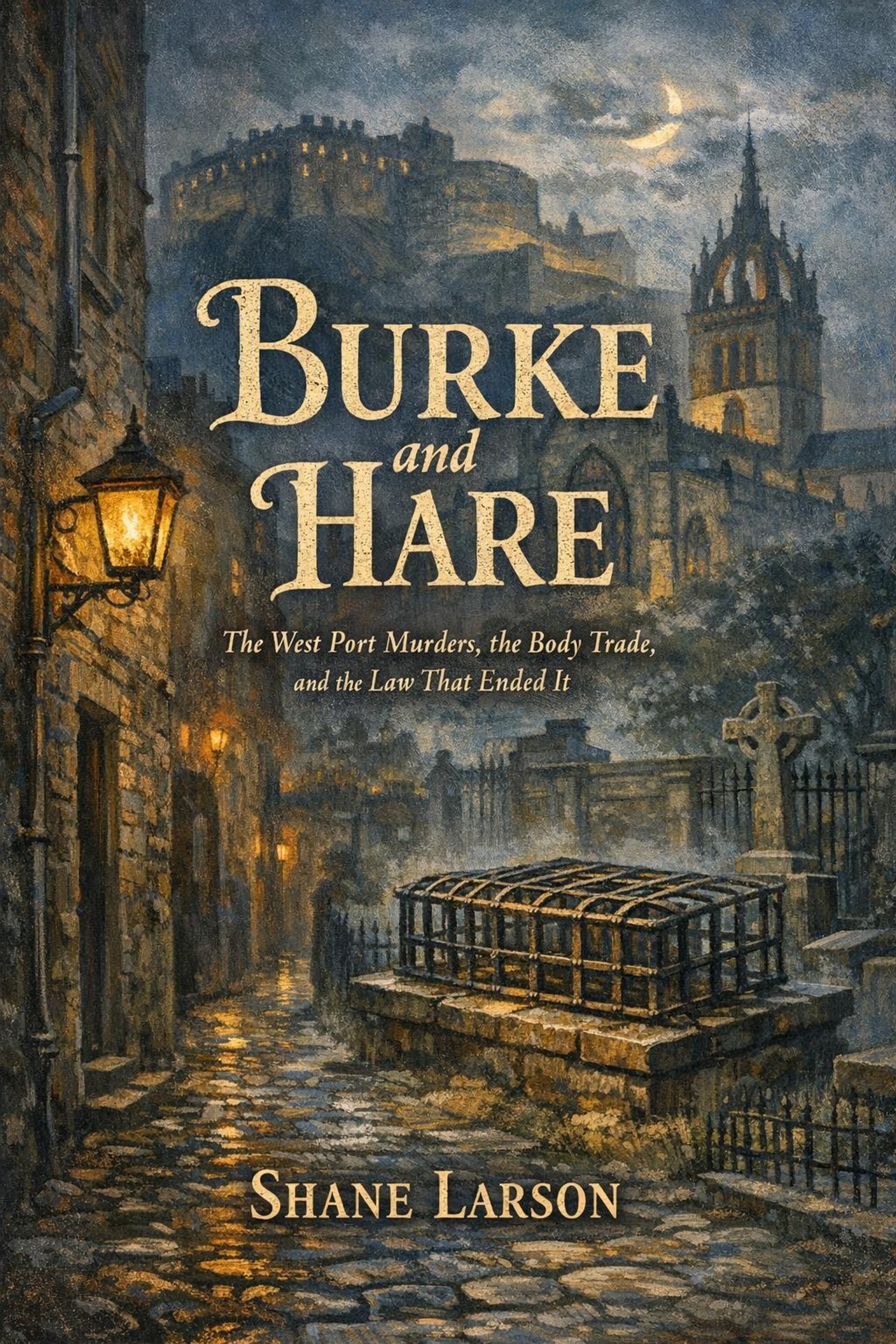
Burke and Hare
The West Port Murders, the Body Trade, and the Law That Ended It
By Shane Larson
About This Book
Walk through an old Scottish churchyard and sooner or later you will find one: a cage of iron bars laid over a grave, heavy enough that it took several men and a block and tackle to lift. It is called a mortsafe. Parishes bought them in the 1810s and 1820s and hired them out by the week, to be bolted over a new burial until the body beneath was of no further use to anyone. Some churchyards built stone watch-houses at the gate as well, and paid men to sit in them through the night with a fire and a gun.
All of that was defense against a trade. The medical schools of Britain taught anatomy by dissection, every student needed a body to work on, and the law supplied only the bodies of executed murderers, which came to a few dozen a year. The difference was made up by men with wooden spades who worked at night and were paid by the corpse.
In 1828 two laborers in Edinburgh found a way to supply the same market without going near a churchyard. No mortsafe could have stopped them, because the people they sold had never been buried.
The Story
William Burke and William Hare were Ulstermen who had come to Scotland to dig the Union Canal. By 1827 Hare was keeping a cheap lodging house in Tanner's Close, off the West Port, and Burke was one of his lodgers. That November an old army pensioner named Donald died in the house of natural causes, owing Hare about four pounds. The two men took the body out of its coffin, weighted the coffin with tanner's bark, and carried Donald to the anatomy school of Dr. Robert Knox at 10 Surgeons' Square. They were paid seven pounds ten shillings and, by Burke's account, told they would be welcome to come again.
They came again sixteen times. Between February and October 1828 they killed lodgers, street sellers, a grandmother and her grandson, a relative of Burke's own partner, and a young man known to half the town. The people they chose were poor, often alone, and unlikely to be searched for, which is also why the record of them is so thin. Each was sold at the same door for eight or ten pounds, depending on the season. Nobody at the school is recorded as asking where so many fresh bodies were coming from.
It ended on Halloween, when two lodgers found the last victim under a heap of straw and went to the police. The Crown had four prisoners and almost no evidence, so it bought some: Hare was given immunity to testify against Burke. Burke was convicted on Christmas morning, hanged a month later in front of a crowd of more than twenty thousand, and publicly dissected by sentence of the court. Hare was put on a coach for the English border. Knox was cleared by a committee of his own choosing and went on lecturing.
The book does not stop there, because the consequences did not. Parliament had been taking evidence about the body trade before anyone had heard of the West Port. After a second set of murders in London in 1831, it passed the Anatomy Act, which licensed the schools and gave them a new and lawful supply: the bodies of people who died in workhouses and hospitals with nobody to claim them. Grave-robbing stopped within a few years. Dissection, which had been a punishment for murder, became a consequence of dying poor.
Why I Wrote This
I knew the rhyme before I knew anything else about the case, and I assumed, like most people, that Burke and Hare dug up graves. Finding out that they never had was what started this. The second surprise was the money. Once you see the first sale written down as a sum, with a rent debt on one side and a price on the other, the whole thing stops looking like a monster story and starts looking like a business with a customer.
What kept me going was the ending nobody tells. The usual account stops at the gallows. The real result came three years later, in a law that solved the surgeons' problem by passing it to the workhouse. I wanted to follow the story all the way there. I also wanted to write about the sixteen as people who had names, without describing what was done to them. The record gives each of them very little, and the book gives them what it has.
Frequently Asked Questions
Were Burke and Hare grave-robbers?
No. There is no evidence either man ever opened a grave. The first body they sold was a lodger who had died naturally, and the rest were people they killed. The confusion comes from the trade they supplied, which until then had been fed mostly by grave-robbers.
How graphic is this book?
It is restrained by design. The way the victims were killed is stated once, in a sentence or two, and never dramatized. Dissections are reported as events, without anatomical detail. If you want the ghost-tour version, this is not it.
How many people did Burke and Hare kill?
Sixteen, by Burke's own count in the confessions he gave before his execution. That figure cannot be checked against much else, and the two confessions disagree on the order and on some details. The book says where the record is firm and where it rests on Burke's word alone.
Why was Dr. Knox never prosecuted?
There was no evidence that he knew the bodies were those of murdered people, and the Crown never charged him. A private committee later found that he had not known but had been careless in asking no questions. The book lays out what his school received and what was said in his defense, and leaves the judgment to the reader.
What was the Anatomy Act of 1832?
It was the law that ended the trade in stolen bodies. It licensed anatomy teachers and allowed workhouses and hospitals to hand over the bodies of people who died unclaimed. It also ended the dissection of executed murderers.
If You Liked This, You Might Like
- Ancient Medicine — the earlier half of the same problem: fourteen centuries of anatomy taught from a book because almost nobody was allowed to look inside a human body.
- The Bloody Benders — another household that killed the strangers under its roof, on the Kansas prairie, told from the documents and not the campfire version.
- The Harpe Brothers — a frontier murder case where two centuries of retelling have to be peeled away from what the sources support.
The iron cages are still in the churchyards. This is the history of what they were built against, of the two men who went around them, and of the law that finally made them unnecessary.
What You'll Learn
- The Murder Act of 1752, which made dissection part of a murderer's sentence, and how that one decision taught the public to dread the anatomist's table.
- A working account of the resurrection trade: how a grave was opened, what the gangs charged, how prices rose, and why the law treated the theft of a shroud more seriously than the theft of the person inside it.
- Edinburgh as the medical capital of the English-speaking world, with three generations of professors named Monro and a ring of private schools competing for students around Surgeons' Square.
- Robert Knox before the scandal: an army surgeon after Waterloo, the most popular anatomy lecturer in Britain, with a class of about five hundred.
- Every known victim, named where the record gives a name, with the two confessions set side by side where they disagree.
- The trial through the night of 24 December 1828, the Scottish verdict of "not proven" that freed Helen McDougal, and the legal argument that kept Hare from being tried.
- What became of Hare, McDougal, Margaret Laird and Knox, with the legends marked as legends.
- The Select Committee, the London murders of 1831, and the Anatomy Act clause by clause, including the objection raised at the time that it punished poverty.
- Two appendices: a register of the sixteen victims and of Donald, and a chronology of the trade with a who's who.
New European History releases and free chapters — no spam, unsubscribe anytime.
More in This Genre
View all →