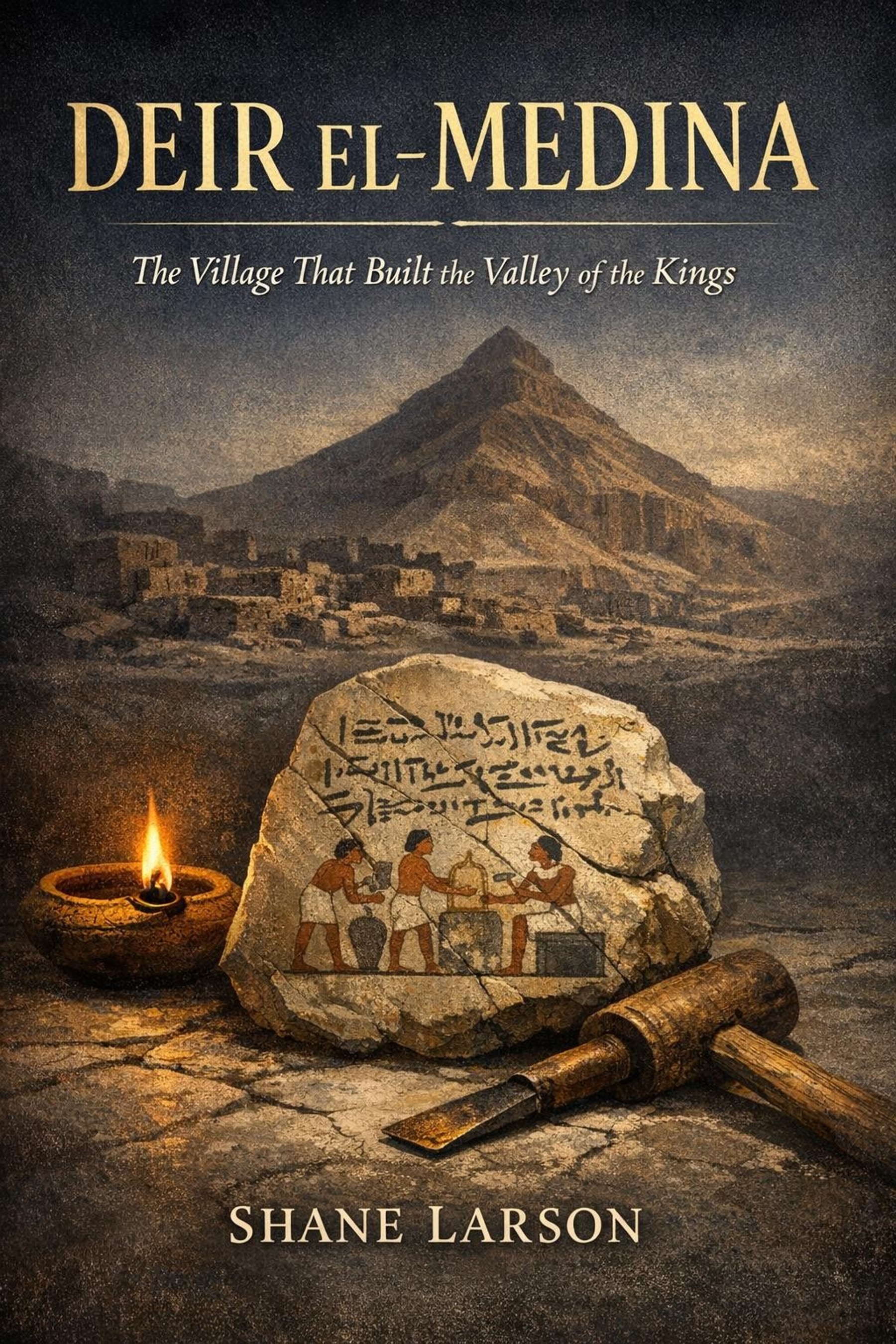
Deir el-Medina
The Village That Built the Valley of the Kings
By Shane Larson
About This Book
Ask who built the tombs of the pharaohs and most people picture a crowd: thousands of nameless laborers hauling stone under a whip. For the Valley of the Kings, almost every part of that picture is wrong. The royal tombs there were cut by a crew that rarely numbered more than sixty. They were salaried specialists on a government payroll, with houses, servants supplied by the state, two days off in every ten, and family tombs of their own that tourists now queue to see.
And they are not nameless. We have their names, their wives' names, their debts, their handwriting, the prices they paid for coffins and donkeys, and the excuses they gave when they did not turn up for work. A stonecutter called Seba missed a day because a scorpion stung him. That fact is about 3,200 years old, and it is in the British Museum.
The reason is a village. Its ruins lie in a dry side valley on the west bank at Luxor, and its modern name is Deir el-Medina.
The Village and Its Paper Trail
The Egyptians called it the Place of Truth, or more often just "the town". It was founded around 1500 BC to house the men who would cut the kings' tombs, and it was kept apart on purpose: a single street of terraced houses inside a wall, in the desert, with no well. Every jar of water came up from the river plain by donkey. The crew walked over the hill to the Valley, worked by lamplight for eight days, slept in stone huts on the pass, and came home for two.
What sets the place apart is that so many of its people could write. A royal tomb needs draftsmen who can lay out hieroglyphic texts and scribes who can account for every copper chisel, and the skills ran in families. Papyrus was expensive, so for everyday purposes the villagers used what was lying around: flakes of white limestone from the tomb cuttings and pieces of broken pot. Scholars call these ostraca. Because the village sat in the desert, far from the damp of the Nile, well over ten thousand of them survived, along with several hundred papyri.
The book is built from that record. It moves from the institution to the households, then to the quarrels, and then to the crisis that ended the village's good years. In the twenty-ninth year of Ramesses III the monthly grain ration, which was the crew's wages, came weeks late. The men walked past the guard posts of the necropolis, sat down behind a royal temple and refused to go back. Their own scribe recorded it day by day. It is the earliest strike known from any written source, and here it is told from inside the village, as the strikers' record has it.
There is no invented dialogue in this book. Where a chapter needs a day in the life, it uses a day that somebody wrote down.
Why I Wrote This
I had written about Tutankhamun, Hatshepsut and Ramesses II, and in all three books the tomb is close to the center of the story. It kept bothering me that I could describe the paintings on a burial chamber wall and say nothing about the people who had stood there with a brush. Then I read the absence list. A man stays home because his daughter is unwell. Another is off brewing beer for a festival. Several are "with the boss", doing private jobs for the foreman on the king's time.
Anyone who has ever worked on a crew will recognize every one of those excuses. That was the hook. Egypt usually reaches us as stone and gold and the official version, and here was a place where it comes as paperwork: who owed what, who was sick, who was lying. I wanted to see how far that paperwork could carry a whole book. It turns out to carry it easily.
Frequently Asked Questions
Who built the tombs in the Valley of the Kings?
A permanent crew of skilled craftsmen who lived at Deir el-Medina with their families. They were paid employees of the state, and the jobs usually passed from father to son. The crew was typically forty to sixty men, though it was raised to 120 for a short time under Ramesses IV.
Were the tomb builders of ancient Egypt slaves?
No. The men of the crew were free, salaried and, by Egyptian standards, comfortable. Some households in the village did own or share the labor of enslaved servants, and the book says what the documents show about them, which is not much. The servants are among the people the record mostly leaves out.
What was the first recorded strike in history?
The walkout by the Deir el-Medina crew in the twenty-ninth year of Ramesses III, about 1156 BC, after their grain rations fell weeks behind. It is recorded on a papyrus now in Turin, written by the crew's own scribe. Whether it was one strike or a series of them is still argued, and the book sets out both readings.
Can you visit Deir el-Medina today?
Yes. The village ruins, a handful of the workmen's painted tombs and a small Ptolemaic temple are open to visitors on the west bank at Luxor, a short drive from the Valley of the Kings. The first appendix is a guide to what you are looking at when you get there.
If You Liked This, You Might Like
- Tutankhamun — the one royal tomb in the Valley found nearly intact, and a close look at what this village's crew produced for a king.
- Ramesses the Great — the pharaoh on the throne when the absence list was written, seen from the palace instead of the workshop.
- Hatshepsut — one of the first rulers to be buried in the Valley of the Kings, in the generations when the tomb builders' trade took its shape.
- Ancient Medicine — for the scorpion stings, eye complaints and home remedies that fill the village sick lists, and what ancient doctors thought they were doing about them.
The pharaohs commissioned their own memorials and chose what went on them. The people in this book never expected to be read at all, which is the best reason to read them.
What You'll Learn
- The mechanics of cutting a royal tomb. Quarrymen, plasterers, outline draftsmen, sculptors and painters, working in two gangs on the left and right walls, with the lamp wicks counted out and counted back in.
- A payroll in grain. What a workman, a foreman and a scribe each received, what a sack of emmer was worth in copper, and how a village with no fields and no water was provisioned by a staff of water-carriers, fishermen and woodcutters.
- Houses you can still walk through. The standard four-room plan, the cellar, the kitchen at the back, and the raised brick platform in the front room that archaeologists have argued about for ninety years.
- Marriage without a wedding. Couples moved in together and moved out again. Property was divided by rule, women owned and bequeathed in their own right, and adultery was a matter for the neighbors and sometimes the court.
- A working-class library. One scribe's family kept a collection of papyri for more than a century, including a manual for interpreting dreams. Apprentices copied the classics of Egyptian literature onto stone flakes, and somebody drew cats waiting on mice.
- Gods close to home. A cobra goddess who lived on the mountain above the village, a long-dead king whose statue answered legal questions, and stone tablets on which workmen confessed their sins and blamed them for going blind.
- Naunakhte's will. An elderly woman stands before the village court and names the children who looked after her and the children who did not. Four of her eight are cut out of her property, and the document survives in Oxford.
- The case against Paneb. A foreman is accused of theft from a king's tomb, assault, seduction and bribery, on a papyrus written by a man who thought the job should have been his. The book treats it as an accusation, which is all it is.
- Three reference appendices: a visitor's guide to the site, a guide to the main documents and where they are held, and a who's who with a timeline.
New Ancient History releases and free chapters — no spam, unsubscribe anytime.
More in This Genre
View all →