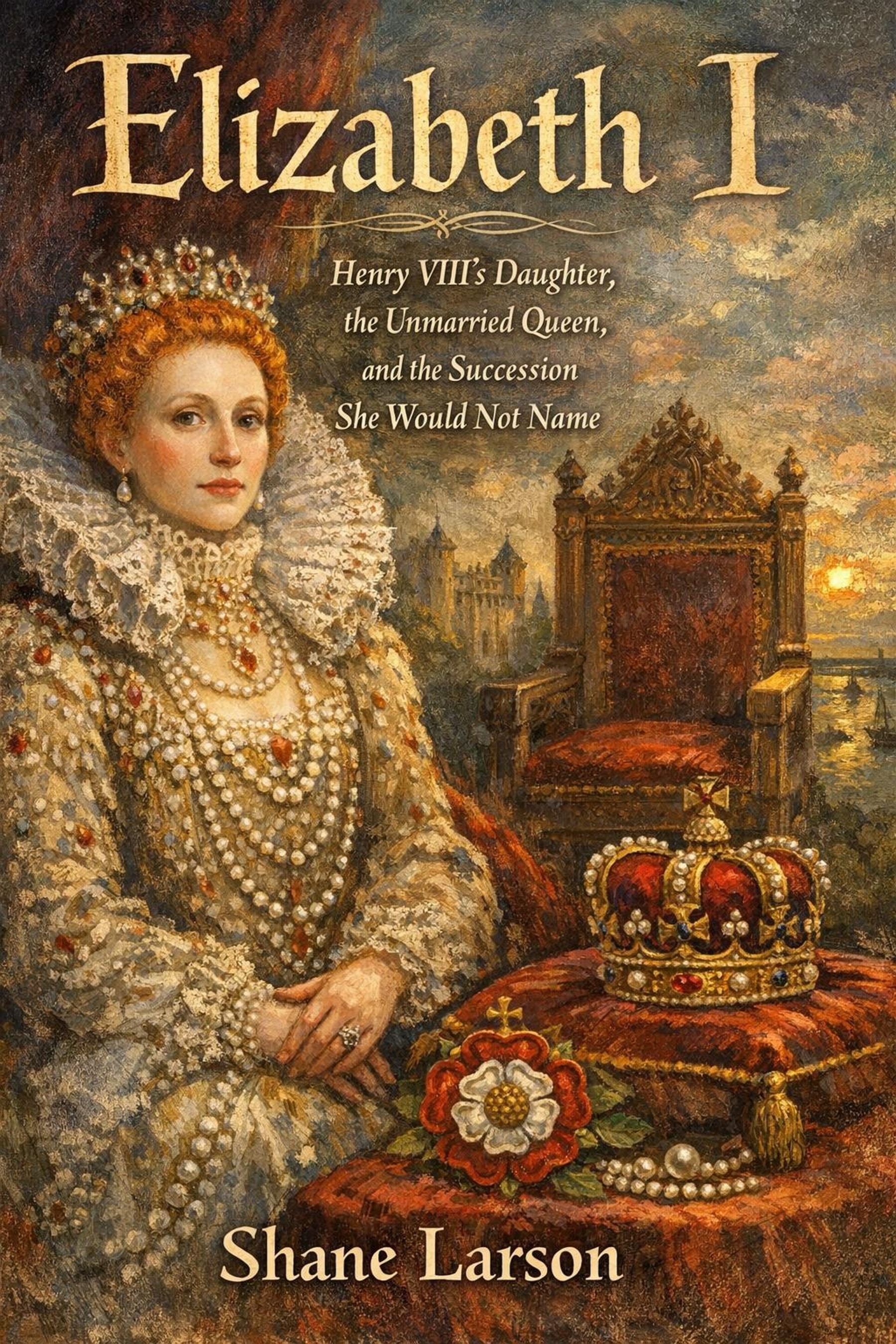
Elizabeth I
Henry VIII's Daughter, the Unmarried Queen, and the Succession She Would Not Name
By Shane Larson
About This Book
In the second week of October 1562 the Queen of England caught smallpox at Hampton Court. She was twenty-nine. Around the 16th she lost her speech and for some hours was thought to be dying, and in the next room her Privy Council tried to agree on who should come after her. Some were for Katherine Grey, next in line under Henry VIII's will and in the Tower for marrying without leave; some for the Earl of Huntingdon; some for handing the matter to the lawyers. They had not agreed when she recovered.
What she asked for, once she could speak, was that Robert Dudley be made Protector of the realm. She did not name a successor. Parliament met in January, begged her to marry or to name one, and went home with neither. She was queen for another forty years, and the men in the next room never got their answer.
Her father had broken with Rome, married six women and passed three Acts of Parliament to fix who would come after him. His younger daughter held the throne longer than any Tudor and would not say. Elizabeth I: Henry VIII's Daughter, the Unmarried Queen, and the Succession She Would Not Name follows that refusal from Greenwich in 1533 to Richmond in 1603, and asks who paid for it.
A Refusal With Reasons
The usual explanation is character, and the book does not pretend to know how much of that mattered, because she never said. What she did say, when pressed, was practical. In September 1561 the Scottish envoy William Maitland asked her to recognise Mary Queen of Scots as her heir, and she told him, by his report, that she had been second in the kingdom under her sister and knew how many had turned towards her then, and that a named heir would be her own winding-sheet held before her eyes. She knew this from the inside. At twenty she had been next in line to Mary, and Mary's council had sent her to the Tower on suspicion of Wyatt's rebellion.
That makes the refusal policy as well as temperament, and policy can be judged. For her it worked: in forty-four years no faction ever had a living, recognised alternative to put at its head. For everyone else the bill was long. Mary Stuart was held for more than eighteen years and then killed. Parliament in 1584 and 1585 had to draft a bond and an Act for governing a kingdom with no sovereign in it. And in 1601 Robert Cecil opened a ciphered correspondence with the King of Scots and settled the matter behind the queen's back, so that a proclamation drafted in advance was read at the gate of Whitehall the morning she died.
The first part of the book belongs with the six queens this set has followed. Elizabeth was raised in the households of four stepmothers and educated under Catherine Parr, whose death in 1548 left her, at fifteen, answering Sir Robert Tyrwhitt's questions at Hatfield and giving him nothing he could use. Those chapters hand back to each queen's volume and keep what was hers alone.
Why I Wrote This
I came to Elizabeth the way this set comes to her, as the last thing left standing from her father's six marriages. After six books watching Henry try to make a succession, I turned to the daughter who inherited the problem expecting the Armada and the portraits. What hooked me instead was a conversation in September 1561, reported by a Scottish envoy, in which a woman of twenty-eight explained why she would never tell anyone who came next, and then kept to it for forty-two years through Parliaments, plots, a near-fatal illness and the execution of her cousin. I wanted to know what that refusal looked like from the inside, and who paid for it. The answer turned out to be almost everyone but her.
Frequently Asked Questions
Did Elizabeth I name James VI as her heir on her deathbed?
Nobody disinterested says so. The hand-to-the-head sign comes from Robert Carey, who rode north with the news and wrote his memoirs some twenty-five years later; the earlier version with words in it is the council's own, and the council had been arranging James's succession in secret for two years. One of the ladies attending her later wrote that there was no sign at all. The book weighs all four witnesses and gives no verdict.
Why did Elizabeth I never marry?
She negotiated marriage seriously for twenty years, and the book follows Susan Doran in treating the courtships as real rather than theatre: the Habsburg match failed on religion, the French one on religion and a divided council, and Robert Dudley on his wife's death. Whether she ever wanted to marry is a different question, and she never answered it.
Did Elizabeth I really give the Tilbury speech?
She went to Tilbury on 8 and 9 August 1588 and spoke to the troops; that much is in accounts printed the same year. The words with the heart and stomach of a king come from a letter Leonel Sharp wrote in the 1620s. The middle view, which the book shares: she spoke, the substance is probably hers, the wording cannot be proved.
What happened to Amy Robsart?
She was found dead at the foot of a staircase at Cumnor Place on Sunday 8 September 1560, having sent her servants to Abingdon fair. The jury found misadventure. The book sets out accident, suicide and murder; the verdict stood, and the death ended any chance of the queen marrying Dudley.
Did Elizabeth I and Mary Queen of Scots ever meet?
No. A meeting planned for the summer of 1562 was cancelled in July. They corresponded for twenty-five years and spent nineteen of them in the same kingdom, Mary as a prisoner, and never once came face to face. The scene in which they do is in the films and not in the record.
If You Liked This, You Might Like
- Anne Boleyn — her mother, from the mother's side: the birth this book gives a page, and the execution that made a two-year-old a bastard in law.
- Jane Seymour — Thomas Seymour's fall in 1549 and the Hertford marriage to Katherine Grey, both told there from the Seymour side.
- Boudica — another queen of England before an army, and the same problem: a speech written down by someone who could not have heard it.
- The Hundred Years' War — how England came to hold Calais, lost in January 1558, the winter before Elizabeth came to the throne.
Forty-four years on the throne, one question asked in every one of them, and an answer that came, if it came at all, after she could no longer speak. This is the reign read along that line, with each famous sentence run back to whoever first wrote it down.
Companion and epilogue to a series on the six queens of Henry VIII.
What You'll Learn
- **The Tide Letter.** With the barge waiting to take her to the Tower on 17 March 1554, she wrote to her sister in her own hand and scored lines through the empty space so nothing could be added.
- **Cumnor Place.** Amy Robsart was found at the foot of a short staircase on 8 September 1560. The coroner's report, located in 2008, records a broken neck and two head wounds; the book sets accident, suicide and murder against it.
- **The suitors.** Philip II, Eric of Sweden, the Archduke Charles and Francis of Anjou, whose courtship in 1579 may be the one she wanted and cost John Stubbs his right hand.
- **The cousin.** Mary Queen of Scots as Elizabeth faced her: the 1568 crossing of the Solway in a fishing boat, the Bond of Association and the Act for the Queen's Safety, and the warrant of February 1587 that Elizabeth signed and then punished a Secretary for sending.
- **Tilbury and its speech.** The words everyone knows were first written down by a chaplain decades after the day and first printed in 1654. The chapter gives the text and both cases.
- **The 1590s at full weight.** The Irish war, Essex bursting into her bedchamber at Nonsuch, the rising of February 1601, the Golden Speech, and the letters in which the King of Scots was 30 and Robert Cecil was 10.
New Early Modern History releases and free chapters — no spam, unsubscribe anytime.
More in This Genre
View all →