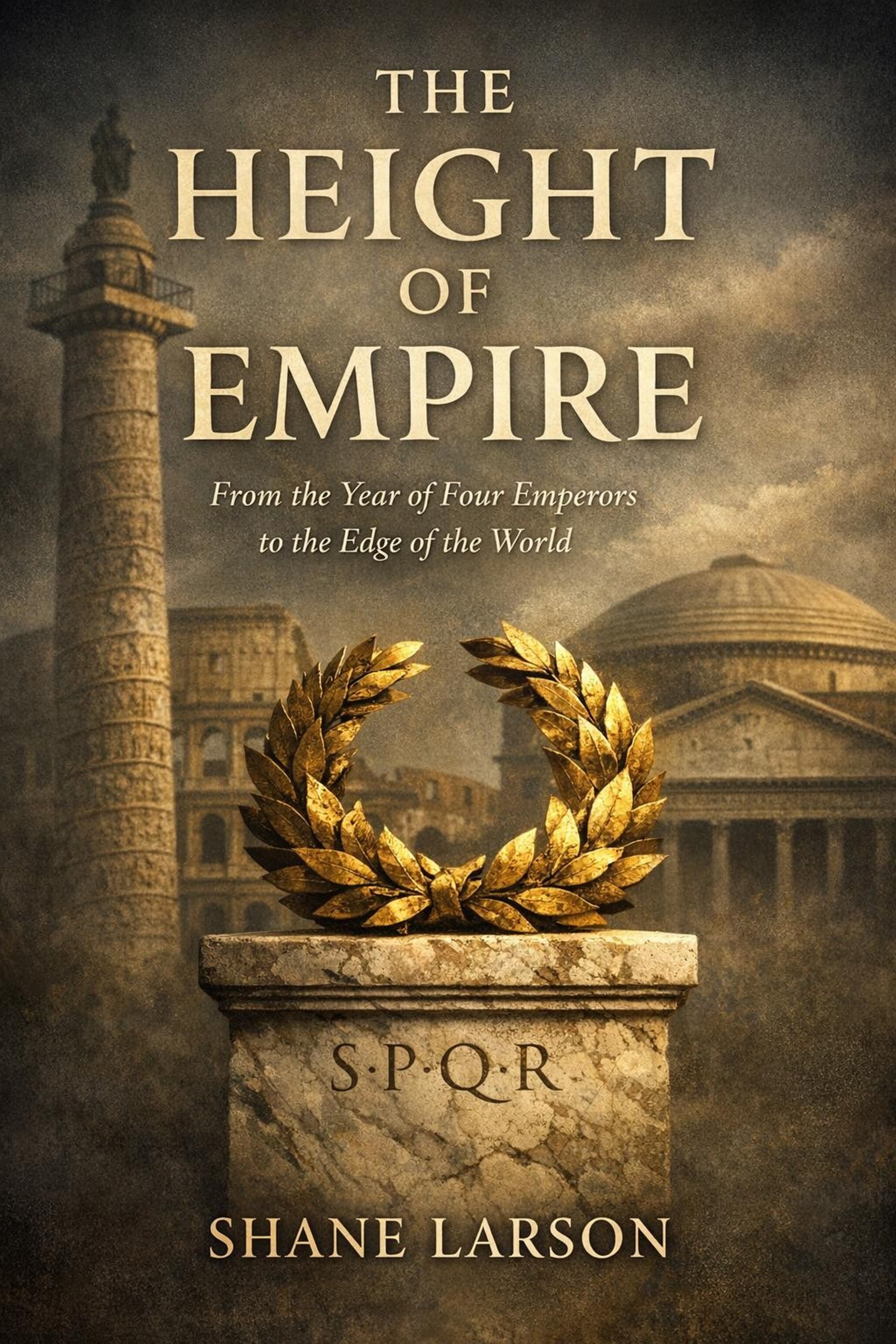
The Height of Empire
From the Year of Four Emperors to the Edge of the World
By Shane Larson · Rome: From Village to Empire (Book 9)
About This Book
Sometime around AD 100, at a fort on the northern edge of the known world, a Roman officer's wife named Claudia Severa dictated a note to her friend Sulpicia Lepidina, inviting her to a birthday party. She added a line at the bottom in her own handwriting — the earliest known Latin written by a woman. The thin wooden tablet was thrown out, preserved in oxygen-starved soil for nineteen centuries, and dug up at Vindolanda, just south of where Hadrian's Wall would rise. In the same trash heaps: a request for warm socks, a unit strength-report listing the sick and absent, complaints about the roads.
A birthday party, on the rim of the empire, planned in writing, delivered by post. That is what the Roman Empire looked like when it worked — so ordinary that its own subjects mistook it for a fact of nature. This book is about the century when it worked best: from the catastrophe of AD 69, when Rome burned its own holiest temple in a civil war that produced four emperors in twelve months, to the death of Marcus Aurelius in 180, when the machine began to turn the other way.
It is the century every image of Rome comes from — the Colosseum, the Pantheon, Trajan's Column, Hadrian's Wall — and almost nobody can connect those monuments into a single story: who built them, in what order, out of what fear or ambition, and why the run of them ended. That story is this book.
The Story
It begins in wreckage. Nero's suicide extinguished the only imperial family Rome had ever known, and the year that followed — the Year of Four Emperors — let out the secret Augustus had spent his life concealing: emperors are made by armies, and armies can be found anywhere. Galba, Otho, and Vitellius each learned the lesson and died of it. The man left standing was Vespasian, a tax farmer's son from the Sabine hills who had been pelted with turnips as a provincial governor and had once fallen asleep during one of Nero's recitals. He balanced the books with taxes on everything up to and including urine, rebuilt the burned Capitol, and raised a fifty-thousand-seat amphitheater on the drained ornamental lake of Nero's private palace — the shrewdest political statement ever made in travertine.
What followed was stranger than recovery. Domitian, the paranoid younger son, governed superbly and terrorized the Senate that wrote his history; his murder in 96 handed the throne to an elderly caretaker with no children and no army. Cornered by his own guard, Nerva reached for the biggest sword available and adopted the governor of Upper Germany as his son and heir. By accident, Rome had found its answer: for eighty-four years, five childless emperors in a row each chose the best available man and adopted him, and supreme power passed from hand to hand without a single murder, coup, or battle. Trajan pushed the frontiers to the Persian Gulf. Hadrian gave the conquests back and walled the empire from the Tyne to the Sahara. Antoninus Pius presided over twenty-three years so calm the sources barely found anything to record.
The book keeps the ledger honest. The same century that built the Pantheon destroyed Jerusalem and its Temple, erased the kingdom of Dacia to fund a forum, and ended Judaea's last war by renaming the province to erase a nation. The golden age was golden from the center. At its edges, the absorption machine that made Spanish provincials into emperors had another face: what it could not absorb, it removed. Both faces belong in the same frame, because Rome never resolved the paradox — and the height of empire turned out to be a height in the exact sense, a place from which every direction is down.
Why I Wrote This
Eight books into this series, I had traced Rome from a hut village to the death of Nero, and I kept noticing that the century everyone pictures when they say "Roman Empire" — the century of the Colosseum and the Wall — was the one stretch nobody I know could actually narrate. We have the monuments memorized and the story lost. What hooked me while writing was how accidental the golden age turns out to be: the famous adoptive succession began as a cornered old man's surrender to the nearest army, worked magnificently for eighty-four years, and evaporated the first time an emperor had a living son. That gap — between the wisdom the era claimed and the luck it ran on — felt like the honest way into the period. And the sources are a gift: an emperor's actual mailbox, soldiers' letters begging for socks, a rebel general's dispatches from a cave. The century speaks for itself. I mostly tried to stay out of its way.
Frequently Asked Questions
Do I need to read the earlier books in the series first?
No. Every volume stands alone. The introduction recaps what the principate was, why it had no succession rule, and how Nero's death opened the crisis of 69 — everything a first-time reader needs.
Is this a biography of the emperors or a history of the period?
Both, deliberately. The narrative runs emperor by emperor because that is how Roman power worked, but the book's real subjects are systems: how the succession was solved and un-solved, how the frontier hardened, how provincials ended up ruling the world. Chapters on the Colosseum, the Jewish wars, and the plague step outside any single reign.
How does the book handle the destruction of Jerusalem and the Bar Kokhba war?
With gravity and without side-taking. These events are sacred history to many readers, and the book treats them as the century's deepest wounds, not as episodes of Roman military color. The sources' atrocity arithmetic is flagged where it is partisan, the archaeology is allowed to speak, and the cost is counted plainly.
Is the Historia Augusta really that unreliable?
Yes — it is the most notorious forgery problem in ancient historiography, a set of imperial lives claiming six authors and written by one, who invents documents and cites historians who never existed. For the emperors after 96 it is also, unavoidably, the only continuous narrative. The book explains the problem up front and then does its checking in the open, against coins, inscriptions, and better sources.
How long is the book?
About 96,000 words — Introduction, seventeen chapters in four parts, a conclusion, and three appendices covering the imperial families, the machinery of the second-century empire, and a source-by-source guide to who wrote about these emperors and how far to trust each one.
If You Liked This, You Might Like
- Marcus Aurelius — the emperor this book hands off to: the full portrait of the philosopher who inherited the golden age just as the luck ran out.
- Pompeii — the disaster that struck two months into Titus's reign, and the fullest surviving snapshot of daily life in the world this century built.
- Nero — the reign whose collapse opens this book: how the last Julio-Claudian fell, and why the year 69 happened.
- The Founding of Rome — where the series and the city begin: the asylum on the Capitoline whose logic, this book argues, was still running a thousand years later.
From the ashes of the Capitol to the plague on the Danube roads — the century Rome ran best, told whole, with the bill included. Book Nine of Rome: From Village to Empire.
What You'll Learn
- The Year of Four Emperors, hour by hour — Galba's fatal economy, Otho's redeeming suicide, two battles at the same crossroads town, and the night the Temple of Jupiter burned with Romans fighting Romans on the Capitol
- The siege of Jerusalem and the war that made the Flavians — told with gravity from Josephus, the rebel commander who surrendered and wrote the war from inside the victor's camp
- A full chapter inside the Colosseum — the engineering, the crowd-flow mathematics, the economics of the gladiatorial schools, and what actually happened on the sand
- Domitian reconsidered — murdered by his own household and erased from the stones, though even his enemies conceded his administration was among the century's best
- The adoption gamble — how a hostage emperor's capitulation in AD 97 became the succession system that gave Rome its five good emperors, and why it quietly died the moment an emperor finally had a son
- The Dacian Wars, read frame by frame up Trajan's Column — including the Roman trooper whose tombstone, found in 1965, records the moment he reached the fleeing King Decebalus
- Trajan at the Persian Gulf — the empire at maximum extent, and the old man watching a merchant ship leave for India, wishing he were younger
- Hadrian entire — the disputed accession, the strategic retreat, the Wall, the Pantheon's impossible dome, and Antinous, the drowned boy whose grief-cult filled the empire with statues
- Bar Kokhba's letters from the Judaean caves — Judaea's last war reconstructed from the rebel leader's own dispatches
- The plague on the roads — how the Antonine pandemic turned the empire's connectivity into its vulnerability, just as the Danube frontier gave way
Included with Kindle Unlimited — read it free if you're a member.
New Ancient History releases and free chapters — no spam, unsubscribe anytime.
More in Rome: From Village to Empire
View series →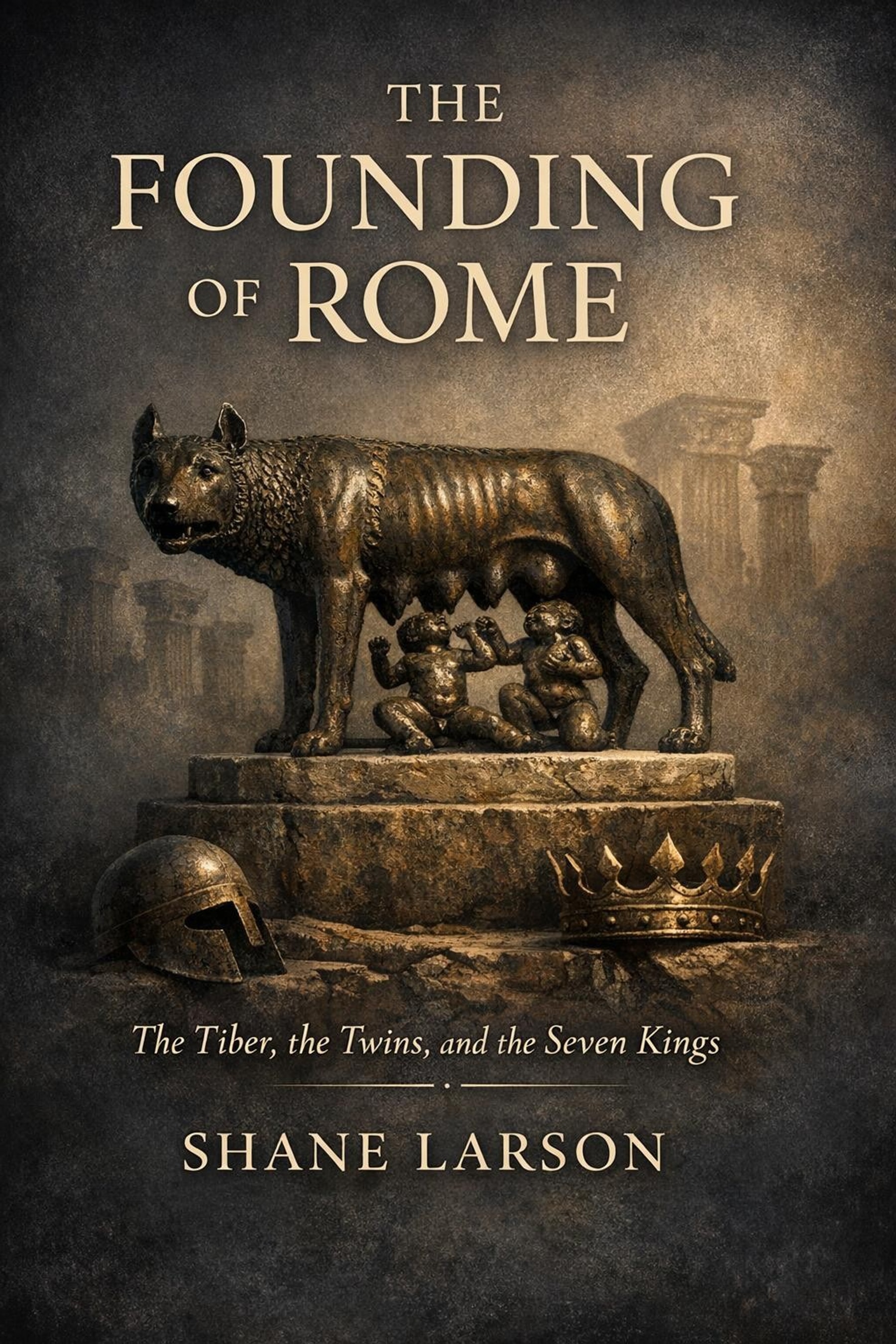
More in This Genre
View all →