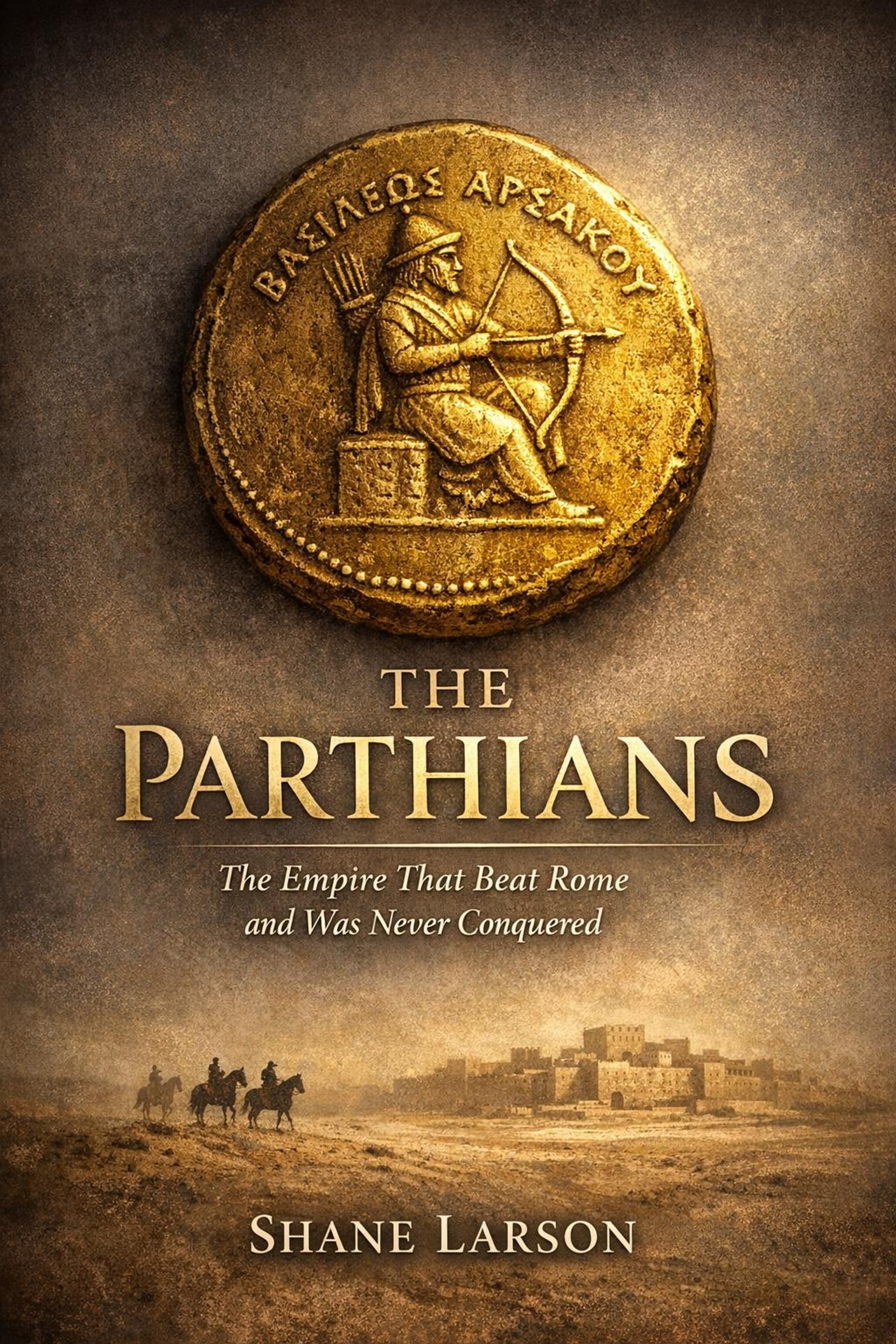
The Parthians
The Empire That Beat Rome and Was Never Conquered
By Shane Larson
About This Book
In AD 217, the emperor of Rome counted out an enormous indemnity to a Parthian king at Nisibis — payment for permission to take his army home. Fifty-three years earlier, Roman legions had sacked Ctesiphon, the Parthian capital. Twenty years earlier they had sacked it again. Rome had invaded this empire five times across four centuries. And at the end of it all stood a Roman emperor buying peace from the dynasty Rome had supposedly humbled, at a price the Roman sources record with embarrassment.
That transaction fairly summarises the longest great-power rivalry in ancient history. For roughly three hundred years the world between the Atlantic and India was divided between two empires. The western one fills entire walls of every bookshop. The eastern one — the empire of the Arsacid kings, which the Romans called Parthia — barely gets a spine. Yet Parthia inflicted on Rome one of the worst defeats in its history, absorbed invasion after invasion, outlasted the Roman Republic entirely, and was never conquered. When it finally fell, in AD 224, no Roman army was anywhere near. It was killed from the inside, by a rebellious vassal from Fars.
This book tells that story with the Parthians as protagonists rather than scenery.
The way in is a single day in 53 BC, near Carrhae in northern Mesopotamia, where a Roman invasion force of some forty thousand men met a Parthian army a quarter its size that contained no infantry at all. Horse archers who refused to close, volleys that never stopped because a camel train carried spare arrows, armoured cataphracts held back for the moment the legions bunched — by nightfall the Roman army had effectively ceased to exist. That was not luck. It was a doctrine engineered against exactly the army it faced, and it kept working for centuries.
But the battle only opens the door. Behind it stands something stranger than the "weaker Persia" the Parthians are usually filed under: a federation rather than an empire, ruled through great noble houses — Suren, Karen, Mihran — who kept private armies, held hereditary offices, and claimed the right to crown the king of kings. That one structural fact explains the empire's astonishing resilience, its chronic civil wars, and its eventual death from within. So does the identity puzzle at its centre: a steppe-descended dynasty that struck its coins with Greek legends for centuries, styled itself Philhellene, and ruled Babylonians, Greeks, Jews, and the peoples of the Iranian plateau by the simple expedient of not asking too many questions.
There is also a mystery to solve, and the book gives it a chapter of its own: the Parthians left no narrative history of themselves — as far as anyone can tell, none was ever written. Their successors spent four centuries deliberately erasing them, and their enemies wrote the only surviving account. What remains is an empire reconstructed from the outside in: tens of thousands of coins, wine-delivery receipts from a royal estate at Nisa, a garrison payroll from Dura-Europos, the astronomical diaries of Babylon, and the cool reports of Han dynasty envoys with no stake in any Roman argument. Where the evidence is thin, the book says so and shows its working.
Why I Wrote This
Somewhere around my fifteenth book on Rome, I noticed that the same enemy was standing at the eastern edge of every one of them. Crassus dies fighting it. Antony ruins himself against it. Augustus builds his reputation on a negotiation with it. Trajan, Lucius Verus, Septimius Severus — all march east, and the frontier always ends up roughly where it began. An empire that beat Rome repeatedly, over four centuries, and was never conquered — and it has no book of its own. When I went looking for one to read, I couldn't find one written for a general reader. The reason turned out to be part of the story: the Parthians never wrote their own history, their successors spent four hundred years erasing what record there was, and their enemies wrote the only account that survives. An empire remembered exclusively by the people it defeated seemed worth a book.
Frequently Asked Questions
Did the Roman Empire ever conquer Parthia?
No. Rome invaded in earnest five times and took the Parthian capital three times. None of it held: the only lasting gain in four centuries was the northern province of Mesopotamia, annexed in the empire's final decades. Parthia fell in AD 224 to an internal revolt led by Ardashir of Persis, with no Roman army involved.
What actually happened at the Battle of Carrhae?
Crassus led about forty thousand men into open country, where a Parthian force of roughly ten thousand — all cavalry — met him. The horse archers refused close combat and never ran out of arrows, because a camel train carried resupply; a breakout led by Crassus's son was destroyed by armoured cataphracts. Around twenty thousand Romans died, ten thousand were captured, the eagle standards were lost, and Crassus was killed at a parley during the retreat.
Why is there so little written about the Parthians?
Two separate erasures. The Parthians wrote no narrative history of their own, so no account survives from inside the empire. Then the Sasanian dynasty that overthrew them spent four centuries writing the Arsacids down into a garbled list of names. Everything else comes from Greek and Roman authors describing an enemy; modern knowledge is rebuilt from coins, potsherds, a garrison payroll, and Babylonian temple records.
Do I need to know Roman history first?
No. Every Roman figure who matters is introduced on the page with the context you need. If you already read Roman history, the book works as a deliberate reversal: campaigns you know from behind the Roman lines, retold from the other side of the field.
Is this a military history or a history of the whole empire?
The whole empire, with the military system given the serious treatment it earns. A full chapter covers the cavalry doctrine and the campaigns run through the second half — but the noble houses, the court culture, the sources, and the caravan trade each get chapters of their own.
If You Liked This, You Might Like
- The Persian Empire — The Achaemenid world the Arsacids inherited and claimed descent from; the natural first half of this story.
- Mithradates — Rome's other great eastern adversary, fighting in the same generation that ended at Carrhae.
- Julius Caesar — The third member of Crassus's triumvirate, whose own planned Parthian war was cancelled by the Ides of March.
- Marcus Aurelius — The reign shaped by the plague a victorious Roman army carried home from Parthia.
Two empires shared the ancient world for three hundred years, and only one of them has ever told you the story. This is the other one's, told from its own side of the river.
What You'll Learn
- Carrhae reconstructed from the Parthian side of the field — Surena's masterpiece rather than Crassus's catastrophe, from the decision to leave the Euphrates to the severed head used as a stage property at a royal wedding.
- The combined-arms doctrine that solved the legion: how a composite bow is built, why the Parthian shot was a habit rather than a trick, and why an enemy who refuses contact defeats every answer heavy infantry has.
- The great houses and the federated state — why Parthia could lose its capital three times and not fall, and why it could never sustain an offensive war.
- Antony's invasion of 36 BC, lost in a single decision about a siege train — and Augustus's negotiated recovery of the lost eagles, inflated into the most successful propaganda campaign in Roman history.
- Armenia, the buffer kingdom neither empire could hold, and the day a Parthian prince was crowned in the Forum at Rome by Nero.
- The Silk Road state: caravan cities, tariff stations, and the Han envoy who reached the Persian Gulf in AD 97 and was talked out of going further.
- Ardashir, the last battle at Hormozdgan, and the four-century campaign of erasure that explains why this book had to be reconstructed from potsherds.
- Three appendices: a working Arsacid king list, an anatomy of a Parthian army, and a campaign-by-campaign war ledger from 53 BC to AD 224.
New Ancient History releases and free chapters — no spam, unsubscribe anytime.