The Gears of Heaven
The Antikythera Shipwreck and the Lost Science of the Greeks
By Shane Larson
About This Book
In 2008 a team of researchers reading X-ray slices of a corroded bronze fragment found a word engraved on a small dial at the back of the machine: the name of Olympia. Around it, in four sections, were the other great festivals of the Greek world — Nemea, Isthmia, Delphi — and smaller local games that only a particular part of Greece would have cared about. Someone, more than two thousand years ago, had built an astronomical instrument precise enough to predict eclipses, and then given it a dial for knowing when the athletes would gather.
That detail changes the question. A machine with a sports calendar on the back was not a philosopher's toy or a one-off curiosity. It was built for a user — someone who wanted to know where the moon would be, when the next eclipse was due, and which games were coming round this year. And nothing like it survives for a thousand years afterwards.
A Wreck, a Machine, and a Missing Millennium
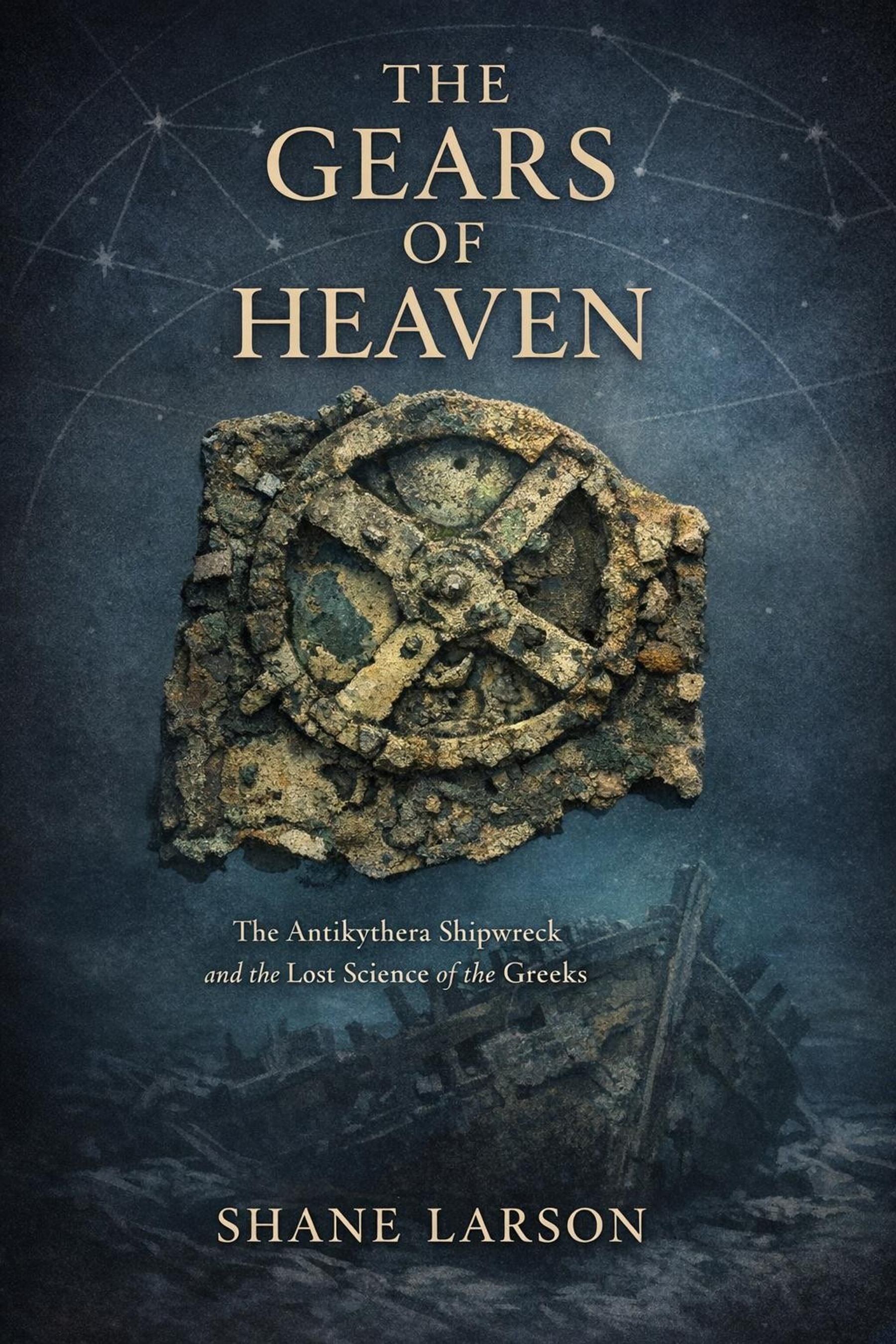
The object came out of the sea in 1901, as one item in the cargo of a ship that sank off the island of Antikythera in the first century BC. The sponge divers who found the wreck were sheltering from a storm, and they spent the following year raising bronze and marble statues from more than fifty metres down, in canvas suits and copper helmets, before anyone understood what deep water does to a diver's body. The gearwheel was noticed only after a lump of corroded bronze split open in the museum in Athens.
The Gears of Heaven: The Antikythera Shipwreck and the Lost Science of the Greeks tells three stories that usually get told separately. The first is the wreck itself — the first underwater excavation in history, the ship's luxury cargo, Cousteau's return, and the modern dives that are still bringing up finds. The second is the century-long effort to read the machine, from the first guesses through gamma-ray photographs, tomography and the 2005 CT survey, with each generation of researchers seeing a different object and each getting part of it right. The third is the science that made it possible: Babylonian astronomical cycles recorded on clay over centuries, carried into Greek hands after Alexander, and cut into bronze teeth.
Throughout, the book keeps a running distinction that popular accounts rarely make: what is actually on the fragments, what the scans show, what is inferred from counting teeth, and what is modern reconstruction. The famous planetary display on the front, for instance, is mostly reconstruction. The eclipse dial is not.
Why I Wrote This
I have written a run of books about knowledge the ancient world gained and then lost — the Library of Alexandria, Hypatia, the translators of Baghdad who saved what they could. Most of that story has to be told from texts, because the instruments themselves are gone. The Antikythera mechanism is the exception: a physical piece of Greek technical skill, recovered by accident, that proves the texts were not exaggerating.
What hooked me was how easy it is to tell this story badly in both directions. Call it an ancient computer and you overstate it; call it a curiosity and you miss what it implies about everything that was melted down or lost. I wanted a version that kept the evidence and the reconstruction clearly apart, and gave the wreck and the Babylonian astronomy the attention they usually don't get.
Frequently Asked Questions
Was the Antikythera mechanism really an ancient computer?
Not in the modern sense. It is a hand-cranked mechanical calculator that models astronomical cycles through fixed gear ratios; it could not be programmed, and its predictions carried the errors of the Greek astronomy it was built on. It is still the most complex machine to survive from the ancient world by a wide margin, and the book explains why that is impressive enough without the label.
Who built the Antikythera mechanism?
Nobody knows. The calendar on the back uses month names from Corinth or one of its colonies, which points some scholars toward Syracuse or north-western Greece, while others argue for Rhodes, home of the astronomer Hipparchus's tradition. The book sets out each case and the evidence behind it rather than picking a winner.
How old is the Antikythera mechanism?
The ship sank around 70 to 60 BC, so the machine is at least that old. Its letterforms and its eclipse calendar suggest it was designed in the second century BC or close to it, and researchers have proposed starting dates for its calendar as early as 205 BC and as late as 178 BC.
Does the book cover the shipwreck as well as the device?
Yes — about a third of the book is the wreck: the 1900–01 excavation, the cargo and passengers, Jacques Cousteau's return, and the modern project that has been diving the site since 2012.
Do I need a science or maths background to follow it?
No. Gearing and ratios are explained once, in plain English, early in the book, and everything after builds on that explanation. The astronomy is introduced the same way, through what the ancient observers could actually see.
If You Liked This, You Might Like
- The Library of Alexandria — the scholarly world that produced engineers like Ctesibius and Hero, and how its knowledge slowly slipped away.
- Hypatia of Alexandria — the last generation of Greek astronomy and instrument-making in its original home.
- The House of Wisdom — where the Greek astronomical tradition went next, and the Baghdad scholars who carried it forward.
- The Ancient World's Greatest Engineers — the wider sweep of ancient building and machinery, from the pyramids to Roman concrete.
One machine survived because a ship sank in the wrong place. This is the story of the wreck that kept it, the century spent reading it, and the vanished workshops it speaks for.
What You'll Learn
- **The sponge divers of Symi** — how a storm, a diving crew and a government ministry produced the first archaeological excavation ever carried out underwater, and the price the divers paid for it.
- **The ship and its passengers** — dating the wreck from its coins and pottery, where its cargo of Greek art was probably heading, and the human remains recovered from the site.
- **A plain-English guide to the gears** — how a train of toothed wheels turns one rhythm into another, explained once and clearly enough that no mathematics is needed for the rest of the book.
- **Five generations of decipherers** — and the honest record of what each got right, what each got wrong, and how the arguments between research groups are documented.
- **The moon that speeds up** — the small pin-and-slot device that models the moon's changing pace across the sky, and its link to the astronomy of Hipparchus.
- **Babylon in Greek bronze** — the eclipse cycle and calendar cycles the machine runs on were Mesopotamian discoveries, centuries in the making.
- **Where and when it was made** — Rhodes, Syracuse or somewhere in north-western Greece, and the competing dates for the start of its calendar, laid out with the evidence for each.
- **Archimedes' sphere** — the geared models of the heavens that ancient writers described, and why historians long dismissed those descriptions as exaggeration.
- **The thousand-year gap** — the Byzantine geared sundial, al-Biruni's geared calendar, and the medieval astronomical clocks, and the open question of whether any thread connects them.
New Ancient History releases and free chapters — no spam, unsubscribe anytime.