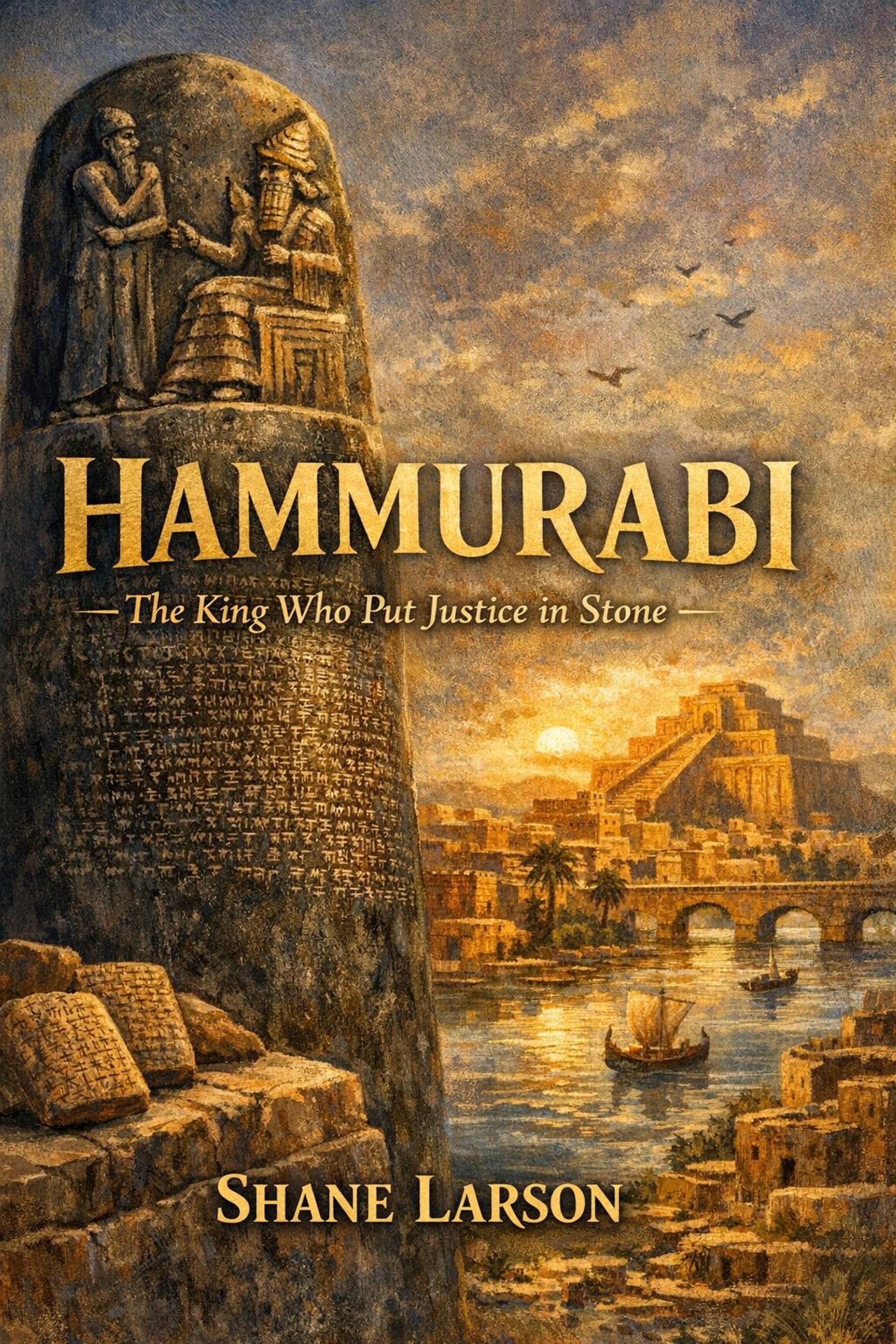
Hammurabi
The King Who Put Justice in Stone
By Shane Larson
About This Book
If a man rents a field and does not grow anything on it, he owes the owner grain measured against what the neighboring fields produced. If a surgeon opens a swelling over a man's eye with a bronze lancet and saves the eye, his fee is ten shekels of silver. If a merchant ship under way strikes a moored ferryboat and sinks it, the merchant pays for the boat and everything that was in it. If a man borrows barley in the spring and the storm flattens the crop or the canal fails, he washes the debt-tablet in water that year and owes nothing.
These are provisions of the Code of Hammurabi. There are roughly 282 of them, and almost nobody has read past one.
The line everyone knows is about an eye. It gets quoted to prove that the ancient world was crude and vengeful, and it is genuinely there — but the provision immediately after it says that if the eye belonged to a commoner, you pay a mina of silver instead, and the one after that says if the eye belonged to somebody's slave, you pay the owner half that person's market value.
The famous line scales by the rank of the victim. The Code says so plainly, in sequence, and the slogan hides it. That is the single most clarifying fact about this document, and it is more interesting than the caricature it replaces: this was a society that wrote its own stratification into statute rather than leaving it unspoken.
The King Who Waited Thirty Years
The man behind it is also better than his reputation, which is mostly that of a name on a stele.
Hammurabi inherited a modest kingdom in a crowded neighborhood around 1792 BC. Larsa, Eshnunna, Assur, Mari and Elam were all stronger than Babylon or comparable to it, and nobody watching would have picked him. For roughly the first thirty years of his reign he mostly dug. The year-names — Mesopotamian years were named for the notable event in them, which leaves us a year-by-year list of what a king thought worth commemorating — record canals, city walls, temple restorations, and the manufacture of divine statues. In an irrigation economy, the man who controls the water controls the harvest, and a canal is a weapon that also feeds people.
Then, in the last third of the reign, he moved. Larsa fell after a long siege. Eshnunna, and the pressure from Elam. And then Mari — his ally of fifteen years, taken and, two years later, its palace razed.
That destruction is why we can write about him as a person at all. The palace archive was buried in the rubble: more than twenty thousand tablets, including the working correspondence of a Bronze Age foreign policy — intelligence reports, troop counts, assessments of rival kings, complaints about allies. It is Mari's archive rather than Babylon's, so we largely see Hammurabi through other people's eyes, which is its own kind of useful.
What the Book Does
It runs the two stories against each other. The conquest gives it momentum; the Code gives it substance. And then it does the thing most books on this subject don't: it tests the Code against how Babylonians actually lived and litigated.
Thousands of contracts, court records, loan tablets and letters survive from this period. Sometimes they match what the stele says. Often they do very much not. Interest rates in the contracts do not match the Code's. No surviving record shows anyone released under the three-year debt-bondage limit. Marriage contracts write their own penalty clauses rather than relying on the ones carved in stone. And most striking of all: across many thousands of surviving Old Babylonian legal documents, essentially none of them cites the Code.
So the book asks the question the Code invites — working statute, royal advertisement, or monument to an ideal? — and holds it genuinely open until late, when the evidence is all on the table.
Why I Wrote This
I went looking for the Code once, expecting to skim a list of gruesome punishments, and found instead a document about wet-nurses and boat collisions and what happens to a woman's dowry if her husband dies. It reads like the paperwork of a functioning society, because that is what it is trying to be.
Then I read the eye provisions in order and understood that the line everybody quotes is the first of three, and that the other two are the point. That reframed the whole thing for me. The Code is not a monument to primitive vengeance. It is a monument to a society that had thought carefully about harm and had decided, explicitly and in writing, that a person's worth depended on their rank.
The other thing that kept me going is the gap. We have the statute and we have thousands of ordinary legal documents from the same century — which almost never happens in the ancient world — and they do not agree. Being able to hold a law up against the life it was supposed to govern is a rare privilege, and it turns a famous artifact into an actual argument.
Frequently Asked Questions
Do I need to know anything about Mesopotamia first?
No. The neighborhood, the kingdoms, the gods and the vocabulary are all explained where they first matter. If you have read other books on Sumer, Akkad or Assyria the map will already be familiar, but nothing is assumed.
Is this a book about the city of Babylon?
No — and deliberately not. Babylon appears here as Hammurabi's capital in the eighteenth century BC: its position, its canals, its temples, its modest place among rivals. The city's later and much longer history is a separate subject and a separate book.
Does the book quote the Code, or just describe it?
Quotes it, at length, from the public-domain translations of L. W. King (1915) and Robert Francis Harper (1904), with the translator named. That was a deliberate choice: the search results for this subject are dominated by bare text editions on one side and scholarly analysis on the other, and a reader deserves both the provision and the explanation in the same paragraph.
Does it decide whether the Code was actually used as law?
It argues the question properly and then gives an honest answer, which is more nuanced than either available slogan. The strongest single piece of evidence — that essentially no surviving legal document cites it — gets its full weight rather than a footnote.
How does it handle slavery?
Plainly and factually. Slavery and debt-bondage are everywhere in this material — in the third rank, in the pledging of children against a loan, in the compensation paid to an owner for an injured slave. The book states what the provisions say without euphemism and without editorializing.
How long is it?
Around 75,000 words: an introduction, thirteen chapters in four parts, a conclusion, and three appendices — the Code grouped by subject so you can see its real proportions, a full treatment of the three ranks with a worked example, and a Mesopotamian timeline. The paperback runs 245 pages.
If You Liked This, You Might Like
- Babylon — The city, across its whole life. This book is the eighteenth-century-BC king who made it matter; that one is what the place became.
- Sargon — The first Mesopotamian empire, four centuries earlier, and the template Hammurabi was working from whether he knew it or not.
- Gilgamesh — The literature of the same world. Read alongside the Code, it shows you what these people wrote down when they were not writing law.
- Assyria — What came next in the north. Hammurabi pulled Assur into Babylon's orbit; a thousand years later it returned the favor with interest.
What You'll Learn
- **The provisions themselves, quoted at length.** This subject has an advantage most ancient history lacks: the Code exists in solid public-domain English, so you get to read the actual clauses rather than be told about them.
- **Thirty years of canals**, and why patience was the strategy rather than the absence of one.
- **The Mari letters**, and what a king's foreign policy looks like in something close to real time.
- **The prologue and epilogue** — the least-read and most revealing parts of the monument, including the claim that a wronged man may come before the stone and have the writing read aloud to him.
- **The three ranks** — *awilum*, *mushkenum*, *wardum* — what each meant, where scholars genuinely disagree, and how the same injury is priced three different ways.
- **Women under the Code and in the contracts**, including the *naditum* priestesses of Sippar, who held property, lent silver at interest and did business in their own names, and whose archives survive in quantity.
- **Debt**, which was the central social pressure of the age: how people fell into it, what pledging a family member meant, and the *mesharum* edicts by which kings periodically cancelled debts outright — an economy that had to be forcibly reset because it reliably ground people into bondage.
- **Surgeons, builders, boatmen and brewers**, and the world's first comprehensive statement of professional liability.
- **Land, water and the *ilkum***: how a king fielded an army in a world with no coinage, by giving out fields in exchange for service.
- **In the courtroom** — witnesses, sealed tablets, the oath before the god, and the river ordeal — reconstructed from surviving verdicts.
- **What happened after**: his son lost most of the empire within a generation, an Elamite king carried the stele off to Susa as loot, and that theft is the reason it survived.
Included with Kindle Unlimited — read it free if you're a member.
New Ancient History releases and free chapters — no spam, unsubscribe anytime.