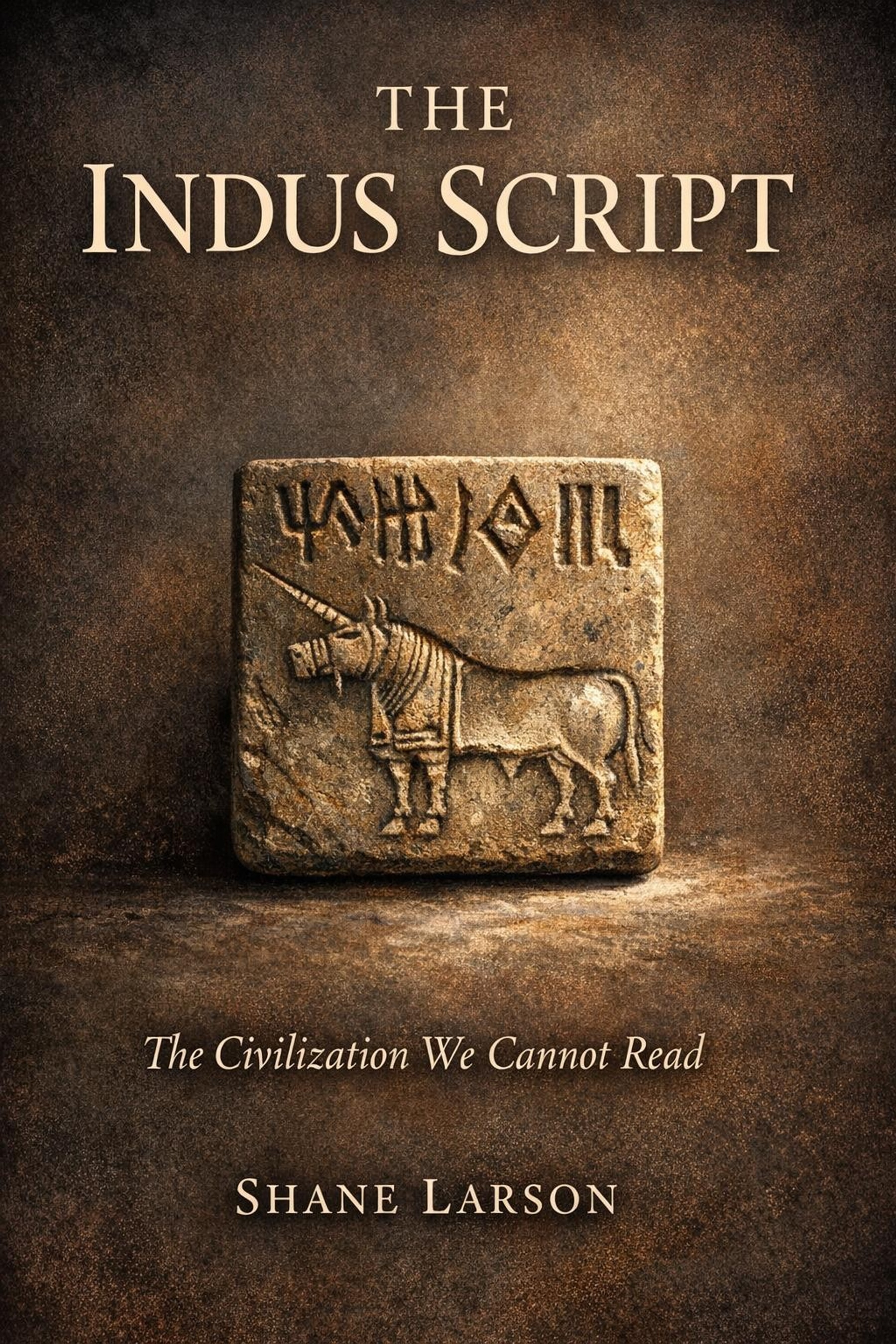
The Indus Script
The Civilization We Cannot Read
By Shane Larson
About This Book
In the 1850s, contractors laying the Lahore–Multan railway across the Punjab needed ballast for the track bed. Near a village called Harappa they found an enormous mound of ancient baked brick — millions of bricks, from a city no one could name. They quarried it. For a hundred miles, trains in Pakistan still run on the crushed remains of one of the oldest cities on earth.
Alexander Cunningham, the founder of Indian archaeology, visited while the demolition was underway. Among the debris he collected a small square of polished stone carved with a bull that matched no known art and a line of signs that matched no known script. He published it, guessed wrong, and filed it away. Seals like it trickled into museum collections for sixty years — until excavations in the 1920s revealed that Harappa and Mohenjo-daro, two hundred and fifty miles apart, were cities of the same forgotten civilization, older than anyone had imagined and vaster than Egypt and Sumer combined.
The first claimed readings appeared within months of the announcement. That was a century ago. The signs on Cunningham's seal have still never been read.
The Argument
Every famous decipherment came through a door. Egyptian hieroglyphs had the Rosetta Stone. Linear B had thousands of long clay tablets — enough raw material for Alice Kober's hand-built grammatical grids and Michael Ventris's leap to Greek. The Maya glyphs had a living descendant language still spoken around the ruins. The Indus script has none of these. There is no bilingual object anywhere. The language behind the signs has never been identified. The script died without descendants. And the texts are crushingly short — most fit on a postage stamp, and the entire surviving corpus adds up to roughly the word count of a newspaper article, scattered across four thousand separate scraps of stone, copper, and pottery.
This book treats the resulting century of failure as a case file. It sets out the standard any real decipherment must meet, then walks each major attempt up to that bar: the fifty-year Dravidian program and its famous fish-sign reading; the Sanskrit claim, with its chronology problem, its notorious doctored "horse seal," and the ancient DNA from Rakhigarhi that now shadows the whole debate; the Soviet and Finnish computer projects of the 1960s and the conditional-entropy fight that followed; and the machine-learning work happening right now. None of them clears the bar. The book shows you exactly where each one falls.
Then it takes seriously the possibility that there is no bar to clear. Respected scholars argue that these sign sequences are too short, too repetitive, and too strange to encode language at all — that the seals may carry emblems, ownership marks, or clan badges, closer to a coat of arms than a sentence. If they are right, the Indus script is not an unsolved puzzle. It is not a puzzle. The rebuttals are formidable, and the question is genuinely open.
Behind the script stands a civilization stranger than its signs. Cities planned on grids, plumbing centuries ahead of anything in Egypt, a weight system so uniform that a merchant in Gujarat and a merchant in the Punjab balanced the same scales — and no palaces, no royal tombs, no monuments to any ruler, and almost no weapons. Something coordinated a territory larger than Western Europe, and we cannot see what it was. The only outsiders who wrote about these people, the Mesopotamians, knew them as a distant land called Meluhha — and never recorded a single word of their language.
Why I Wrote This
I came to this subject through Linear B — through Alice Kober filling cigarette cartons with hand-cut index cards, building the grids that let Ventris hear Greek in a script nobody could read. It is the best detective story in scholarship, and I wanted the case where the same method met a wall. The Indus script is that wall. Here is a civilization whose cities we can measure to the centimeter — the drains, the wells, the weights — and whose voice is completely gone. We know how these people built and traded and washed, and we do not know one thing they said. That gap seemed to me the most honest place in ancient history: the point where you can watch brilliant people fail for a hundred years and learn more from the failing than from any tidy answer.
Frequently Asked Questions
Has the Indus script ever been deciphered?
No. Dozens of decipherments have been claimed since the 1920s, and not one has been accepted, because none has produced a reading that works on inscriptions it wasn't built from. Appendix B is a scorecard of every major attempt and the specific reason each one fails.
Is the Indus script even writing?
Genuinely unknown. A serious scholarly position holds that the sign sequences are too short and too limited to encode language, and are better understood as emblems or ownership marks. The counterarguments — especially the rigid sign ordering maintained across a vast area for seven centuries — are equally serious, and the book presents both cases without pretending to settle what the field has not.
What language did the Indus people speak?
Nobody knows, and that is a large part of why the script resists. Dravidian is the most developed hypothesis; the Indo-Aryan alternative faces a hard chronology problem. Both remain unproven, and the book shows exactly what evidence would move either from plausible to demonstrated.
Do I need to read The Indus Valley Civilization first?
No. That book is the full history of the Harappan world; this one is the file on its central unsolved problem. Each stands alone, and they can be read in either order.
Does this book propose its own decipherment?
No — deliberately. Its position is that the evidence cannot support any reading, and that claiming one anyway is how the field got its shelf of failures. What it gives you instead is a practical checklist for testing the next claimed breakthrough you see in a headline.
How long is the book?
Around 75,000 words — fifteen chapters plus an introduction, conclusion, and three appendices, roughly 250 pages in print.
If You Liked This, You Might Like
- The Indus Valley Civilization — the companion volume: the full story of the cities, the trade, and the disappearance, for readers who want the civilization whole rather than through the lens of its script.
- Twilight of the Ziggurats — the literate neighbour: the Sumerians traded with the Indus world, wrote everything down, and are the reason we know Meluhha's name but not its own.
- Doggerland — another vanished world rebuilt entirely from physical evidence, where the sea keeps the archive and no one left a written line.
A hundred years in, the case is still open. This book hands you the complete file — evidence, suspects, failed solutions — and an honest account of what it would take to close it.
What You'll Learn
- **The missing kings.** Why the largest civilization of its age shows no palaces, royal tombs, or ruler portraits — and every serious model for what governed it instead.
- **Meluhha.** The Indus world as Mesopotamia saw it: the sea trade, the carnelian and copper, and the Meluhhan interpreter mentioned in a cuneiform record — the most tantalizing figure in the entire field.
- **The corpus, measured honestly.** What four thousand inscriptions amount to when the average is five signs, the longest seventeen, and even the sign count is disputed between catalogues.
- **The rules of the game.** What actually cracked hieroglyphs, Linear B, and the Maya glyphs — and why every one of those keys is missing here.
- **The fish sign, step by step.** The most celebrated proposed reading in Indus studies, walked through completely so you can judge whether the method proves anything.
- **The DNA and the politics.** What the Rakhigarhi genome does and does not establish, and why an unreadable script attracts nationalist claims from every direction.
- **The heraldry hypothesis.** The full strength of the case that the signs are not writing at all — and the full strength of the reply.
- **What the signs can still say.** Everything recoverable without reading a word: where seals were used, which signs cluster where, and what the system was probably *for*.
Included with Kindle Unlimited — read it free if you're a member.
New Ancient History releases and free chapters — no spam, unsubscribe anytime.
More in This Genre
View all →