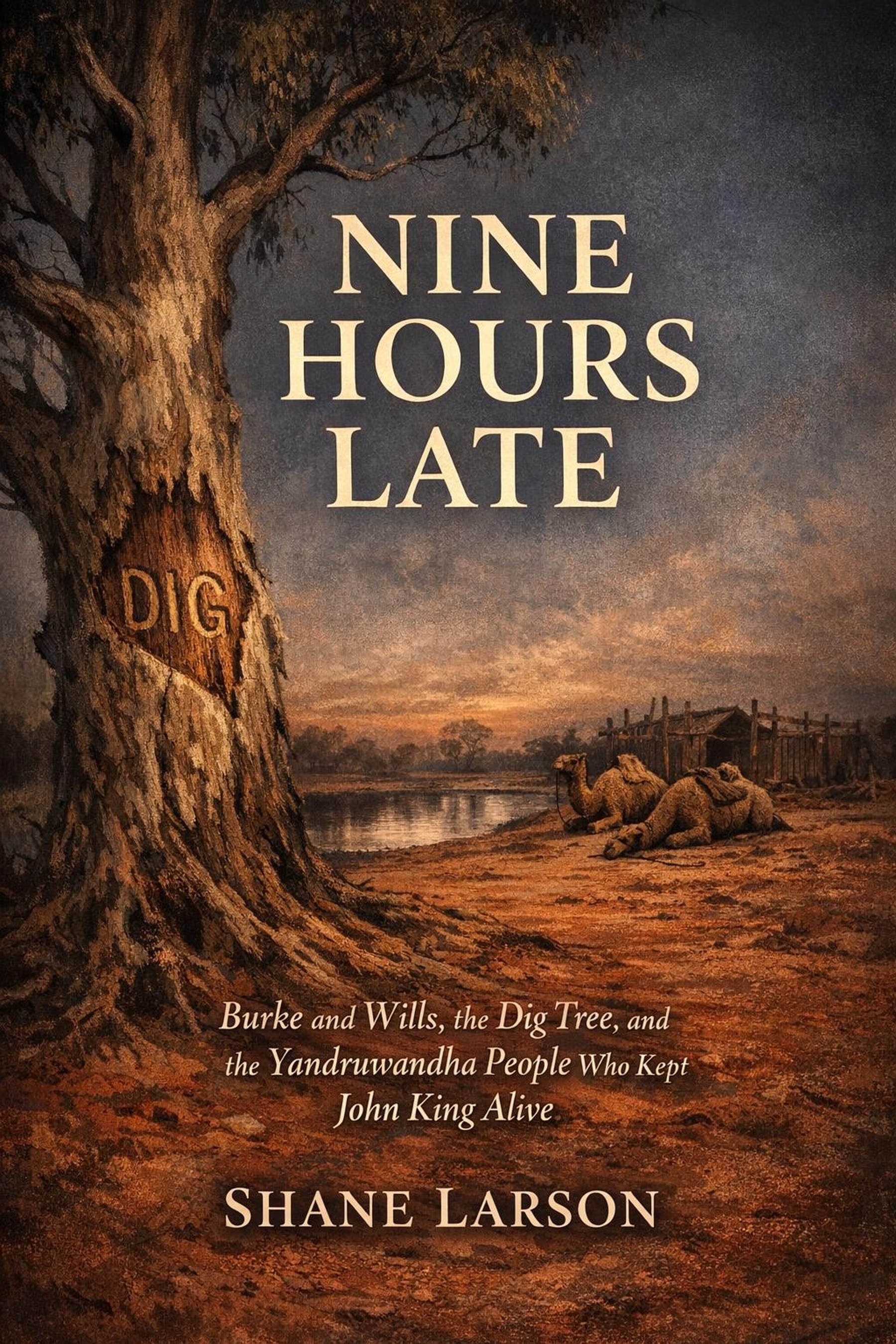
Nine Hours Late
Burke and Wills, the Dig Tree, and the Yandruwandha People Who Kept John King Alive
By Shane Larson
About This Book
On the morning of 8 May 1861 two men rode up to a stockade of saplings on Cooper Creek, deep in the Australian interior. William Brahe had left this camp seventeen days earlier after waiting more than four months for his leader to come back from the north. William Wright had spent the summer failing to reach it with the expedition's supplies. They had come to check, one last time, whether anybody had been there.
They looked at the ground over the buried cache. It was smooth. They looked at the coolibah tree where Brahe had cut the word DIG. Nothing had been added to it. They saw the ashes of fires and took them for the fires of the Yandruwandha people who lived on the creek. They stayed about a quarter of an hour, did not dig, and rode away.
Robert O'Hara Burke, William John Wills and John King were then a day or two's ride down the creek, alive, and out of food. They had been to the cache. They had taken what was in it, left a letter in its place, and raked the ground smooth again so that nobody would know it had been touched.
The Story
The Victorian Exploring Expedition left Melbourne on 20 August 1860 before a crowd of about fifteen thousand. It had nineteen men, camels brought from India with their handlers, six wagons and some twenty tons of stores. Its leader, Burke, was a police superintendent from the goldfields who had never led an exploring party and kept no journal. Its surveyor, Wills, was twenty-six and wrote everything down.
By the time the expedition reached the Darling River it had lost its second-in-command, most of its wagons and two months. Burke split it there, hurried ahead to Cooper Creek with eight men, and split it again: he and three others would walk to the Gulf of Carpentaria and back, about fifteen hundred miles, while Brahe held the depot and Wright brought up the stores. Nothing was put in writing.
Burke, Wills, King and Charles Gray reached tidal salt water in February 1861 and turned around with a third of their food left. Gray died on the way back. The other three reached the depot on the evening of 21 April. Brahe had left that morning.
What followed took ten weeks. The three tried for a police outpost at a place called Mount Hopeless and could not reach it. The Yandruwandha gave them fish and cakes of ground nardoo seed, and for a while that kept them going. Then, by King's account, Burke fired his revolver over a man's head, and the Yandruwandha moved their camp. Burke and Wills died at the end of June. King walked until he found the Yandruwandha again, and they took him in.
Why I Wrote This
I knew the outline before I knew anything else: explorers, a desert, a tree with a word on it, a camp missed by hours. It reads as a story about bad luck, and that is how it was told for a hundred years.
Then I read what Wills wrote on 3 June 1861. He describes being called over to a camp, sat down and fed fish and seed cakes until he could not eat any more. He is dying of hunger in a place where his hosts have food to spare, and he is honest enough to record it. That entry changed the book I wanted to write. The interesting question stopped being why Brahe left and became why three men with a creek full of fish beside them could not live there, when several hundred people plainly could.
I have tried to answer it without making anyone a fool or a saint, and without putting thoughts in the heads of people who left no written account of their own.
Frequently Asked Questions
How late were Burke and Wills getting back to the Dig Tree?
About nine hours. Brahe's party left the depot on Cooper Creek at about half past ten in the morning on Sunday 21 April 1861, by Brahe's own evidence, and Burke, Wills and King came in at about half past seven that evening. Brahe camped that night only about fourteen miles away.
Why didn't Burke and Wills just follow the depot party?
Their two camels were finished and they could barely walk, and Brahe's note said his own men and animals were in good condition, which suggested he would be moving fast. Burke decided instead to make for a South Australian police outpost near Mount Hopeless, about 150 miles away. According to King, he and Wills would have followed Brahe.
Who were the Yandruwandha and what did they do for the explorers?
The Yandruwandha are the Aboriginal people whose country includes the stretch of Cooper Creek where the depot stood. They gave Burke, Wills and King fish and nardoo cakes repeatedly through May 1861, and after Burke and Wills died they fed and sheltered John King for about two and a half months until a relief party found him on 15 September.
Did nardoo poison Burke and Wills?
Possibly, but it is not settled. Nardoo contains an enzyme that destroys vitamin B1, and the way the explorers prepared it may have left that enzyme active, causing beriberi. Other researchers point to simple starvation, scurvy and winter cold. The book sets out both cases.
Does the Dig Tree still exist?
Yes. It is a coolibah on Nappa Merrie station in south-west Queensland, close to the South Australian border. The carved word has long since grown over.
Is this book only for Australian readers?
No. It assumes the reader has never heard of Burke, Wills or Cooper Creek, and explains the country, the distances and the terms as it goes.
If You Liked This, You Might Like
- A Ton of Goods — the Klondike stampede, where the people who knew the country were packing the newcomers' supplies over the pass.
- Sitting Bull — another famous story retold from the side the usual version leaves in the background.
- Crazy Horse — what can honestly be said about a man and a people when nearly all the records were written by someone else.
The nine hours are the part everyone remembers. This book is about the months on either side of them, and about the people who were on the creek the whole time.
What You'll Learn
- How a committee picked its leader. The gentlemen of the Royal Society of Victoria passed over experienced bushmen for an officer with dash, then tried to manage him by letter from seven hundred miles away.
- Three parties on one calendar. From December 1860 the expedition was three groups of men who could not see each other. The book keeps all three in view by date, so the near-misses of 21 April, 8 May and 30 May can be followed as they happened.
- What each man knew. Brahe's reasons for leaving, Wright's eleven weeks on the Darling and Burke's choice of Mount Hopeless are each set out from the evidence the man had in front of him, followed by what was said about him afterwards.
- The walk to the Gulf and back, from Wills's field books: the Stony Desert in a wet season, the mangroves they could not get through, and whether reaching tidewater counts as crossing a continent.
- The Yandruwandha on their own creek. What the records of 1861 say about how people lived on the Cooper, what they gave the explorers, and what they did for King, with nothing added that the record or the community's own published accounts do not support.
- Nardoo. Why three men grew weaker on full stomachs: the thiaminase hypothesis explained from the beginning, and the reasons some researchers are not convinced.
- The Royal Commission of 1861–62, its findings on Burke, Wright, Brahe and the committee, and the questions it never asked.
- Three appendices: every member of the expedition and what became of him, a dated timeline and route for all three parties, and the Commission's findings assessed one by one.
New World History releases and free chapters — no spam, unsubscribe anytime.
More in This Genre
View all →