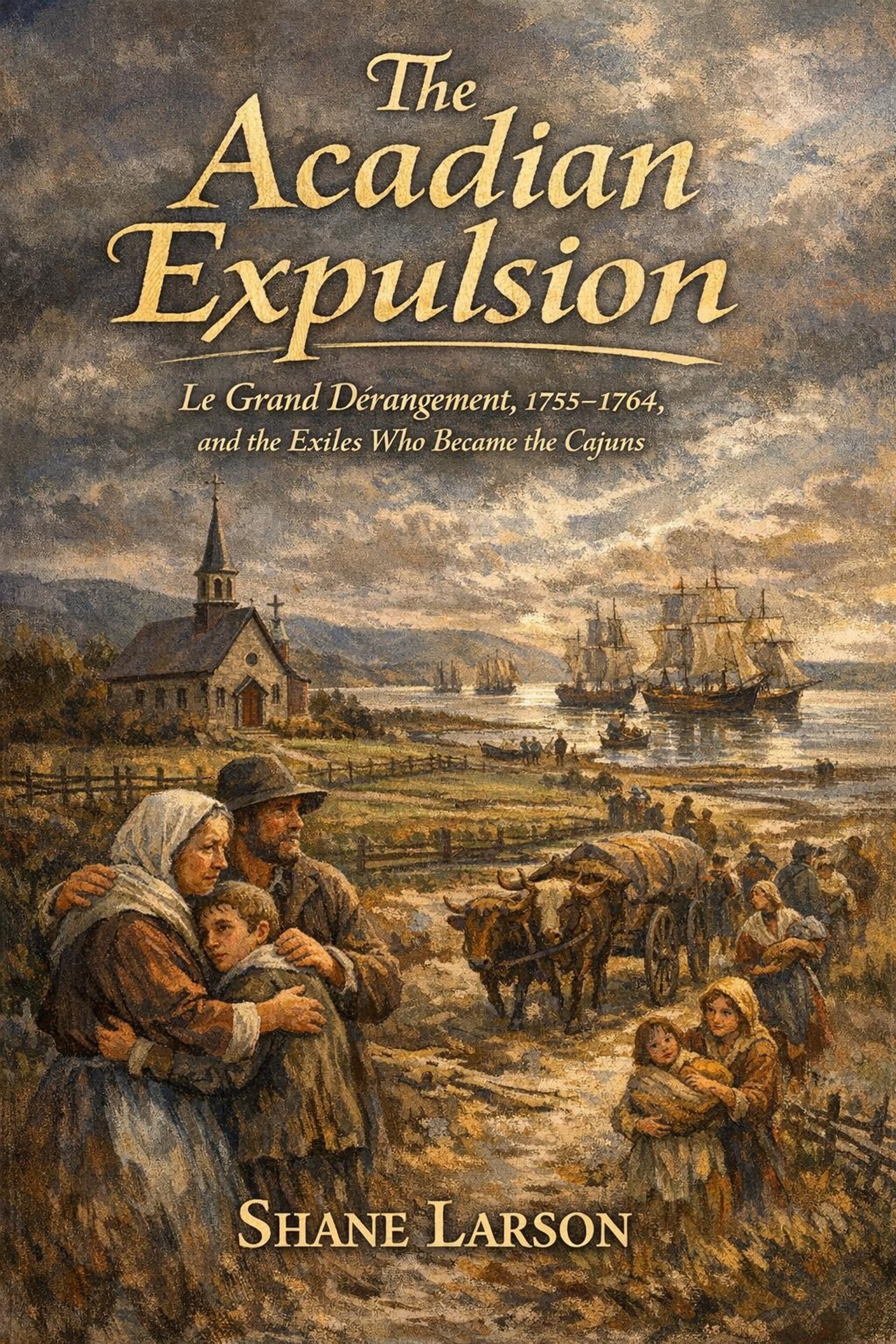
The Acadian Expulsion
Le Grand Dérangement, 1755–1764, and the Exiles Who Became the Cajuns
By Shane Larson
About This Book
Drive west out of Baton Rouge and Interstate 10 climbs onto pilings for eighteen miles to cross the Atchafalaya swamp. Where it comes down near Henderson, a levee holds the water back from the farms of St. Martin Parish, and on that levee there are dance halls. On a Sunday afternoon one of them is full: accordion, fiddle, steel guitar, and a floor of people two-stepping in a circle worn smooth by decades of the same motion.
Read the names. The band has a Thibodeaux in it, or a Broussard; the sign over the bar may say Hébert. These are the surnames of a few dozen families from western France, carried to the Bay of Fundy in the 1630s and written down by a Massachusetts officer in a church in Nova Scotia in 1755. Most picked up a final x in Louisiana. Otherwise they are unchanged.
That is strange, because the people who put those names on ships meant for them to vanish. The Nova Scotia Council that ordered the Acadian expulsion in July 1755 was explicit about method: the deportees were to be parcelled out among the British colonies to the south in groups too small ever to form a community again. Instead there is a Cajun flag in Louisiana, an Acadian flag in the Maritimes, and a UNESCO World Heritage Site where the officer pitched his tents.
How a People Were Scattered, and How They Came Back Together
The Acadians were not a conquered enemy in 1755. They had been British subjects since 1713, Catholic and French-speaking, farming dyked salt marsh on the Bay of Fundy, and too numerous for a garrison of a few hundred men to replace. They offered, again and again, to swear loyalty to the king on one condition: that they never be made to bear arms against France or the Mi'kmaq. In 1729 and 1730 Governor Richard Philipps administered an oath. The text he sent to London was unconditional. The Acadians maintained, and two priests later attested in writing, that he had promised them verbally they would not have to fight.
For twenty-five years both sides lived inside that gap. Then a new war began, a British and New England force took Fort Beauséjour, and Charles Lawrence, the acting governor, demanded the oath with no condition. The deputies offered the old one. On July 28, 1755, his council ruled that an oath with a reservation was no oath, and that the people who refused it would be removed.
The Acadian Expulsion: Le Grand Dérangement, 1755–1764, and the Exiles Who Became the Cajuns spends real time on that oath. It then follows the mechanics from John Winslow's journal: 418 men and boys summoned to the church at Grand-Pré, the young men marched to the transports first, ships that came late and short, and the villages burned behind them. Somewhere between 10,000 and 11,500 people were removed between 1755 and 1764.
The second half is the part Canadian accounts stop before and Louisiana accounts start after. Joseph Broussard dit Beausoleil fought from the woods and in 1765 led a party from Halifax to the Attakapas prairies. The exiles France had taken in after 1763 and never found a use for sailed from Nantes in 1785, seven ships and some 1,600 people, to join them. On the bayous, Acadien became Cadien became Cajun.
Why I Wrote This
What hooked me was the design. This was a brutal removal, and a planned one, and the plan had a specific goal: not just to empty the land but to make sure the people on the ships could never find each other again. And then, two thousand miles away and thirty years later, they reassembled anyway, in a swamp, under a Spanish flag. I wanted to understand how the dissolving was supposed to work, and why it didn't.
I should be honest that I have no Acadian ancestry and no family stake in this. I live in Alaska, a place made almost entirely by people who came from somewhere else and had to start over, and I think that is why the second half got to me. The Acadians built their farms out of the sea, one tide at a time, and then had to begin again on prairie and bayou. I know a little about how much patient work it takes to make a piece of ground livable.
Frequently Asked Questions
Why were the Acadians expelled from Nova Scotia?
The immediate trigger was an oath. In 1755 the Nova Scotia Council demanded an unconditional oath of allegiance; the Acadians offered the conditional one they had sworn in 1730, which exempted them from bearing arms. The council ruled that was no oath and ordered them removed, with a new war with France and New England's interest in the Fundy farmland behind the decision.
Was the Acadian expulsion ethnic cleansing?
Some historians argue that it was: a population removed from territory because of who they were, their homes destroyed, the land intended for others. Others read it as a wartime security measure, or as a land grab driven from Boston. This book presents each reading with its critics and does not pick one.
How many Acadians were deported?
Nobody counted, and every figure is a range. The population in 1755 was somewhere between 13,000 and 15,000; the total removed between 1755 and 1764 is usually put at 10,000 to 11,500. How many died is not known even approximately.
How did the Acadians get to Louisiana?
In stages, over twenty years. Beausoleil Broussard's party reached New Orleans from Halifax via Saint-Domingue in early 1765 and settled the Attakapas prairies. The largest single movement was in 1785, when seven ships carried about 1,600 Acadians from France to Spanish Louisiana.
Is Evangeline a true story?
No. Longfellow's 1847 poem invented its heroine, her betrothed, and her village. It also did more than any document to fix the deportation in the English-speaking imagination, which is why the book treats the poem as a historical event in its own right. Nothing else in the book is invented.
If You Liked This, You Might Like
- Sitting Bull — a leader who refused to sign, and a people whose exile across the Canadian border is the Acadian road run the other way.
- The Burning of the Codices — an attempt to erase a people's record that failed the same strange way: what was meant to be destroyed survived in the destroyer's own paperwork.
- The Notebook — a full American history covering the colonial seaboard where the Acadian ships were put ashore: the receiving end of 1755.
- The Year Without a Summer — a single shock that pushed farmers off their land and across a continent, told as one connected chain.
The council's minutes say the Acadians were to be scattered so thinly that they could never be a people again. This book is the record of the scattering, and of the two places where it failed.
What You'll Learn
- **The aboiteau.** How a clapper-valve sluice in an earthen dyke let a few hundred migrants farm salt marsh instead of forest, and why that produced a society the British could not leave alone.
- **The oath, word by word.** What was sworn in 1730, what was written to London, the priests' certificate, and who later denied the difference.
- **The Mi'kmaq as a thread of their own.** Their 1726 and 1752 treaties, the war Abbé Le Loutre and the Mi'kmaq fought against the new town of Halifax, and Cornwallis's 1749 scalp proclamation.
- **Who decided, in their own words.** Lawrence's letters to the Board of Trade, Chief Justice Belcher's opinion, and William Shirley pressing from Boston.
- **The second wave.** Louisbourg's fall in 1758, the deportation of Île Saint-Jean to France, the *Duke William* and *Violet* lost that December, and the starvation winter at Miramichi.
- **New Acadia.** Why Spanish Louisiana wanted Catholic farmers, the 1785 voyages, and the two centuries in which Acadien became Cajun.
- **Memory as politics.** Longfellow's *Evangeline* and its errors, the Acadian conventions of the 1880s that chose a flag and a feast day, CODOFIL, and the 2003 Royal Proclamation.
- **Three appendices built for genealogists:** a timeline from 1604 to 1785, destinations with the range of estimates for each, and the core surnames with their Cajun forms.
New Early Modern History releases and free chapters — no spam, unsubscribe anytime.
More in This Genre
View all →