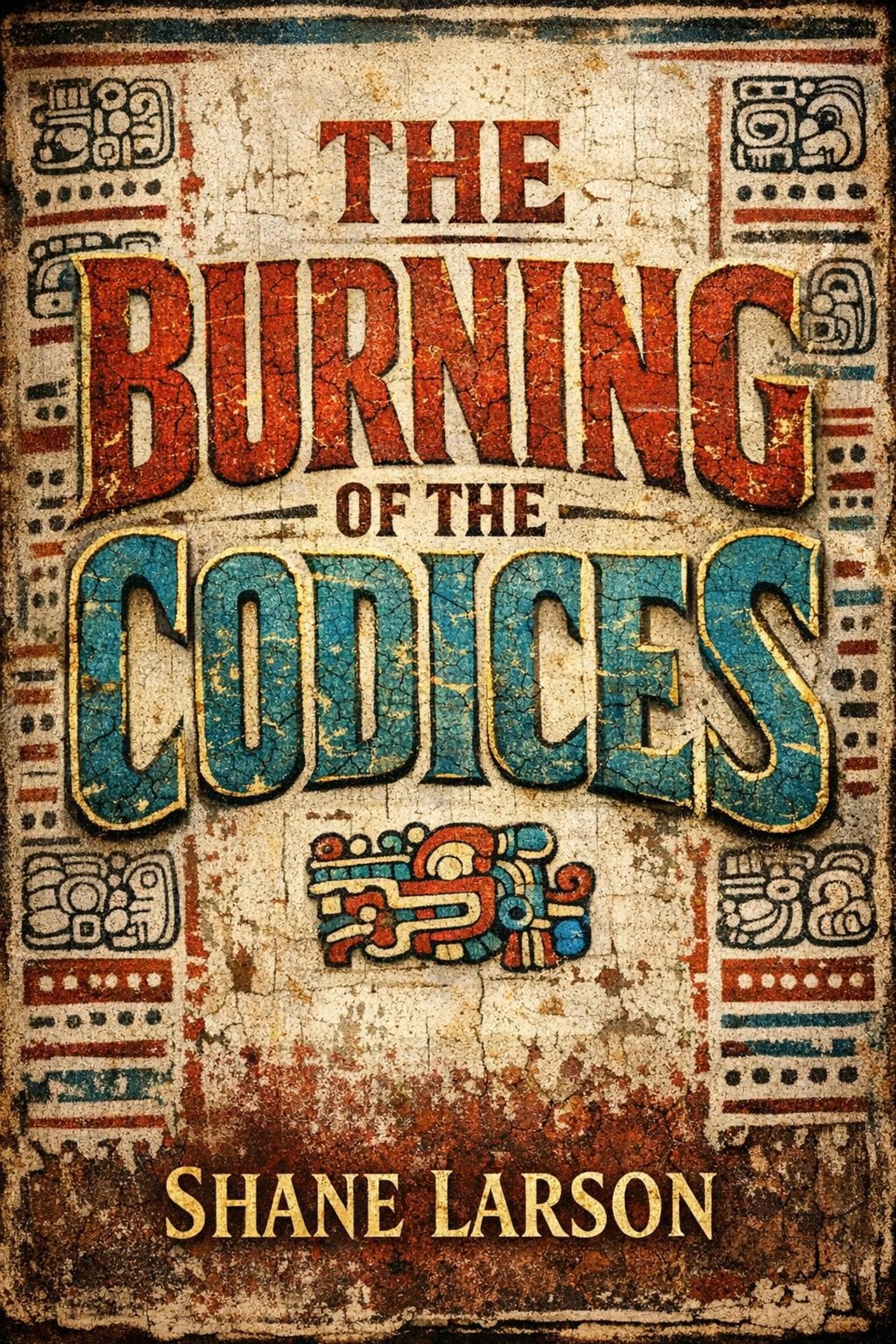
The Burning of the Codices
Diego de Landa and the Erasure of Maya Writing
By Shane Larson
About This Book
On the night of 13 February 1945, in the flooded cellar of the Japanisches Palais in Dresden, one of the last four Maya books in existence sat underwater while the city above it burned. The Dresden Codex — bark paper, white gesso, painted centuries earlier by a scribe in the Yucatán — had already outlived the conquest of its civilisation and four hundred years of European neglect. It came out of the cellar damaged but intact. The count of surviving Maya books stayed at four instead of falling to three.
Four is the entire number. A civilisation that manufactured its own paper, trained scribes as a profession, and kept books in the households of its priests and lords is represented today by four screenfold volumes held in Dresden, Madrid, Paris, and Mexico City. And unlike almost every other great destruction of written knowledge, this one comes with a name attached — because the man most associated with it wrote down what he did.
The Story
Most people never learn that the Maya wrote books at all, and that ignorance is itself evidence of how thorough the destruction was. These were genuine books: fig-bark paper coated with lime gesso, folded accordion-style into screenfolds, painted in carbon black, hematite red, and the astonishingly durable pigment we call Maya blue. Their pages carried a 260-day divinatory calendar, tables tracking Venus to within hours across centuries, eclipse predictions, medicine, prophecy, genealogy, and the histories of real kings.
In July 1562, in the town of Maní in the Yucatán, the Franciscan friar Diego de Landa presided over an auto de fe — the public conclusion of a brutal three-month investigation into Maya converts he believed were secretly maintaining the old religion. Idols recovered from caves went into the fire that day. So did a stack of codices. Alexandria's destruction is a fog of competing legends and Baghdad's a later myth, but Maní has a date, a documented legal proceeding, a colonial inquiry file, and a written account from the perpetrator himself. Among all the vanished libraries of history, this is the loss with a signature on it.
What happened next is the reason this book has a second half. Landa was recalled to Spain to answer for the severity of his proceedings, and his defence produced the Relación de las cosas de Yucatán — an account of Maya life, religion, calendar, and writing so detailed that no scholar of the Maya has ever been able to work without it. Buried in it was a list of signs he believed was the Maya alphabet, dictated by an informant who was actually supplying syllables, because syllables are what the script uses. The list looked like nonsense, and for three centuries scholars dismissed it as a blunder or a fraud.
Then, in Moscow in 1952, a Soviet linguist named Yuri Knorozov read the garbled list for what it really was — a partial syllabary — and produced readings from the surviving codices that worked. A Cold War academic brawl followed, but the approach cracked the script. Today most Maya inscriptions can be read, and they record not priestly abstraction but history: named kings, dated wars, marriages, defeats. The friar who destroyed the library had, in his own defence, preserved the key to reading everything the fire missed.
Why I Wrote This
I had been writing about destroyed libraries for a while — Alexandria, the House of Wisdom, Nalanda — and a pattern kept repeating: the closer you look at any famous burning, the more it dissolves into legend, gradual decay, or a chronicle written centuries later. Nobody lit the match at Alexandria. Then I came to Maní, and everything inverted. Here was a burning with a date, a town square, a named man, an official inquiry into his conduct, and his own written account of the day. The one loss in the whole genre you can actually pin down. And then the story did something I did not expect: the man responsible, defending his career in Spain, wrote the very document that let scholars crack the script three hundred years later. I have never found another piece of history shaped like that, and I wanted to tell the whole arc in one book — the destruction and the recovery, together.
Frequently Asked Questions
Did Diego de Landa really burn the Maya books?
Yes — the bonfire at Maní in July 1562 is documented, dated, and described by Landa himself. What is genuinely contested is the scale: books were also destroyed elsewhere in the Yucatán by other friars, lost in the conquest. Landa's fire is best understood as the documented emblem of a much larger erasure.
How many Maya codices survive today?
Four: the Dresden, Madrid, and Paris codices, and the Grolier fragment, now officially the Códice Maya de México. The Grolier was widely dismissed as a forgery for fifty years after it surfaced in the 1960s, until materials analysis and its Venus-table content confirmed it as genuine in 2018.
How was Maya writing deciphered?
The turning point came in 1952, when Yuri Knorozov in Moscow recognised that Landa's misrecorded "alphabet" was actually a list of syllable signs and used it to produce readings that checked out against the surviving codices. His approach was resisted for roughly twenty years, notably by the field's dominant authority, J. Eric S. Thompson, before the evidence won. Tatiana Proskouriakoff's 1960 demonstration that the monuments record royal births, accessions, and deaths completed the revolution.
Do the Maya still exist?
Emphatically yes — roughly six million people speak some thirty Mayan languages today across Guatemala, Mexico, and Belize, and highland daykeepers still keep the same 260-day calendar found in the Dresden Codex. A generation of Maya epigraphers now reads Classic-period inscriptions professionally.
Was the loss of the codices permanent?
The books themselves are unrecoverable — especially the histories, which survive in no codex. But more was retained than the fire could reach: mission-educated Maya nobles wrote their traditions down in Latin letters, producing the Books of Chilam Balam and the Popol Vuh, and the inscriptions on stone and pottery preserve the same narrative tradition.
If You Liked This, You Might Like
- The Maya Collapse — What ended in the ninth century was a political order, not a people; that story is the essential prelude to the world Landa found.
- The Conquistadors' Smallpox War — The demographic catastrophe that accompanied the conquest; this book is its cultural counterpart.
- The Library of Alexandria — The most famous lost library of all, and the perfect contrast: a destruction with no date, no perpetrator, and no confession.
A civilisation's written voice, silenced in the sixteenth century and painstakingly recovered from stone, pottery, and four battered books — with the strangest twist in the history of lost knowledge at its centre. Part of the Lost Knowledge series.
What You'll Learn
- How a Maya codex was physically made — paper, gesso, screenfold binding, pigments — and what a working book culture looked like, from scribal training to elite libraries.
- A full account of the events at Maní — the cave discovery that started it, the interrogations reported plainly from the inquiry record, and an honest apportionment of what Landa is and is not responsible for.
- The reckoning: Bishop Toral's intervention, Landa's journey to Spain to face the Council of the Indies, his acquittal, and his return to the Yucatán as its bishop.
- The strange career of the *Relación* itself — never published in Landa's lifetime, surviving only as a copyist's abridgement, and rediscovered in a Madrid library in 1862.
- The biographies of all four surviving codices, from a Vienna bookshop in 1739 to the fifty-year forgery dispute over the Grolier fragment and its final authentication.
- The decipherment as a detective story: Förstemann working out the calendar, Thompson's decades-long freeze on phonetic readings, Knorozov's breakthrough, and Proskouriakoff's proof that the monuments record human lives.
- What the lost books most likely contained, reconstructed from pottery texts, monuments, the Books of Chilam Balam, and the Popol Vuh — with the size of the loss stated as precisely as the evidence allows.
- Three appendices: a reference guide to the four codices, a primer that teaches you to parse a simple glyph, and a timeline of the decipherment from 1566 to the present.
New Early Modern History releases and free chapters — no spam, unsubscribe anytime.
More in This Genre
View all →