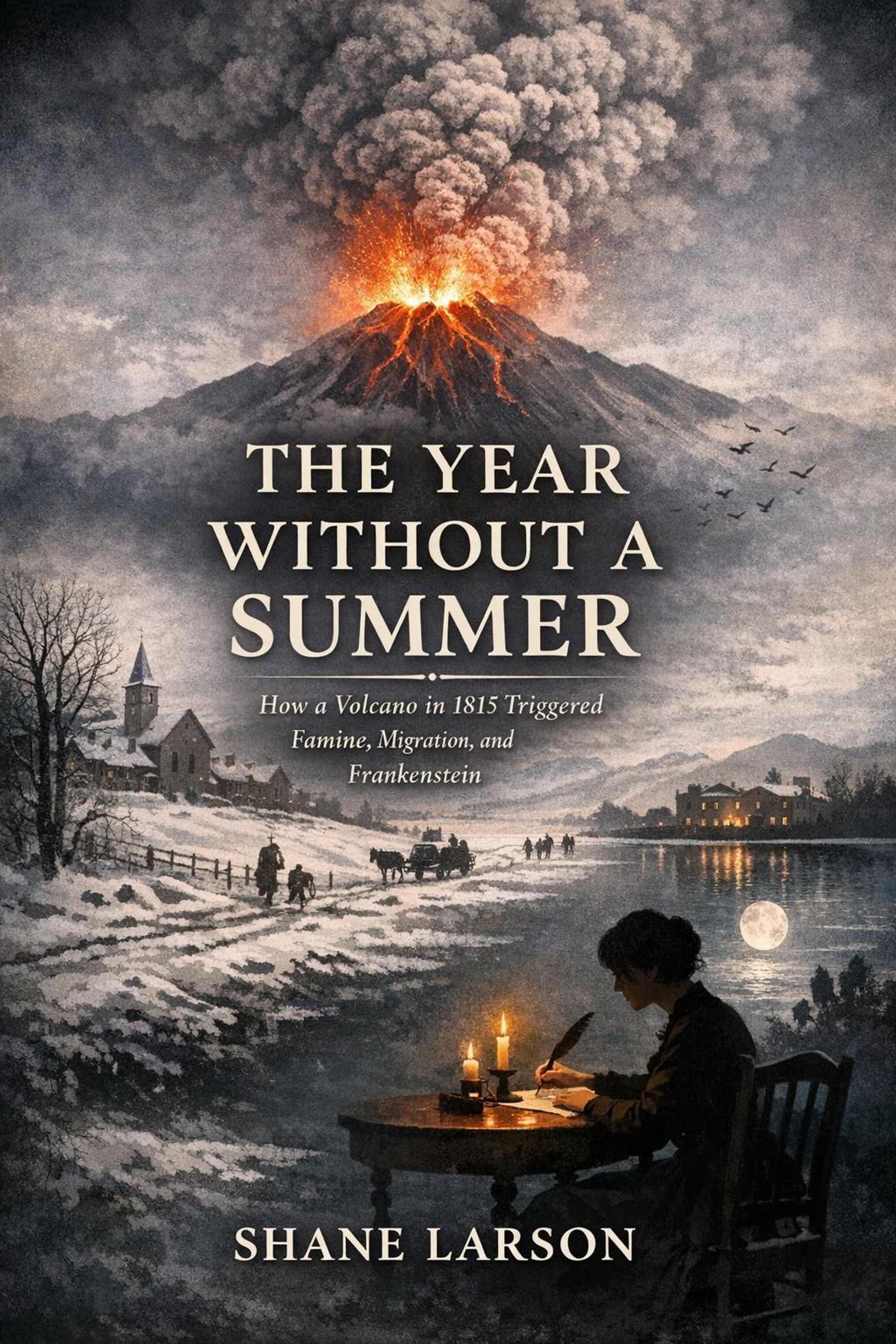
The Year Without a Summer
How a Volcano in 1815 Triggered Famine, Migration, and Frankenstein
By Shane Larson
About This Book
On the shore of Lake Geneva in June 1816, a small group of English travelers gave up on the weather. They had come for a Swiss summer and gotten frost, thunder, and days so dark they needed candles at noon. Trapped indoors at a rented villa, bored and rain-soaked, they agreed to a contest: each would write a ghost story. One of them, an eighteen-year-old woman, dreamed of a man assembling a creature from dead tissue and jolting it into life. She called him Victor Frankenstein.
Nobody in that villa knew why the sky had turned against them. They blamed sunspots, or the wrath of God, or nothing at all. They could not have known that fourteen months earlier and seven thousand miles away, a mountain they had never heard of had detonated with a force that dwarfed anything in recorded history, and that the fine gray haze dimming their summer was the top of that mountain, spread thin across the entire sky of the Northern Hemisphere.
The gloom that birthed Frankenstein was not a mood. It was a measurable atmospheric event, and it was killing people by the tens of thousands on three continents while the poets complained about their holiday.
The Argument
In April 1815, Mount Tambora in the Dutch East Indies blew itself apart in the largest volcanic eruption in the span of human record — roughly four times the size of Krakatoa, and beyond any comparison with the eruptions people in the developed world have actually witnessed. Tens of thousands died on and around the island, buried, burned, or starved in the aftermath. That was only the opening act.
The eruption threw an immense volume of sulfur into the stratosphere, where it formed a fine aerosol veil that circled the planet and reflected sunlight back into space. The result was a measurable drop in global temperature that peaked the following year. 1816 became "the year without a summer": snow fell in New England in June, frost struck in every month, and a belt of crop failure ran across the Northern Hemisphere from Canada through Europe into China. The membrane between an ordinary harvest and mass hunger turned out to be about half a degree of global average temperature, and the volcano had pushed straight through it.
This book follows the chain reaction outward from the summit — not as a catalog of disasters but as a single connected story of how a planet's systems are wired together. A failed harvest in one place becomes a typhus epidemic in another, a wave of migration in a third, a bank panic in a fourth. In Ireland a ruined potato crop touched off a fever that killed somewhere between sixty-five thousand and a hundred thousand people, a grim rehearsal for the far greater famine of the 1840s. In New England, ruined farmers abandoned their stony fields and pushed west, redrawing the American interior. In Germany, oats grew so dear that horses starved, and an inventor named Karl Drais unveiled a two-wheeled machine that needed no feeding — the ancestor of the bicycle. Famine, disease, migration, financial collapse, religious revival, technological invention, and a handful of immortal works of art all trace back to the same cloud of sulfur.
The through-line is a single unsettling idea: civilization sits on top of the weather, and the weather sits on top of geology, and every so often the ground reminds us of the order of things.
Why I Wrote This
I came to Tambora through a footnote. I was reading about the origins of Frankenstein and saw the throwaway line that the bad weather had a volcanic cause, and I couldn't let it go. One mountain, on the other side of the world, quietly rewriting European literature — how had I never heard this?
The deeper I dug, the more the story stopped being about a volcano and started being about connection. I've always been drawn to how systems fail — how a single disturbance propagates through everything downstream until it surfaces somewhere that looks totally unrelated to the cause. Tambora is the cleanest example I've ever found. You can trace a line from a crater in Indonesia to a fever in Cork, a migration in Vermont, a monster on a page in Switzerland — and, more arguably, to a bicycle in Germany. I wrote it because that line is real, and because most people walk past the biggest eruption in human history without knowing it happened.
Frequently Asked Questions
Is this a science book or a history book?
It's a narrative history with the science woven in where you need it. You'll come away understanding how a volcanic winter actually works, but the spine of the book is human — the harvests, the famines, the migrations, the art. No equations, no jargon wall.
Do I need to have read the Collapse Pattern series first?
Not at all. This stands completely on its own. That said, if you've read those books, this reads as a natural companion — one real, fully documented case of the fragility those books describe in the abstract.
How much of it is about Frankenstein?
One thread of several. The Villa Diodati and the birth of Frankenstein are the most famous piece of the story and the book gives them their due, but they share the stage with famine in Ireland, migration in America, and hunger across Asia. The point is how one event touched all of it.
Is this a climate-change book in disguise?
No. It's a book about how sensitive human systems are to a sudden shift in the climate, using a natural experiment from two centuries ago. The modern implications are there — a chapter asks what a repeat would do now — but the argument is historical and physical, not partisan.
How long is it?
About 75,000 words — thirteen chapters plus an introduction, a conclusion, and three appendices, roughly 255 pages in paperback. Long enough to follow the cascade all the way around the world and back to the present, without padding.
If You Liked This, You Might Like
- Pompeii — another eruption that rewrote a society, told at ground level where the geology meets the people who lived on top of it.
- The Collapse Pattern — the framework book on how complex systems come apart; Tambora is what one of its cascades looks like when the trigger is a mountain instead of a mistake.
- The Black Death — a single shock racing across a continent and remaking everything in its path, the same shape of story with a pathogen at the center.
- Ancient Apocalypse — a whole interconnected world brought down partly by climate stress, showing how thin the margin has always been between a good harvest and a dark age.
The mountain is still there, and it is still active. What it did in 1815 is the clearest lesson we have in how a planet actually works — and how quietly it can stop working for a season.
What You'll Learn
- **The scale of Tambora** — why it out-classes every eruption modern people have lived through, and how a mountain in Indonesia reached into a farmhouse in Vermont.
- **The physics of a stolen summer** — how stratospheric sulfur cools a planet, why the effect peaks more than a year after the blast, and how scientists reconstructed all of it from ice cores and old diaries.
- **Frankenstein's real origin** — how the same locked-in, sunless weather that birthed Mary Shelley's monster also produced the first vampire story in English, written a few feet away.
- **Ireland's forgotten famine** — the 1816 typhus catastrophe that killed tens of thousands and foreshadowed 1845, and why it fell out of memory.
- **The westward push** — how climate refugees fleeing the dying farms of New England reshaped the map of the young United States.
- **The bicycle's hungry birth** — why the first two-wheeler appeared in a Germany of starving horses, and whether the hunger was really the reason.
- **The panic of 1819** — how the disruptions rippling out of the eruption helped set up the first true American economic depression.
- **The question that won't close** — what an eruption on Tambora's scale would do to a global food system of eight billion people, running with almost no slack.
New World History releases and free chapters — no spam, unsubscribe anytime.
More in This Genre
View all →