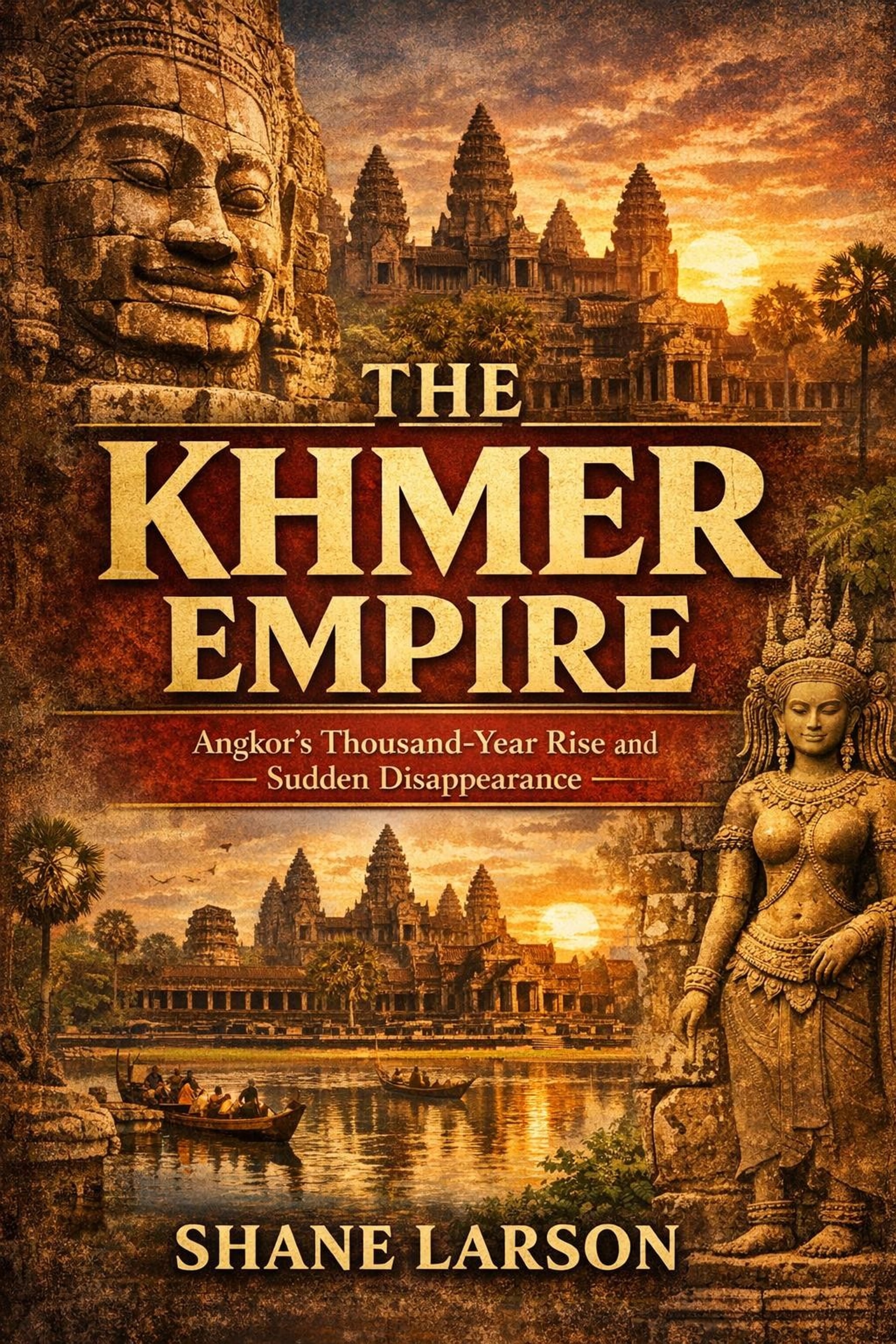
The Khmer Empire
Angkor's Thousand-Year Rise and Sudden Disappearance
By Shane Larson
About This Book
Sometime after 1431, people stopped maintaining the canals. Not all at once, and not with any single catastrophe to mark the moment — but the dredging crews thinned out, the embankments went unrepaired, and the vast reservoirs that had watered the largest city on Earth began to silt shut. Within a few generations the forest had folded over the temples. The medieval world's greatest metropolis became a rumor, then a ruin, then nothing the wider world remembered at all.
That city was Angkor, and the empire that built it ruled mainland Southeast Asia for six hundred years. At its height it sprawled across an area larger than modern Paris and supported something on the order of three-quarters of a million people — a scale no European city would approach for centuries. It raised Angkor Wat, the largest religious monument ever constructed, and crowned the Bayon with its hundreds of enigmatic stone faces. And then it let go.
The Khmer Empire: Angkor's Thousand-Year Rise and Sudden Disappearance is the story of how a civilization built itself on water, and how water unbuilt it.
The Story
The Khmer Empire was, before it was anything else, a machine for moving water. Its kings ruled a monsoon landscape that flooded for half the year and parched for the other half, and their power rested on a simple, brutal proposition: control the water and you control the harvest, the population, and the gods. The huge man-made reservoirs called barays, the lattice of canals, the moats that doubled as flood buffers — these weren't decoration. They were the empire's circulatory system, and historians today call Angkor a "hydraulic civilization" for exactly this reason.
This book follows that system from its origins to its failure. It opens in 802 CE, when a ruler named Jayavarman II declared himself a god-king and welded a scatter of competing chiefdoms into a single state. It runs through the building boom under Suryavarman II, who raised Angkor Wat, and the feverish construction of Jayavarman VII, the master builder who gave the empire its hospitals, its roads, and the face-towers of the Bayon. Then it traces the long unwinding — the climate swings that whipsawed the monsoon between drought and flood, the canal network that grew too large and too brittle to repair, the quiet spread of Theravada Buddhism that dissolved the cult of the god-king from underneath, and the rise of Ayutthaya to the west.
The throughline is a single hard question, the same one Jared Diamond asked in Collapse: what actually makes a great civilization disappear? The answer here isn't a single villain or a sudden disaster. It's a system that worked beautifully for centuries and then, under converging pressures, became the very thing that broke it. This is narrative history with the hype stripped out — grounded, evidence-driven, and built on the recent LiDAR surveys that have finally mapped the true scale of the lost city sleeping beneath the Cambodian forest.
What You'll Discover
- How one ruler in 802 CE transformed a region of feuding chiefdoms into a centralized god-kingdom, and why that founding act shaped everything that followed
- Why the barays and canal network represented hydraulic engineering centuries ahead of anything comparable in the medieval world
- The real construction story behind Angkor Wat and the Bayon — who built them, why, and what they were actually for
- What LiDAR finally revealed about the size of the medieval megacity, and how it overturned a century of assumptions about Angkor's scale
- How drought, flooding, and a decaying water infrastructure compounded into a failure no single repair could fix
- Why the spread of Theravada Buddhism quietly hollowed out the god-king ideology that had held the empire together
- How a capital the wider world had forgotten became one of history's most celebrated rediscoveries
Why I Wrote This
I kept running into Angkor as a footnote. It shows up in collapse books as a quick example — drought, abandonment, jungle — and then the author moves on to the Maya or the Bronze Age. But the Khmer story is stranger and more specific than the footnote version lets on. This wasn't a fragile society that got unlucky. It was one of the most sophisticated states in the world, running on water management that engineers still study, and it came apart anyway.
What pulled me in was the engineering. Once you understand Angkor as a hydraulic system rather than a collection of temples, the collapse stops being mysterious and starts being legible — you can actually watch the failure propagate through the network. I wanted to write the version of this story that takes the water seriously, leans on what the LiDAR data has shown us recently, and resists the urge to turn a slow, compound failure into a dramatic single cause. The plain answer is more interesting than the dramatic one.
Frequently Asked Questions
Do I need to know anything about Cambodian or Southeast Asian history first?
No. The book assumes no prior background. It introduces the geography, the dynasties, and the religious context as it goes, so you can pick it up cold and follow the full arc from 802 CE to the abandonment of Angkor.
Is this a narrative history or an academic textbook?
It's narrative history — written to be read straight through, in plain and direct language. It's grounded in current scholarship, including the LiDAR survey work, but it's built for a curious general reader, not for specialists wading through footnotes.
How does this compare to Jared Diamond's Collapse?
If you read Collapse and wished the Khmer received more than a passing mention, this is that chapter expanded into a full book. It shares Diamond's interest in why complex societies fail, but it stays tightly focused on Angkor and goes deeper into the specific mechanics of the water system.
Does it actually explain why Angkor was abandoned, or just describe it?
It explains it. The book lays out the converging pressures — climate volatility, an overextended canal network, religious change, and military rivalry from Ayutthaya — and shows how they interacted, rather than reaching for a single tidy cause.
Is the book available on Kindle Unlimited?
Yes. It's enrolled in Kindle Unlimited, so KU subscribers can read it as part of their membership.
If You Liked This, You Might Like
- The Maya Collapse — the closest companion to this book: another sophisticated civilization that walked away from its cities under drought and water stress, on the other side of the world.
- The Collapse Pattern — the analytical framework behind the question Angkor raises: the recurring ways great civilizations dismantle themselves from within.
- Indonesia: Empires of the Archipelago — for readers drawn into Southeast Asian history who want the wider regional story, from the dawn of civilization to the modern era.
- The Ancient World's Greatest Engineers — if Angkor's waterworks hooked you, this one is about the builders across history who reshaped the world with engineering ambition.
The water made the empire possible. When the water failed, six hundred years of kings, temples, and cities went silent with it — and the forest kept the secret for centuries.
Included with Kindle Unlimited — read it free if you're a member.
New Ancient History releases and free chapters — no spam, unsubscribe anytime.