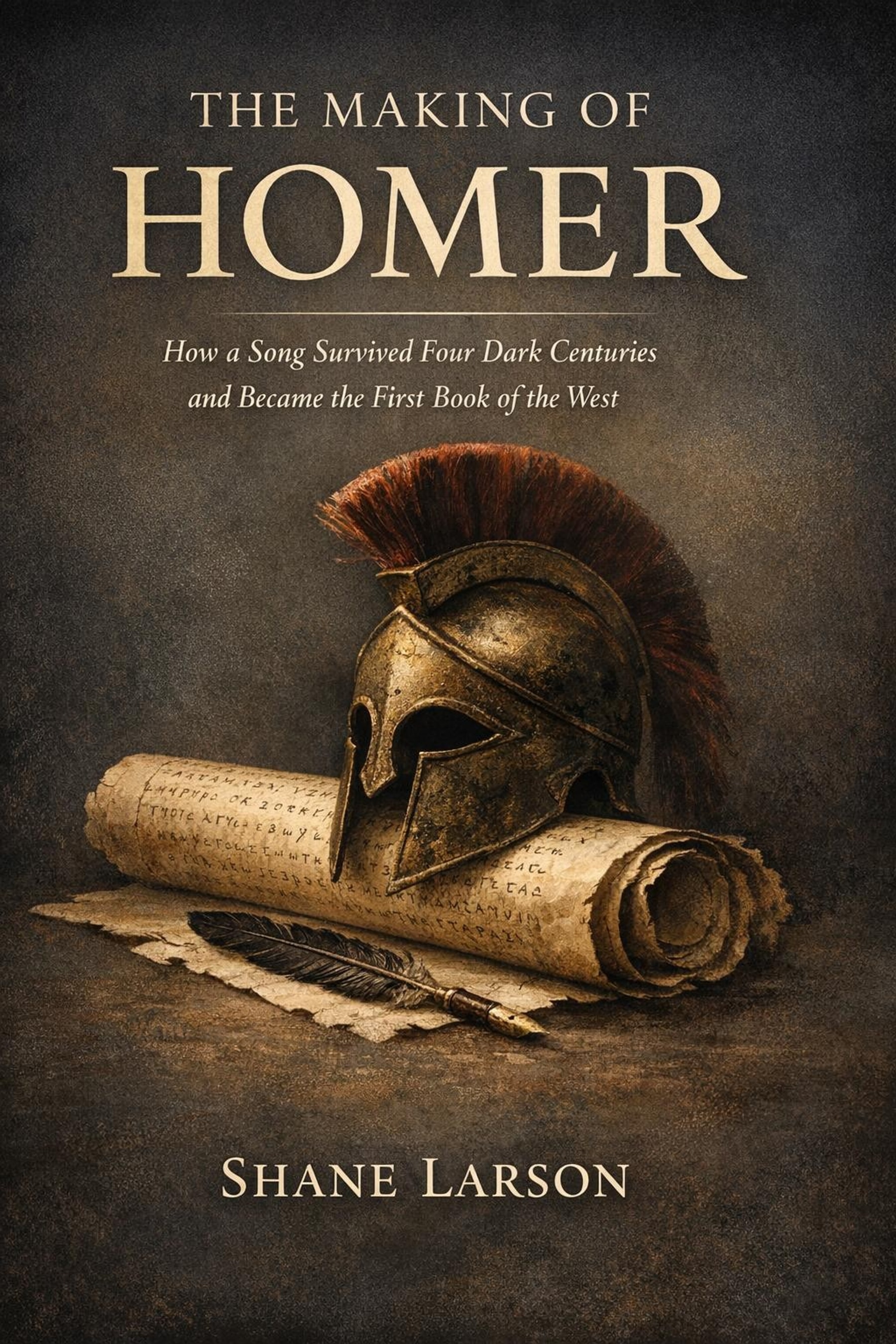
The Making of Homer
How a Song Survived Four Dark Centuries and Became the First Book of the West
By Shane Larson
About This Book
Archaeologists digging in the ruins of Mycenae and Knossos kept finding the same strange objects: small curved plates of boar's tusk, drilled at the corners, dozens to a tomb. Eventually someone assembled them and realized what they were — the plating of a leather helmet, sewn in overlapping rows, worn by Bronze Age warriors around 1300 BC and by nobody afterward. The style died with the world that made it.
Here is the problem. Homer's poetry describes that helmet — the leather cap, the felt lining, the rows of gleaming tusk — in detail so precise it reads like a museum catalog entry. And the poems were not written down until roughly five hundred years after the last boar's-tusk helmet rusted apart in the ground. No poet in the chain of singers who carried the epic had ever seen one. Yet the description survived, intact, like an insect in amber.
An heirloom like that does not survive by accident. It survives because something carried it — and the carrier was not ink. For roughly four hundred years, Greece had no writing at all. The civilization that built Mycenae collapsed around 1200 BC and took literacy down with it. Everything that crossed that gap crossed it inside human memory. This book is about the machine that made that crossing possible.
The Making of Homer reconstructs the entire journey of the Odyssey from living performance to printed page. It begins in the firelit halls of early Greece, where a professional singer could compose epic verse for hours at a stretch — not reciting a memorized script, but building the poem in real time out of an inherited toolkit of ready-made phrases, fitted to a meter that did half the remembering for him. The famous repetitions everyone notices — rosy-fingered dawn appearing again and again, the sea forever wine-dark — are not stylistic laziness. They are the visible gears of a memory technology refined over centuries, and once you learn to see them, the whole poem changes in your hands.
Proving that took one of the great detective feats in the history of scholarship. In the 1930s the classicist Milman Parry decided the argument over Homer's identity could never be settled in a library, so he hauled a custom recording rig into the mountains of Yugoslavia and captured illiterate village bards composing epics live — including performances rivaling the Odyssey in length, sung by men who could not sign their own names. What Parry and his student Albert Lord documented dissolved a question that had raged for two millennia and replaced it with a far more interesting answer.
From there the trail runs forward in time: to the borrowed Phoenician letters that Greeks adapted around 800 BC — with the Odyssey plausibly among the first things the new alphabet ever recorded — then to the rhapsodes who performed the fixed text in relay at Athenian festivals, to the librarians of Alexandria whose editorial judgments still govern every translation on your shelf, and finally through papyrus and parchment and print to the paperback of today. Each link in the chain is a story, and every one of them had to hold.
Why I Wrote This
I keep coming back to survival stories. I've written about the Bronze Age collapse — cities burning, trade routes dissolving, writing itself disappearing from Greece — and I've written about Gilgamesh, an epic that survived only because clay tablets are nearly indestructible and got lucky under the sand. The Odyssey had no such luck. Nothing was buried. Nothing was carved. For four hundred years the poem's entire existence was the breath of whoever was singing it that night, and if the chain of singers had broken once, it would have vanished without leaving a trace to tell us what we'd lost. Every book about Homer I read as I worked skipped past that — straight to the meaning, the symbolism, the question of whether Troy burned. The mechanism itself, the actual answer to "how do we even have this?", was the story I couldn't find on any shelf. So I wrote it.
Frequently Asked Questions
Did one person actually write the Odyssey?
The honest answer is more interesting than yes or no. The poem emerged from generations of singers sharing a common technique and inherited story-stock, and the modern consensus holds that a monumental composer near the end of that tradition — working orally, not at a desk — shaped the version that got written down. So "Homer" names something real, but not an author in the usual sense — a distinction the book spends several chapters unpacking.
How could anyone preserve a 12,000-line poem for four centuries without writing?
Not by rote memorization — that is the crucial discovery. Oral bards composed anew in every performance, using a system of metrical formulas and standardized scenes that generated correct verse on demand, the way a fluent speaker generates grammatical sentences. The system kept the poem stable in substance while flexible in wording, which is what let it carry Bronze Age details across centuries so faithfully.
Do I need to read the other Homer's World books before this one?
No. This is Book 5 of the series, but it stands fully on its own and assumes nothing. The earlier volumes — The Search for Ithaca, The Real World Behind the Odyssey, Mapping the Voyage, and Cult of the Hero — look outward at the geography, archaeology, and afterlife of the epic; this one turns inward to the poem's own construction and transmission. Read them in any order.
Is this an academic book? How much background does it assume?
None. It's narrative nonfiction written as a detective story, and every technical term — formula, hexameter, recension — is explained in ordinary language the moment it appears. Readers who want the scholarly apparatus can go on to Albert Lord's The Singer of Tales; this book makes that discovery, and the survival story around it, gripping for someone meeting it all for the first time.
Does it cover the Iliad too?
Substantially, yes. The two epics came out of the same oral tradition, use the same formula system, and traveled the same road from song to text, so evidence from each illuminates the other throughout — the boar's-tusk helmet, for instance, appears in the Iliad. The Odyssey is the through-line, but the mechanics apply to both poems equally.
If You Liked This, You Might Like
- Gilgamesh — The other great story of an ancient epic's survival, preserved by buried clay where Homer's poem was preserved by living memory: the perfect mirror-image companion.
- The Mycenaeans — The palace civilization whose warriors, helmets, and halls the bards kept alive in verse for centuries after the palaces themselves fell.
- Ancient Apocalypse — The catastrophe around 1200 BC that destroyed Greek literacy and made the poem's four-century memory feat necessary in the first place.
- Iron Age Dawn — The recovering world in which the alphabet arrived and the song finally became a text.
A poem carried on nothing but breath for four hundred years became the foundation stone of Western literature — and the way it happened is knowable, link by link. Book 5 of the Homer's World series.
What You'll Learn
- A working tour of the memory machine — how dactylic hexameter, stock epithets, and repeatable type-scenes let a bard generate thousands of lines on the fly without a text, explained in plain language with the machinery shown in motion.
- The Parry expeditions, told as narrative — the drive into the Balkans, the aluminum-disc recordings, and the guslars whose live performances became the decisive evidence in a two-thousand-year-old argument.
- The Bronze Age fossils in the verse — the boar's-tusk helmet, the tower shield, bronze weaponry in an iron world, and place-names from vanished kingdoms, each one hard proof of what oral tradition can preserve.
- The collapse that erased Greek writing — what Linear B recorded in the Mycenaean palaces, what it never recorded, and how four illiterate centuries became the crucible of the entire tradition.
- The alphabet's arrival around 800 BC — the Greek innovation of vowels, the earliest inscriptions already scratched in Homer's meter, and the provocative case that epic poetry drove the writing-down itself.
- The Homeric Question as intellectual history — Friedrich August Wolf's bombshell, the century of warfare between Analysts and Unitarians, and how fieldwork finally broke the stalemate.
- The editors who built your edition — Zenodotus, Aristophanes of Byzantium, and Aristarchus at the Library of Alexandria, whose critical marks and twenty-four-book division persist on your shelf today.
New Ancient History releases and free chapters — no spam, unsubscribe anytime.