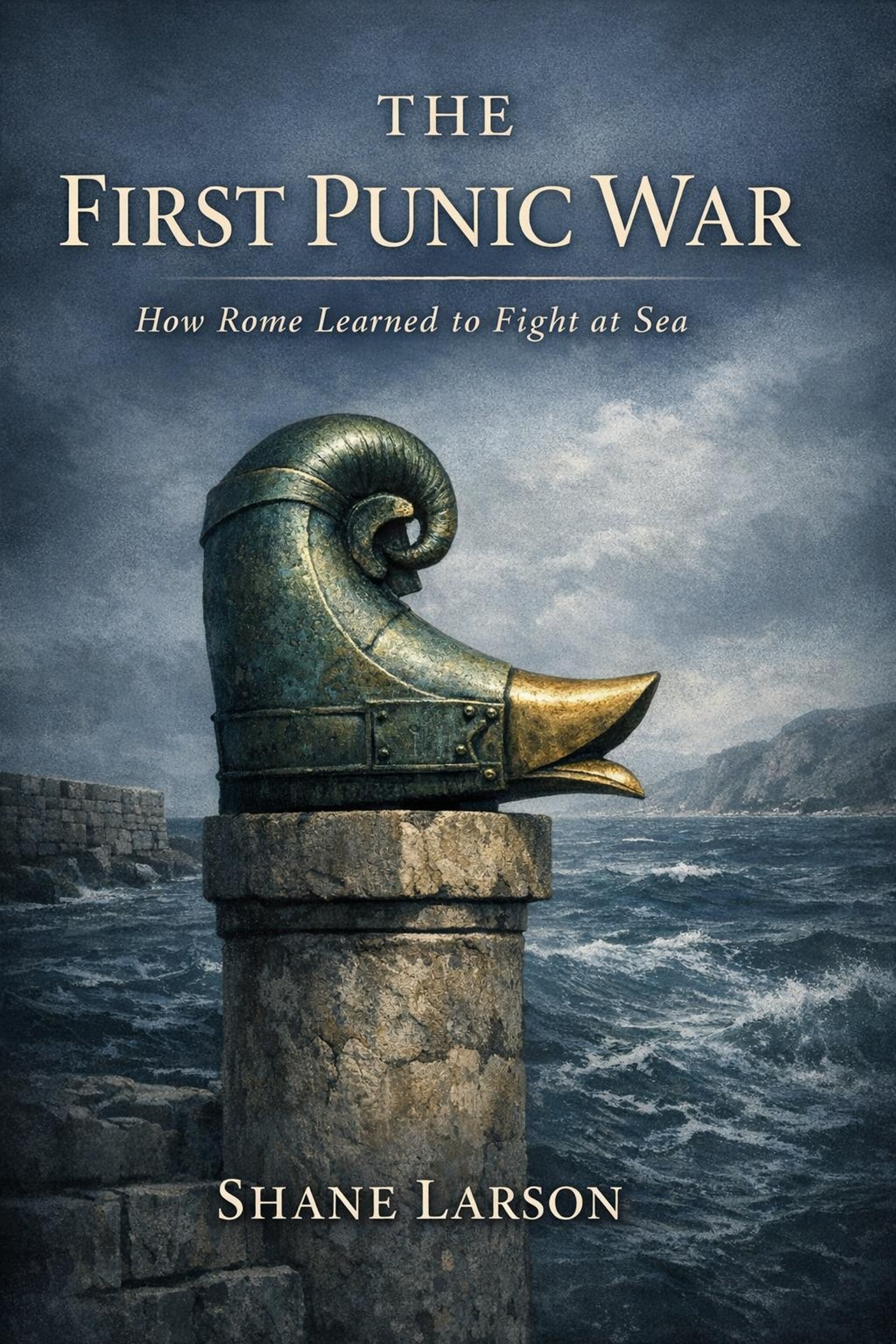
The First Punic War
How Rome Learned to Fight at Sea
By Shane Larson · Rome: From Village to Empire (Book 4)
About This Book
Since 2004, bronze warship rams have been coming off the seabed northwest of Levanzo, off western Sicily — more than two dozen so far, more ancient rams than the world possessed before the site was found. The hulls they were bolted to rotted away twenty-two centuries ago. The bronze kept. Where each ram lies, a ship died.
Several carry inscriptions. At least one is Punic: a dedication committing the weapon to the god Baal. Most of the rest are Latin, and they are not prayers. They are paperwork — formulaic records that named Roman officials, quaestors of the treasury, inspected each casting and accepted it for state service. A receipt, cast into a weapon, lying among grain amphorae and Roman helmets exactly where a historian said a battle was fought on the morning of 10 March 241 BC.
That morning ended the longest continuous war the ancient world had yet seen: twenty-three years, Rome against Carthage, fought mostly in and around Sicily. It is the war everyone skips on the way to Hannibal and the elephants — and it is the war that made him.
The Argument
Strip away the legend and the First Punic War is a strange story to tell about Rome. Its commanders were elected amateurs on one-year terms — some competent, most unremarkable, a few catastrophic, including one who threw the sacred chickens into the sea at Drepana and handed Carthage its only clear victory afloat. Its one tactical invention, the corvus boarding bridge, won battles for a few years and then, on the reading many naval historians accept, helped drown the fleets that carried it. And the finest general on either side was Hamilcar Barca, who fought for the losers.
What Rome had was not brilliance. It was a system: a citizen and allied levy that regenerated after disasters that would have bankrupted any mercenary army, shipyards that learned Carthage's own prefabrication methods and turned out 220 warships in three months, and a political class built so that no man could afford to be the one who proposed giving up. Rome lost something like seven hundred ships in this war, most of them to weather rather than to the enemy — one storm in 255 BC drowned on the order of a hundred thousand men — and it absorbed every loss and produced again. When the treasury finally ran dry, private citizens paid for the last fleet themselves, repayable only if Rome won. Roman power in this war was an industrialised capacity to absorb catastrophe and keep producing.
Say the other half in the same breath, because the book does. That capacity is not a virtue. Twice Rome faced a beaten enemy asking for terms and offered conditions so unsurvivable that the enemy chose to keep fighting a war it was losing. And in 238 BC, with the peace signed and Carthage fighting for its existence against its own unpaid mercenaries, Rome seized Sardinia and demanded a further indemnity for the affront of being objected to. Polybius — our best source, and a historian who admired Rome — called the seizure contrary to all justice and the true seed of the next war. A state that cannot be stopped by defeat, it turns out, cannot be stopped by victory either. The book ends there on purpose.
Why I Wrote This
I came to this war backwards, the way nearly everyone does. I knew the son — everyone knows the son, the elephants, the Alps. I did not know that his father spent six years on a fortified mountain in Sicily, never beaten, while his government lost interest and stopped paying his troops, and that he came down only to arrange the surrender of a war other men had lost forty miles from his position. That asymmetry — the most famous soldier of antiquity raised by a man history barely mentions — pulled me in.
What kept me in was the silence. Carthage was a literate civilisation with its own libraries and its own account of these events, and in 146 BC Rome burned all of it. One side of this war cannot speak. Writing a book that keeps pointing at that absence felt like the only honest way to tell the story.
Frequently Asked Questions
What was the corvus?
A boarding bridge — a spiked gangplank hinged in a warship's bow, dropped onto an enemy deck to pin the two ships together so Roman infantry could walk across. It let a land power fight land battles on water, and it won every major fleet action from 260 to 255 BC. Then it vanishes from the record, and the book examines the modern inference that its weight helped drown the fleets that carried it.
Why did Rome and Carthage go to war?
Over Messana, a Sicilian city that Italian mercenaries had stolen, whose occupiers appealed to Rome and Carthage simultaneously when their past caught up with them. Neither state wanted the war; they had treaties older than most governments. The book's first chapter covers why Rome intervened anyway — and why Polybius himself found the justification thin.
Did Rome really lose more ships to storms than to Carthage?
Yes. Polybius puts total Roman losses at about seven hundred quinqueremes, and the majority went down in the great storms of 255, 253, and 249 BC rather than in battle. The 255 disaster alone destroyed some 280 ships, with modern estimates of the dead near a hundred thousand men.
Did the Carthaginians really sacrifice their children?
Honestly: unresolved. The literary claims all come from Carthage's enemies; the excavated urn precincts are real; serious specialists read the same bones in opposite ways. The book lays out both bodies of evidence and declines to settle what the excavators cannot.
Do I need to read the earlier books in the series first?
No. Every volume stands alone, and the introduction covers the three things a cold reader needs — what Rome was in 264 BC, what Carthage was, and why Sicily mattered. If anything, this book works well as an entry point, since it ends where the published sequel begins.
If You Liked This, You Might Like
- Hannibal's War — the direct sequel: the war Hamilcar's son swore at an altar to fight, and the reason this one matters.
- The Last Days of Carthage — how the story ends, in the fire of 146 BC that destroyed the libraries this book keeps mourning.
- Canaan to Carthage: The Phoenician Civilization — the deep background of the losing side, from the Levantine coast to the western sea lanes.
- The Etruscans — another great civilisation known mostly through the words of the Romans who outlasted it.
Twenty-three years, a drowned generation, and an emptied treasury bought Rome a navy it never wanted and an empire it had no category for. The First Punic War is Book Four of Rome: From Village to Empire.
What You'll Learn
- Why Rome went to war over a stolen city held by mercenaries whose crime Rome had recently punished with executions
- What a quinquereme actually was, what it cost to run, and why ancient fleets hugged coasts and beached at night
- How the corvus won every fleet action it fought — and the evidence that it helped drown the fleets that carried it
- What happened at Ecnomus, possibly the largest naval battle ever fought
- Why the martyrdom of Regulus is almost certainly fiction, and what Rome needed the story to do
- How divers located the war's final battle on the seabed — bronze rams still carrying the names of the Roman officials who inspected them
- Why Rome's seizure of Sardinia in 238 BC made the next war inevitable
Included with Kindle Unlimited — read it free if you're a member.
New Ancient History releases and free chapters — no spam, unsubscribe anytime.
More in Rome: From Village to Empire
View series →