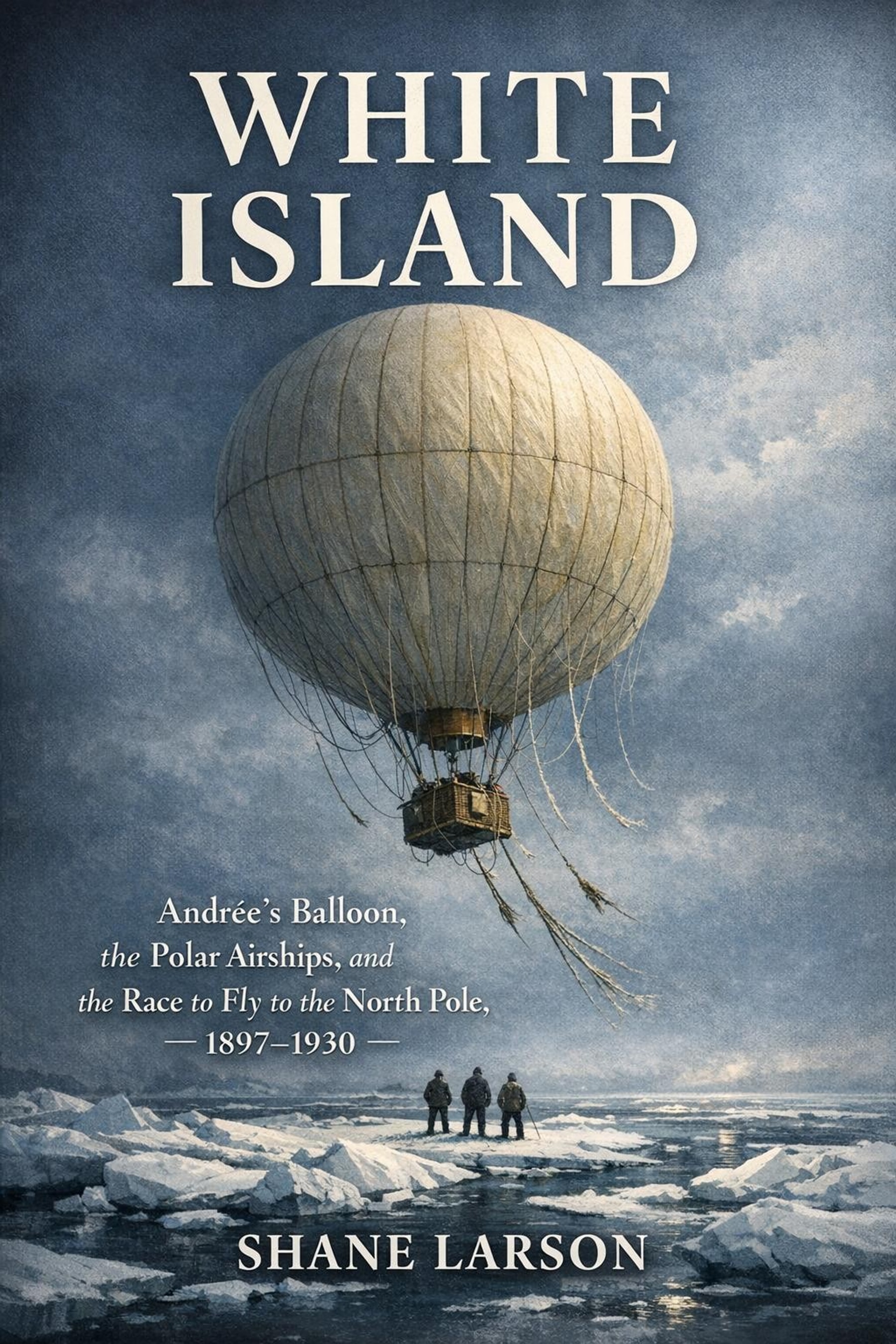
White Island
Andrée's Balloon, the Polar Airships, and the Race to Fly to the North Pole, 1897–1930
By Shane Larson
About This Book
When the balloon had cleared the beach and was drifting out over the sound, the men left standing on Danskøya looked down and saw rope. Three heavy drag lines had been laid out on the shingle so that they would pay out as the balloon rose. Most of each one was still there. The sections had been joined with screw couplings, meant to let a snagged rope part safely, and by most accounts the twist of the rising balloon unscrewed all three.
Those ropes were the steering. Dragged across the ice, they were supposed to hold the balloon below the speed of the wind so that a sail could turn it, and to keep it at a steady height without anyone touching the ballast. Without them the Eagle was an ordinary free balloon, and it went where the weather sent it. That was 11 July 1897. The three men aboard had been in the air for perhaps five minutes.
They did not come back, and for thirty-three years nobody could say what had happened to them.
The Story
Salomon August Andrée was an engineer at the Swedish Patent Office who believed that the North Pole, which had beaten every ship and sledge sent toward it, could simply be flown over. Alfred Nobel and the king of Sweden paid for the attempt. Nils Strindberg, twenty-four, went as photographer. Knut Frænkel, twenty-seven, replaced a meteorologist who had measured how fast the balloon leaked hydrogen and resigned.
The flight lasted sixty-five hours and ended on the pack ice well short of the Pole. The three then hauled sledges across drifting floes for three months, first east, then south-west, while the ice carried them wherever it liked. In October they reached Kvitøya, White Island, a lump of ice cap with one strip of bare stones. The diaries stop soon afterward.
The book does not stop there, because the idea did not. Over the next three decades it was tried again and again from the same few miles of Svalbard coast. Walter Wellman, a Chicago newspaperman, built an airship shed beside Andrée's derelict balloon house. Roald Amundsen and Lincoln Ellsworth put two flying boats down at 87°44′N in 1925 and spent more than three weeks cutting a runway to get out. Richard Byrd flew north in 1926 and came back claiming the Pole, a claim his own diary later complicated. Three days after Byrd's flight the airship Norge crossed the Pole and went on to Alaska. In 1928 Hubert Wilkins and Carl Ben Eielson flew the other way, from Point Barrow to Spitsbergen, and a month later the airship Italia crashed on the ice north of Svalbard. Seventeen men died in the wreck and the rescue. Amundsen was one of them.
Two years after that, in a summer of unusually open water, the sealer Bratvaag stopped at White Island.
Why I Wrote This
What hooked me was the film. Strindberg carried a camera across the ice for three months, and the exposed rolls then lay in the snow for thirty-three years. When they were developed in Stockholm in 1930, the pictures showed the balloon lying on its side on the ice and the men standing beside it. I cannot think of another lost expedition that came back with its own photographs.
The longer I read, the less the story stayed with those three men. The harbor they left from was used again by the next attempt, and the one after that. The people involved kept reappearing. And I live in Alaska, which turned out to be the far end of most of these plans: the Norge landed at Teller, and Wilkins and Eielson took off from Barrow.
I also liked that the best questions are still open. Nobody knows for certain why Andrée and his companions died with food on hand, or how far north Byrd got. I have tried to lay out what is known and leave it there.
Frequently Asked Questions
What happened to the Andrée balloon expedition of 1897?
The balloon lost most of its drag ropes at launch, flew for about sixty-five hours and came down on the pack ice on 14 July 1897. Andrée, Strindberg and Frænkel walked across the ice for three months and reached Kvitøya (White Island) in early October, where all three died. Their camp was found on 6 August 1930.
How did the Andrée expedition members die?
It has never been established. The camp held food, fuel and ammunition, so starvation is unlikely. Proposals include exposure and exhaustion, trichinosis from undercooked polar bear meat, carbon monoxide from the stove, and a polar bear attack on Strindberg. The bodies were cremated in 1930, which closed off most further testing. The book sets the theories side by side and does not pick one.
Did Richard Byrd really fly over the North Pole in 1926?
That is disputed, and the book treats it as a dispute. Byrd reported reaching the Pole on 9 May 1926 and was honored for it. Doubts about the aircraft's speed were raised at the time, and a flight diary published in the 1990s contains sextant figures that some analysts read as showing he turned back short. Others defend the claim. If Byrd did fall short, the first people certain to have seen the Pole were the crew of the Norge, three days later.
How did Roald Amundsen die?
He disappeared on 18 June 1928 after leaving Tromsø in a French flying boat, the Latham 47, to join the search for the crew of the crashed airship Italia. A float and a fuel tank from the aircraft were later recovered. The wreck and the six men aboard have never been found.
Is this book only about Andrée?
No. Andrée's expedition opens and closes it and takes up about a third of the pages. The rest follows the airships and aircraft that tried the same route between 1906 and 1928.
If You Liked This, You Might Like
- A Ton of Goods — The Klondike stampede began the same summer the balloon left Svalbard, and it is another story of people heading north with the wrong equipment.
- The Norse in Greenland — An Arctic settlement that went silent, reconstructed from what its people left in the ground.
- The Alaska Purchase — How the territory at the far end of the transpolar flights came to be American in the first place.
- The Pioneer Road — Fifteen years after the Norge landed at Teller, the Alaska Highway was cut through the same North by men working in the same cold.
The first people to try to fly to the North Pole were the last to be accounted for. This book follows what happened in between, and says where the evidence ends.
What You'll Learn
- How drag-rope steering was meant to work, why Andrée trusted it, and what the balloon became in the minutes after it lost them.
- The first attempt, in 1896, when the wind never turned, and the leakage figures that led Nils Ekholm to walk away from the second.
- The three months on the ice, reconstructed from Andrée's diary, Strindberg's log and letters, Frænkel's weather journal and the surviving photographs.
- Walter Wellman's airship America and its equilibrator, a trailing tube of provisions that was supposed to improve on the drag rope and failed in much the same way.
- The 1925 flying-boat expedition: six men, one usable aircraft, and a runway stamped out of a moving floe.
- The Byrd flight as an evidence problem: the official report, the diary found in 1996, the speed question, and the arguments on each side, with no verdict imposed.
- The Norge and the quarrel that followed it, over whether the flight belonged to Amundsen, who led it, or Umberto Nobile, who built and flew the ship.
- The Italia disaster and the rescue: the red tent, the walk of Finn Malmgren and two Italian officers, the Soviet icebreaker Krassin, and Amundsen's last flight.
- The 1930 discovery in detail: what the two landing parties found, what the developed film shows, and every serious theory of how the three men died, each with its evidence and its weakness.
- Three appendices: a table of every aerial attempt from 1897 to 1931, an inventory of the Kvitøya find, and a who's who with a glossary of balloon and airship terms.
New World History releases and free chapters — no spam, unsubscribe anytime.
More in This Genre
View all →