The Oath Nobody Could Find: Why Britain Deported the Acadians in 1755
October 25, 2026 · 8 min read
In the autumn of 1755 the British government of Nova Scotia put something like six or seven thousand people onto ships and sent them down the Atlantic coast to be distributed among the other colonies, in parcels small enough that they could never reassemble. Over the next nine years the number would climb past ten thousand. The farms were burned behind them. The reason given, in the minutes of the council that ordered it, was that the Acadians had refused to swear an oath of allegiance to the King.
That is true as far as it goes. What it leaves out is that the Acadians had sworn an oath of allegiance to the King twenty-five years earlier, that the government in London had accepted it and had treated them as British subjects ever since, and that the thing they refused in 1755 was a second, harsher oath on top of the first. From where they stood they were not refusing allegiance. They were declining to be asked twice.
I spent a book on what happened to these people, and the thing I want to set out here is the hinge the whole story turns on, because it is usually dispatched in a sentence. It is not a battle. It is a promise that one side remembered and the other side never wrote down.
Sixteen years of no
Britain acquired peninsular Acadia, which it called Nova Scotia, by treaty in 1713. The French-speaking, Catholic farming population that came with it, some two thousand people on the salt marshes of the Bay of Fundy, was given a year to leave. Nearly all of them stayed, because leaving meant abandoning dyked land their grandfathers had built, and because the British garrison at Annapolis Royal, a few hundred men in a fort with slumping earth walls, could neither make them go nor afford to lose the only farms in the colony.
From then on the governors asked for an oath of allegiance, and the Acadians answered with a condition. They would promise to be faithful to the British king. They would not promise to fight for him, and specifically not against the French, who were their kin across the isthmus, or against the Mi'kmaq, who were their neighbours in the woods and who would take a dim view of Acadians turning up in arms beside the garrison. A people who had watched their fort change hands half a dozen times in a century had every reason to think it might change hands again.
The British, for their part, developed a practice of their own. In 1726 a lieutenant-governor got the Annapolis River settlements to swear on a text whose English version was unconditional and whose French version, the one the Acadians actually signed, carried a note in the margin exempting them from bearing arms. The following year a junior officer sent up the bay to administer the oath to the new king came back with signatures and a set of concessions he had granted to get them, including the same exemption. The council voided the concessions as given without authority, and kept the oaths. That precedent, something less than was asked for, written down as something closer to what was wanted, and reported to London as a success, was in place before the governor who finally settled the matter ever landed.
What Philipps said, and what he sent
Richard Philipps had been governor since 1717 and had spent perhaps two years of it in the province. In 1729, pressed by the Board of Trade, he came back, and within eight months he did what four predecessors had failed to do. The Annapolis settlements swore before the year was out. In April 1730 he went up the bay himself, to Minas and Pisiquid and Cobequid and Beaubassin, and came back with the rest.
The oath he administered was short and it was unconditional. The inhabitant promised, on the faith of a Christian, to be entirely faithful to King George the Second and to obey him as the sovereign lord of Nova Scotia. There was nothing about arms. There was nothing in the margin. Philipps sent the lists of names to London and reported that the whole province had submitted. The Board of Trade was pleased. From that point the government in London took the Acadians to be British subjects in the full sense.
What the Acadians believed they had sworn was something else. They said, repeatedly, to every governor who asked over the next quarter century, that Philipps had promised them in person, in the King's name and in front of witnesses, that they would never be required to bear arms, and that they had sworn the unconditional text on the strength of that promise. They did not claim it was written into the oath. They claimed that a governor's word, given that way, was as binding as anything on paper.
The Acadian Expulsion
There is a document. It is dated April 25, 1730, at the Minas Basin, in the middle of Philipps's tour, and it was signed by the two priests then serving the Minas parishes. In it they certified that the governor had promised the inhabitants exemption from taking up arms against anyone, French or Native, and that on that understanding the people had sworn. It is short, it is contemporary, and it survives in the French archives. It was not produced in 1755 by people trying to escape a ship, or in the nineteenth century by nationalists trying to vindicate their ancestors. It was written the same week as the oath.
It is also French and Catholic, written by two priests whose superiors were in Quebec and whose salaries came from France, and a historian who wants to discount it can do so on those grounds. Some have. But nobody seriously argues that the Acadians invented the promise later, because the certificate exists and so does twenty-five years of consistent testimony. And nobody seriously argues that Philipps wrote the exemption into the oath, because he plainly did not. What is argued is what the spoken promise was worth. To Philipps it was evidently the price of a report that would satisfy London. To the Acadians it was the substance of the bargain. To every official who came after him, it was nothing, because it was not in the file.
The arrangement, and the men who stopped believing in it
For twenty-five years both sides lived with that gap, and it worked better than anyone had a right to expect. The British called the Acadians the neutral French, which was a description and a complaint at once. The Acadians farmed, multiplied past seven thousand, sold cattle to the garrison at Annapolis and to the French fortress at Louisbourg both, and kept out of the wars to the degree that a people on a war frontier can. When fighting came through the Minas villages in the 1740s, a few Acadians helped the French, most tried to help nobody, and the British afterwards found it hard to tell the two groups apart. The governor who ran the province through that war, a Huguenot who spoke French as his first language, accepted the Acadian understanding in practice and never asked them to fight.
The arrangement depended on three things. A British government too weak to demand more. A French government too far away to offer more. And a run of officials at Annapolis willing to honour a promise they could not have written down, because the Board of Trade would never have approved it.
All three changed at once. In 1749 a new governor sailed into Chebucto harbour with thirteen transports of Protestant settlers and orders to build the town that became Halifax. He brought a copy of the oath as written and no memory at all of what anyone had said at Minas in 1730, and he read the exemption as an Acadian invention. Six years later, with a new war beginning and a British force fresh from taking the French fort at Beauséjour, his successor summoned the Acadian deputies to Halifax and demanded the unconditional oath. The deputies offered the old one. The council ruled that an oath with a reservation was no oath, that people who would not swear could not be trusted in a province at war, and that they should be removed. Their continued appeal to a promise nobody in the room had witnessed was taken as evidence of bad faith.
Philipps had died in England in 1750, in his late eighties. He had never been asked.
Historians still disagree about what the deportation was. One reads it as ethnic cleansing and argues the term fits. Others read it as a security measure with a long and specific history, taken by officers who had run out of patience in the middle of a war. A third reading, as old as the event, points at the New England merchants who got the shipping contracts and the New England farmers who wanted the marsh. The book sets those readings out side by side and leaves the weighing to the reader. But every one of them has to pass through the same door, which is that the Acadians were deported for refusing to swear a thing most of them believed they had already sworn, on terms they had been told were acceptable, by a governor who was dead.
The oath is the least dramatic document in the story. It is also the one that explains it.
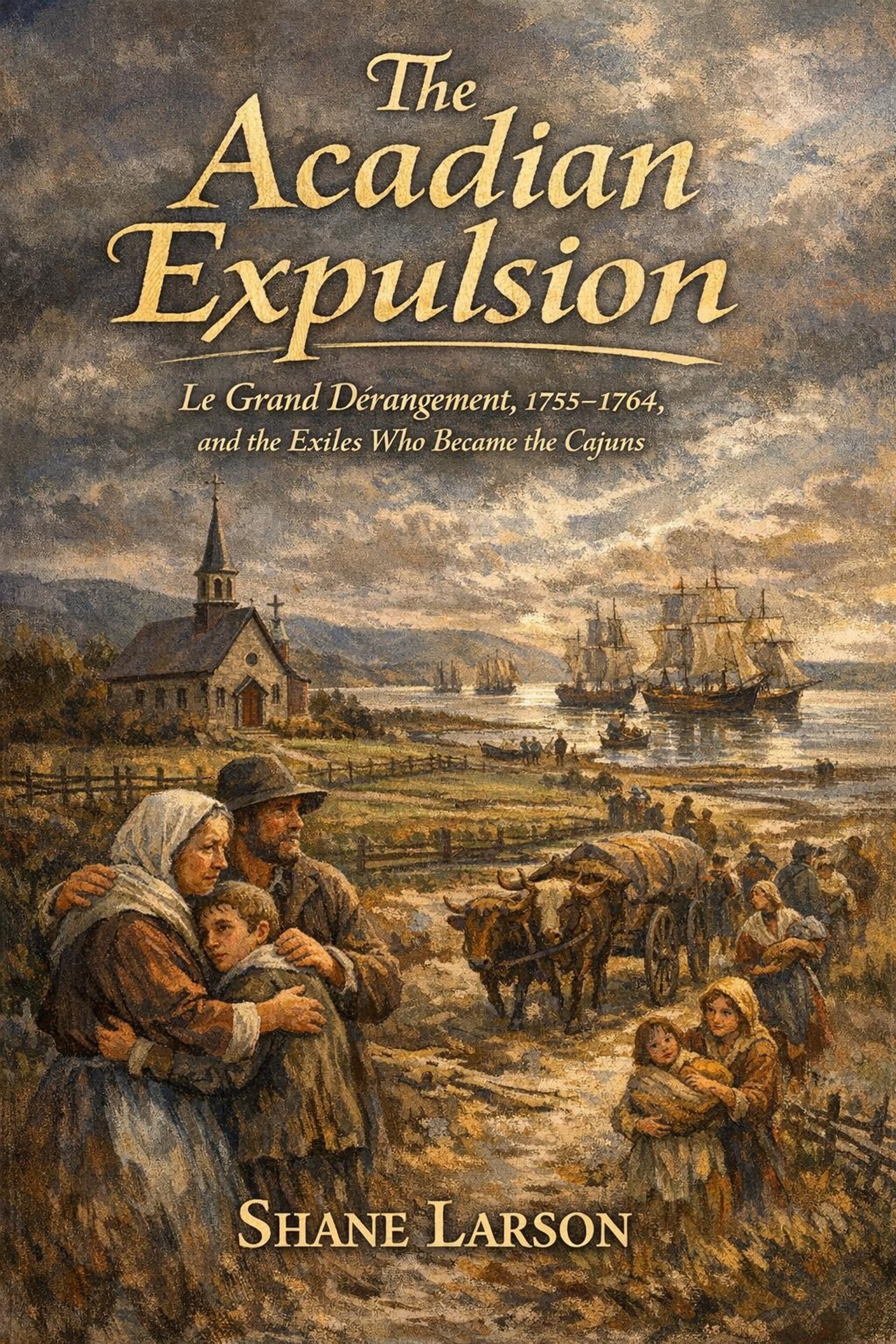
*The Acadian Expulsion: Le Grand Dérangement, 1755–1764, and the Exiles Who Became the Cajuns* is available now as an ebook from Apple Books, Kobo, Barnes & Noble and other retailers. It follows these people from the dyked marshes of the Bay of Fundy, through the ships and the nine colonies and the English prisons and the French provinces that did not want them, to the Louisiana prairies where they became the Cajuns, and it reads cold for anyone arriving from Longfellow. Readers coming from the American side of the story will find the colonial seaboard where the ships were put ashore in *The Notebook*.
The Acadian Expulsion
New posts and releases, straight to your inbox. No spam, unsubscribe anytime.