Everything Written About Alexander the Great by People Who Knew Him Is Lost
July 10, 2026 · 5 min read
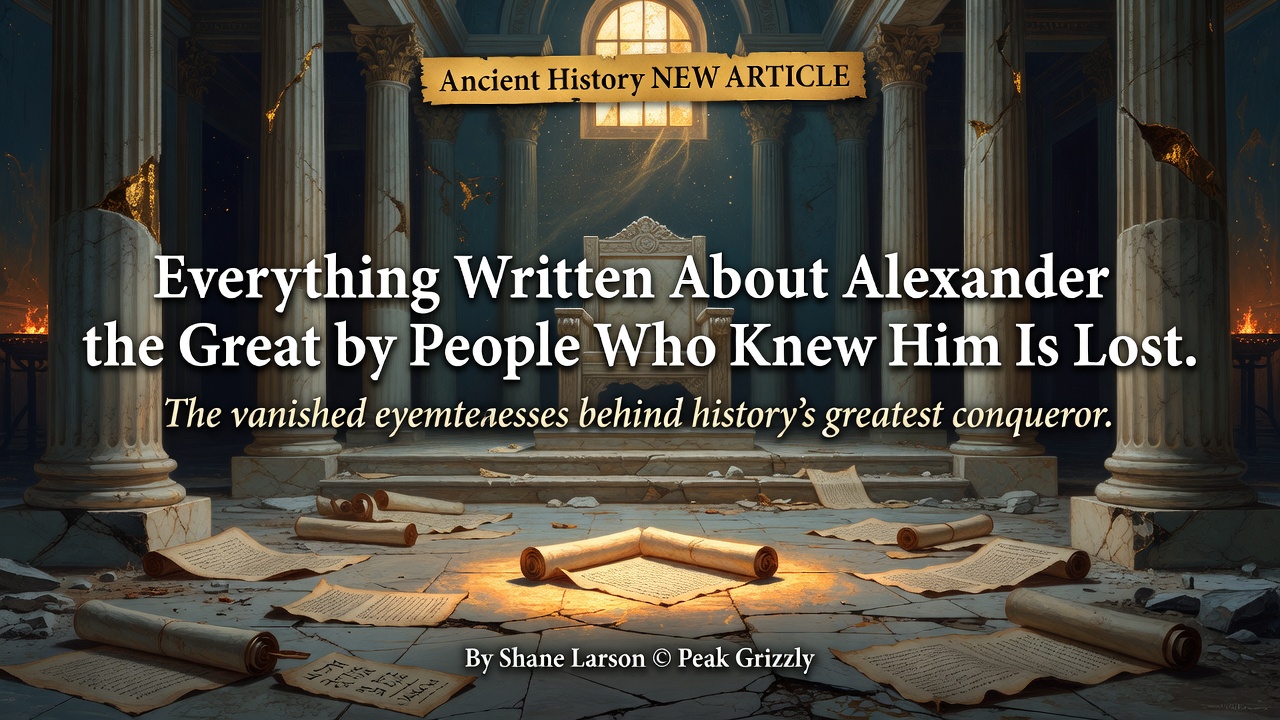
Here is a fact that should be more famous than it is: every single account of Alexander the Great written by someone who actually knew him has been lost.
Ptolemy — his general, his possible half-brother, later king of Egypt — wrote a detailed campaign memoir. Gone. Aristobulus, the engineer who served through the whole conquest, wrote his own account. Gone. Callisthenes, the official campaign historian (Aristotle's great-nephew, hired to make the king look good, executed when he stopped), published as the army marched. Gone. Nearchus, who commanded the fleet down the Indus and along the Persian Gulf — gone. The royal journals themselves, the day-by-day court records — gone, except for a few disputed fragments quoted by later writers.
Everything you have ever read about Alexander descends from books written three to five centuries after his death — Arrian and Plutarch in the Roman era, Curtius Rufus, Diodorus — historians doing their honest best (mostly) with sources that no longer exist. It is as if every firsthand account of Napoleon had burned, and we reconstructed him entirely from biographies written last century, by authors with their own agendas, quoting memoirs we could never check.
Once you know this, the entire Alexander shelf reads differently. And more interestingly.
How to Read a Legend
Take the most famous Alexander story of all: the boy taming Bucephalus, the horse no grown man could ride, after noticing it feared its own shadow. Wonderful story. It comes to us from Plutarch, writing four hundred years later — a moralist who openly composed his biographies to illustrate character, and who introduces the tale in exactly that spirit. Is it true? Maybe. It's the kind of story courts generate about princes, and the kind biographers keep because it's too good to lose. The honest answer is: we can't know, and anyone who tells it as flat fact has stopped doing history.
Or the Gordian knot. Two versions survive: Alexander slashes it with his sword (the famous one), or he quietly pulls the pin that held the yoke and lets the knot fall apart (the clever one, from Aristobulus via Arrian). The sword version is better theater. The pin version was written by an eyewitness — whose book we know only through another man's summary. Which happened? Pick your source. That choice, multiplied by a thousand, IS Alexander scholarship.
This isn't cause for despair. It's cause for discipline — and the discipline turns out to make the story better, not worse, because the parts that survive scrutiny are astonishing enough.
What Actually Survives Scrutiny
Strip away everything doubtful and you still have this: a twenty-two-year-old crossed into Asia in 334 BC with about 37,000 men, against an empire of perhaps twenty-five million. Twelve years later he was dead in Babylon, undefeated, master of everything from the Adriatic to the Punjab. Those are not legends. The empire really fell. The cities really got founded — one of them still carries his name and five million people. The battles are attested from multiple independent lines of the tradition, and their locations, participants, and outcomes are as solid as ancient history gets.
Alexander the Great
So is the inheritance, which the hero-myth systematically obscures: the army that did all this was built by Alexander's father. Philip II spent two decades turning Macedon from a despised, unstable borderland into the finest military machine on earth — the eighteen-foot sarissa pikes, the professional year-round soldiery, the Companion cavalry, the siege train. Alexander was a general of genuine genius. He was also handed, at twenty, the best instrument any commander had ever held, and the invasion of Persia was literally his father's war — planned, announced, and begun before the assassination that made the son king. Any honest telling of Alexander starts with Philip.
And so is the other half of the story, the one usually reduced to scenery: Persia. The Achaemenid Empire had governed a quarter of the human race for two centuries — competently. Satrapies, royal roads, religious tolerance, functioning multi-national taxation. It wasn't a rotten door waiting to be kicked. Its fatal flaw was structural: legitimacy lived entirely in the king's person, so when Darius III fled at Issus and again at Gaugamela — decisions defensible as strategy, since a dead Great King meant instant collapse — his nobles each faced a rational choice between a fugitive and a conqueror who paid the army and honored the temples. Babylon's governor Mazaeus surrendered the city and kept his job. Empires don't die when their armies lose; they die when their elites change their bets.
The Myth Started Immediately
Within a generation of the fever that killed him at thirty-two, Alexander was becoming something no evidence supports: a demigod. The lost eyewitness books were already partisan — Ptolemy wrote as a king legitimizing his own rule, Callisthenes flattered for pay while he lived. Then came the Alexander Romance, a fantasy novel of the ancient world that made him the son of an Egyptian sorcerer-pharaoh and sent him to the bottom of the sea in a glass bell — and which, for over a thousand years, was translated into more languages than any book except scripture. Roman generals posed at his tomb. Medieval Europe, Persia, and Ethiopia all folded him into their own legends. The man vanished into the mirror.
That process — how a documented human being becomes a myth in real time — is itself one of the best stories antiquity has to offer. And it's only visible if you keep the record and the legend rigorously apart.
That's what my new book does. Alexander the Great: The Twelve Years That Remade the World tells the whole arc — Philip's machine, the succession murder, Granicus, Issus, and Gaugamela, the Persian collapse from the Persian side, Siwa and the uses of divinity, the hard war in Bactria, the mutiny in India, the desert, the fever, and the instant myth — in a book you can read in two evenings, honest at every step about what we know, what we infer, and where the sources simply run out.
Alexander the Great
New posts and releases, straight to your inbox. No spam, unsubscribe anytime.