The Oldest Written Greek Isn't Poetry. It's Receipts.
July 9, 2026 · 5 min read
In the summer of 1952, a 30-year-old English architect named Michael Ventris sat down at a BBC microphone and announced, almost apologetically, that he had solved a problem that had defeated professional scholars for half a century. The clay tablets dug out of Bronze Age palaces in Crete and southern Greece — inscribed in an unreadable script called Linear B — were written in Greek.
That sentence sounds mild. It detonated a thousand years of assumed history.
Greek wasn't supposed to exist yet. The tablets came from palaces that burned around 1200 BC — five centuries before anyone believed Greek was written down, centuries before Homer. If the tablets were Greek, then the palaces were Greek, and the age of heroes that Greek poets sang about — Agamemnon's Mycenae, Nestor's Pylos, the war at Troy — sat on top of something real: a lost civilization of Greek-speaking warrior kings that archaeologists had been digging up for seventy-five years without being able to read a word it wrote.
And then came the joke history played on everyone. Scholars opened the newly readable archive of the earliest Greek ever written, braced for poetry, prayers, the raw material of epic.
They got paperwork.
The Civilization That Wrote Everything Down and Said Nothing
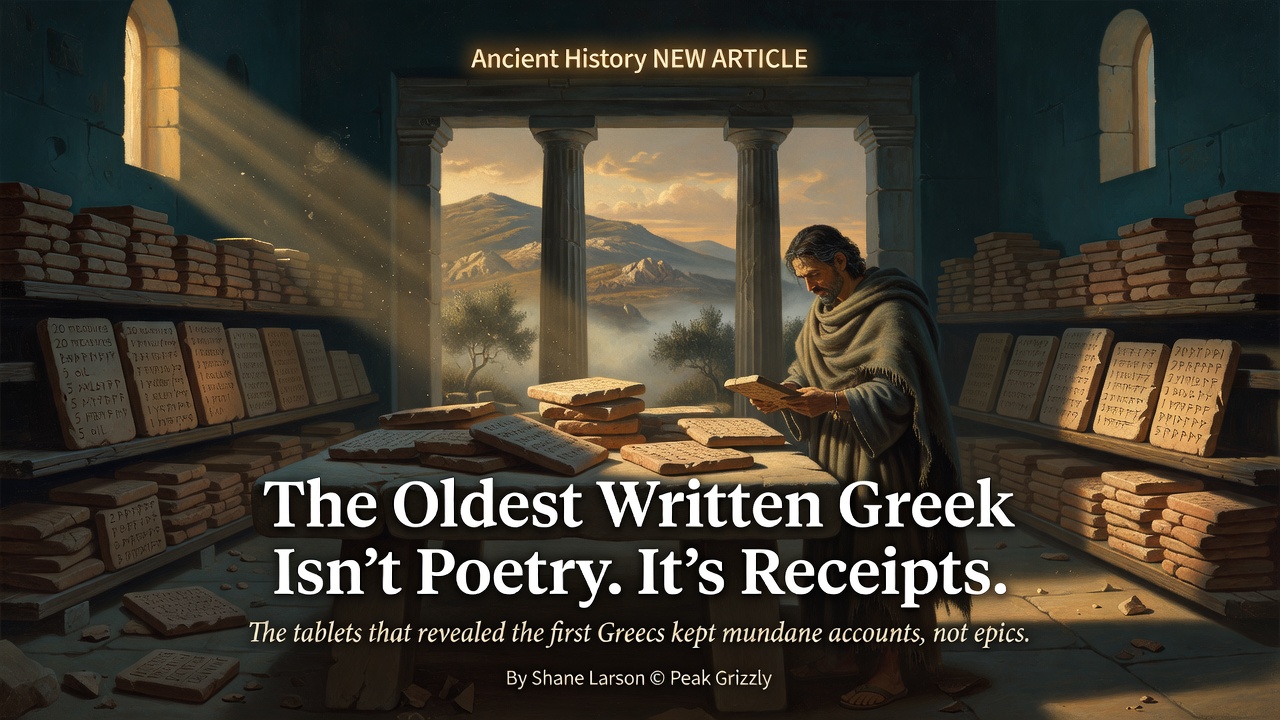
The Linear B tablets are receipts. Ration lists for textile workers and their children, measured out in grain and figs. Inventories of chariot wheels, serviceable and broken, in the palace workshops. Bronze allocations to named smiths, with quotas. Land-tenure records. Rowers mustered to watch a coastline. Offerings of oil and honey scheduled for the gods — including a Poseidon who, at Pylos, outranked Zeus.
Not one line of narrative. Not one law, one letter, one poem. The scribes of Mycenaean Greece wrote down everything the palace needed to track and nothing it needed to remember. The tablets were meant to be scraped and reused after the accounting year; the only reason we have them at all is that the fires that destroyed the palaces baked the clay hard. The archive survived because the world ended.
Here's the thing, though: the paperwork turned out to be a better witness than poetry could ever have been. Epic tells you what a civilization wanted to believe about itself. Receipts tell you what it actually did on a Tuesday.
What the receipts describe is a command economy of startling precision — and startling fragility. Everything flowed through the palace: wool in, cloth out; bronze in, swords and plowshares out; grain in, rations out. No money. No visible markets. No apparent written law. The palace was the economy's operating system — which meant that when the palaces burned, there was no fallback. The system didn't degrade gracefully. It ceased. Writing itself, a technology the scribes alone practiced for the palace alone, vanished from Greece for four hundred years.
Centralization buys efficiency and sells resilience. The Mycenaeans paid in full, and their creditors were the centuries we now call the Greek Dark Age.
The Professor With 180,000 Index Cards
The decipherment itself is one of the great intellectual detective stories of the twentieth century, and its most important chapter is the one that usually gets skipped.
The Mycenaeans
Arthur Evans found the first tablets at Knossos in 1900 and spent four decades guarding them like dragon's gold — publishing slowly, controlling access, and insisting to his death that the language could not possibly be Greek. The professionals who tried to crack the script mostly started from a guess about what the language was and worked backward, which is how you stay lost for fifty years.
Alice Kober, a classics professor at Brooklyn College, did something different. Through the 1940s, working nights at her kitchen table, she refused to guess at all. She catalogued sign patterns on index cards — 180,000 of them, hand-cut from whatever paper wartime rationing allowed, filed in cigarette cartons — and proved, through pure pattern analysis, that the hidden language was inflected: words changed their endings, like Latin, like Greek. Her grids of related sign-groups were the structural key to the whole problem. She died in 1950, at 43, two years before the door she'd built swung open.
Ventris — who had been obsessed with the script since hearing Evans lecture when he was a schoolboy — took the grid method further, made one brilliant guess (that certain recurring sign-groups were place names: Knossos, Pylos, Amnisos), and watched the syllabary unlock. The language behind the signs was Greek. He'd spent years assuming it wouldn't be. When the evidence said otherwise, he followed the evidence — the exact discipline Evans never managed with his own tablets.
Four years after the announcement, Ventris was dead in a late-night road accident at 34. He and Kober between them had given Greek history back five hundred lost years, and neither lived to see forty-five.
The Legend Was the Backup Copy
There's one more turn in this story, and it's my favorite. After the palaces burned around 1200 BC — the suspects include the Sea Peoples, drought, earthquake, internal revolt, and the brittleness of the palace system itself, and the honest answer is "several at once" — Greece forgot nearly everything. The script died with the scribes. The citadel walls at Mycenae and Tiryns stood so far beyond the engineering of the survivors' descendants that they decided giants must have built them.
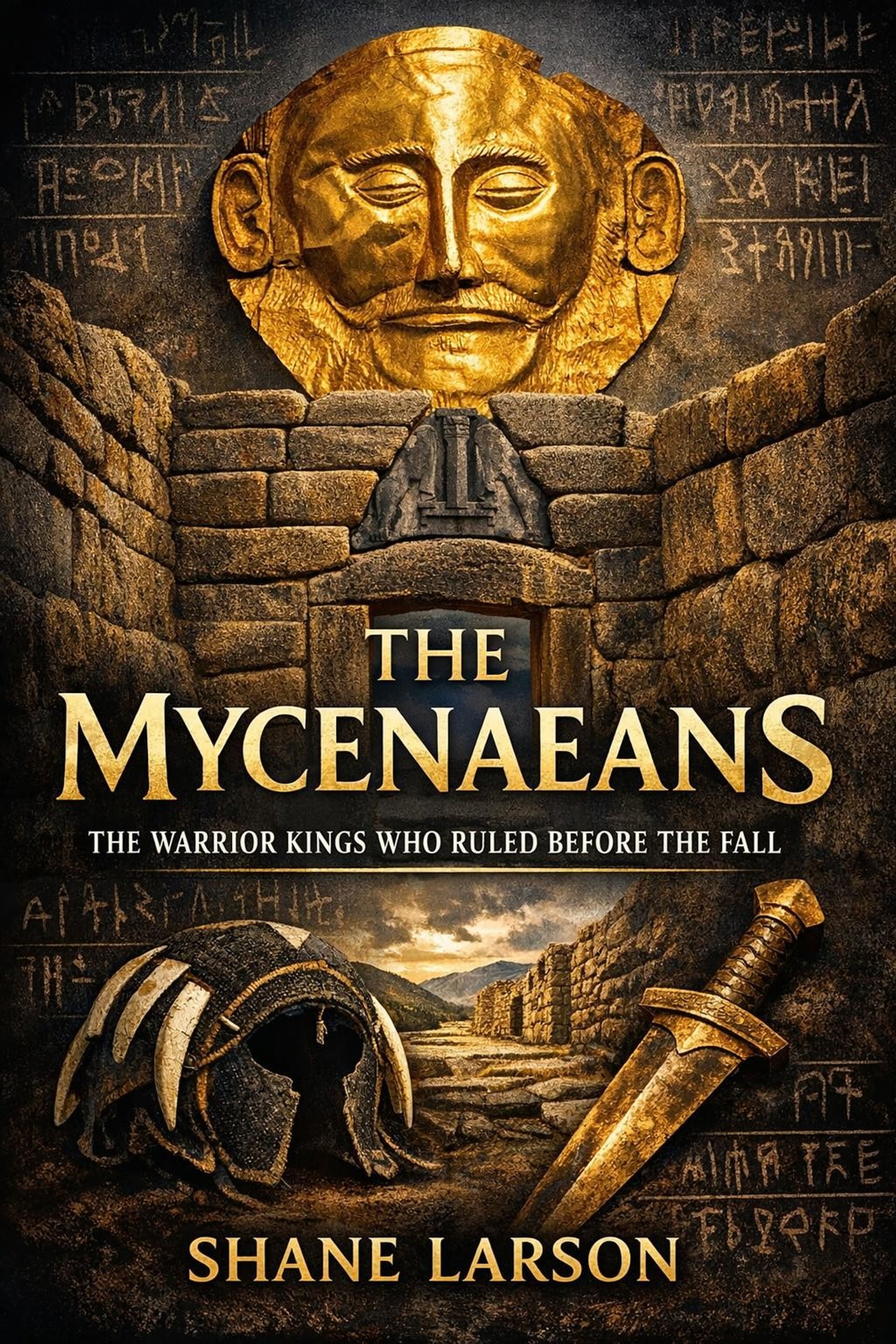
But four hundred years of illiterate bards, singing in the ruins, kept a garbled copy of the lost world alive. When the poems were finally written down as the Iliad and the Odyssey, they preserved details no poet of 750 BC could have invented: boar's-tusk helmets that archaeologists have since pulled out of Bronze Age graves, tower shields centuries obsolete, a political geography of kingdoms that matches the tablet archives better than it matches classical Greece. The epic tradition was a lossy, mythologized, unreliable backup — but it was a backup, made by a civilization that had lost every other storage medium.
The tablets and the epics are two witnesses to the same lost world: one wrote down everything and explained nothing, the other explained everything and documented nothing. The real history of the first Greeks lives in the space between them — and that space is exactly what my new book explores.
The Mycenaeans: The Warrior Kings Who Ruled Before the Fall tells the whole arc: the mysterious gold of the shaft graves, the conquest of Minoan Crete, the palace world reconstructed from its own records, the Hittite files on a troublesome western power near a city that was almost certainly Troy, the collapse of 1200 BC, and the long afterlife in legend. Evidence first, Homer second — and honest, at every step, about what we know and what we don't.
The Mycenaeans
New posts and releases, straight to your inbox. No spam, unsubscribe anytime.