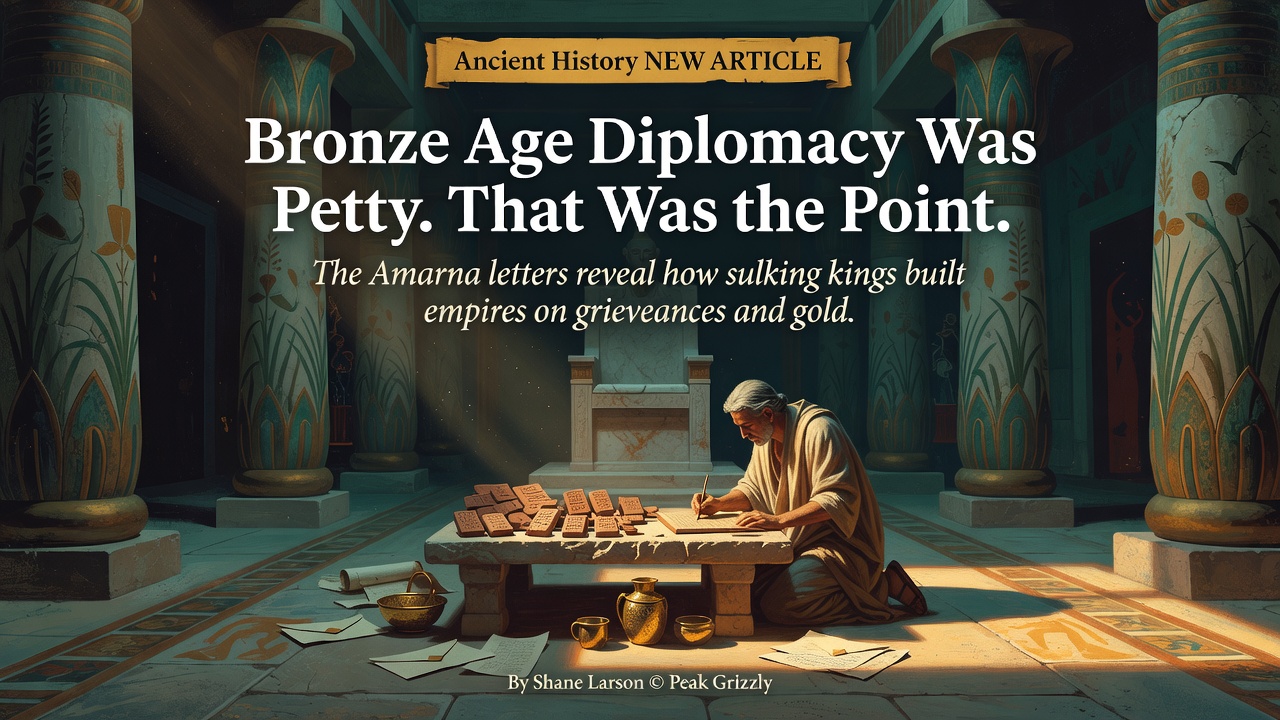
Bronze Age Diplomacy Was Petty. That Was the Point.
August 17, 2026 · 8 min read
Sometime in 1887 — the exact date was never recorded, because nobody involved thought it mattered — an Egyptian woman was digging in the ruins of a dead city in Middle Egypt. She was not looking for antiquities. She was looking for sebakh, the decayed mud brick of ancient buildings, which local farmers dug out and spread on their fields as fertilizer. The city she was mining had been built fast, occupied for perhaps fifteen years by the court of the pharaoh Akhenaten, and then abandoned so thoroughly that it was never built over — which is why, that day, her digging turned up clay tablets covered in dense wedge-shaped writing.
Cuneiform tablets are not supposed to come out of Egypt. Cuneiform is Mesopotamian; Egypt wrote on papyrus and stone, in its own scripts. So when the tablets reached the antiquities dealers, several experts pronounced them forgeries — clumsy ones, at that. They were sold off in cheap lots, scattered through the market, and hauled in sacks across the country; an unknown number were ground to powder in transit. By the time scholars in Europe realized what they were looking at and started buying frantically, the find had been strewn from Cairo to London to Berlin. What survived, once the corpus was reassembled across a dozen collections, came to roughly 350 tablets.
They turned out to be the diplomatic archive of the Egyptian state in the mid-fourteenth century BC — the incoming correspondence of the superpower of the age, left behind in a filing room when the court moved out. Letters from the kings of Babylon, Assyria, Mitanni, the Hittites, Cyprus, and Anatolia, and from dozens of small-time rulers across Canaan and Syria, all written in Akkadian — a Mesopotamian language native to almost none of the people using it, the diplomatic lingua franca of the entire eastern Mediterranean, the way French once was in Europe.
Nothing like this archive survives from anywhere else in the ancient world. And the first surprise, for anyone expecting the marble solemnity of ancient statecraft, is what the great kings of the earth actually wrote to each other about.
The gold was underweight, and other affairs of state
The king of Babylon, Burna-Buriash, writes to Pharaoh with a grievance he has clearly been nursing. The last shipment of gold from Egypt, he reports, was put in the furnace — and when it was melted down and weighed, it came up far short of the amount promised. Not slightly short. Insultingly short (EA 7 and its companions return to the theme more than once). In the same stretch of correspondence he complains that when he was sick, his brother the pharaoh never sent anyone to ask after his health.
An earlier Babylonian king has a darker version of the same complaint. His sister had been sent to Egypt years before as a royal bride and had effectively vanished into the palace; the woman paraded before his messengers might have been anyone. He wants proof his sister is alive.
Tushratta, king of Mitanni in northern Syria, writes the longest and neediest letters in the archive. He wants gold — for a mausoleum, for a dowry, for the general maintenance of his dignity — and he supports the request with what may be the oldest surviving version of a line every fundraiser still uses: gold, he assures Pharaoh, is so abundant in Egypt that it might as well be dirt (EA 19). Surely his brother will not miss some. In another letter (EA 23) he sends the statue of Ishtar of Nineveh, his kingdom's great goddess, on a visit to Egypt — scholars still argue over whether she came to bless a diplomatic marriage or to heal an ailing pharaoh, but either way the goddess traveled with a cover letter asking that she be treated well and sent home.
The king of Alashiya — Cyprus, the copper source of the Bronze Age world — writes to apologize for a small shipment. He has excellent cause: plague has swept his island and killed his coppersmiths (EA 35). Having apologized, he pivots smoothly to asking for silver, in quantity.
And running under all of it is protocol so touchy it would embarrass a modern embassy. Great kings address each other as "brother" — membership language in the most exclusive club on earth — vassals grovel as servants, and everyone polices the boundary. When upstart Assyria starts writing to Egypt directly, Babylon fires off a furious letter insisting the Assyrians are Babylonian subordinates with no right to correspond at pharaonic level. Egypt, for its part, maintains one rule it never bends: foreign princesses come to Egypt, but no daughter of Egypt is ever sent abroad, to anyone. A Babylonian king, stung by the refusal, replies with something close to a shrug: fine — then send a beautiful woman, any beautiful woman, and who will know she isn't a princess? (The exchange survives in EA 4.)
It reads, in other words, like a family group chat among relatives who are rich, prickly, and not entirely sure they like each other. Which brings us to the second surprise: none of this pettiness is a failure of the system. It is the system.
The Amarna Letters
Auditing the brotherhood
There was no international law binding Egypt to Babylon, no neutral arbiter, no way to enforce anything across a thousand miles of desert and sea. What held the club of great kings together was a continuous, calculated exchange of gifts, brides, and messengers — and the only way to know where a relationship stood was to test it, constantly, and complain the moment it slipped.
Melting down the gold and weighing it was not paranoia; it was an audit. Gift exchange between kings was the international finance of the age — gold flowed out of Egypt, horses and lapis lazuli and copper and skilled labor flowed back — and a short shipment was simultaneously a budget problem and a diplomatic signal. Was the pharaoh distracted? Broke? Losing respect for Babylon? A king who accepted underweight gold without protest was announcing that he could be shorted. The complaint was not a breach of etiquette. The complaint was the etiquette.
The same goes for the sulking over health inquiries, the haggling over dowries, the years-long marriage negotiations with their escorts and inspections. Every exchange was a measurement of standing, taken because standing was the only security anyone had. Read this way, the Amarna letters stop being an amusing pile of royal grievances and become something rarer: a functioning international order, documented from the inside, at the level of its daily maintenance. The Late Bronze Age had a working multipolar diplomacy — dynastic marriage, extradition, resident messengers, summitry by correspondence — a thousand years before classical Greece, and the pettiness in the letters is the sound of that machinery running.
Then there is the other half of the archive, where the machinery is failing.
Sixty letters, no answer
Most of the tablets are not from great kings. They are from the small rulers of Canaan — Egypt's vassals, mayors of city-states like Byblos, Jerusalem, and Megiddo — and their letters are not about gold. They are about survival. Neighbors are seizing each other's towns. Loyal men are being denounced by rivals who are themselves writing to Pharaoh claiming loyalty. Rootless armed bands the letters call the Apiru are in the countryside, and city after city is going over to them.
One correspondent towers over all the others. Rib-Hadda, ruler of Byblos, wrote more than sixty of the surviving letters — the largest body of correspondence from any single person in the archive — and they trace, letter by letter, the destruction of everything he had. His towns defect or fall. His rival Abdi-Ashirta, and then Abdi-Ashirta's son Aziru, close in. His city grows hungry; his own family wavers. He asks Egypt for troops — a garrison, fifty archers, anything — and the requests get smaller as the situation gets worse. What answers survive suggest the imperial court found him exhausting. Eventually the letters stop, because Byblos was no longer his to write from: deposed in a coup while he was away seeking help, he ends the correspondence as an exile, still petitioning for troops, for a word, for a way home. There is no evidence he ever got one.
The archive breaks off in the 1330s BC, mid-conversation, when Akhenaten's city was abandoned and the working files were left in the dirt. The correspondents had no idea they were writing the last intact record of their world. Within about a century and a half, nearly every kingdom in the archive — Mitanni, Hatti, Alashiya, Ugarit, the palaces of Greece — had been destroyed or diminished in the cascade of collapse that ended the Bronze Age. The letters about underweight gold and unsent princesses became the "before" photograph of a vanished international order, and the desperate mail from Canaan turns out to have been the system's edges failing first, in real time, while the great kings at the center argued about shipments.
That is what makes these tablets, dug out of a fertilizer pit and sold as fakes, one of the most extraordinary survivals from the ancient world: nowhere else do the people of the deep past sound this alive — this proud, this aggrieved, this funny, this frightened — and nowhere else can you watch a whole world work, fray, and head toward an ending it cannot see.
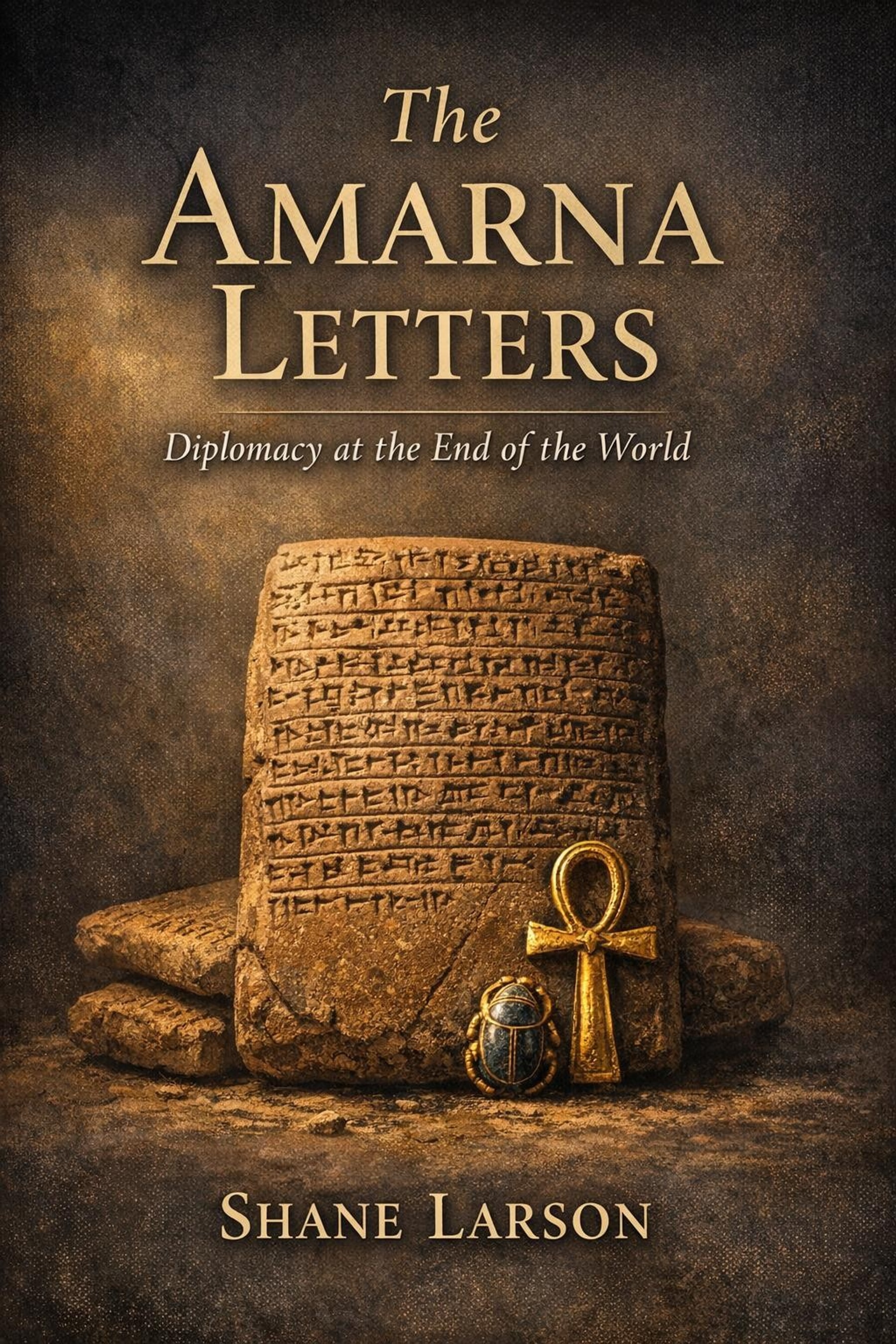
If you want the full story — the discovery and near-destruction of the archive, the kings behind the letters, Rib-Hadda's whole terrible saga, and how this diplomatic world connects to the collapse that followed — my book The Amarna Letters: Diplomacy at the End of the World tells it at length, with every letter paraphrased and cited by EA number for anyone who wants to chase the sources. The charm of these documents lies in what the kings say, and that survives retelling in any voice.
The Amarna Letters: Diplomacy at the End of the World is available now on Amazon Kindle.
The Amarna Letters
New posts and releases, straight to your inbox. No spam, unsubscribe anytime.