The 2022 Phrasebook That Let the Amorites Speak: Two Clay Tablets and a Language Known Only From Names
November 11, 2026 · 7 min read
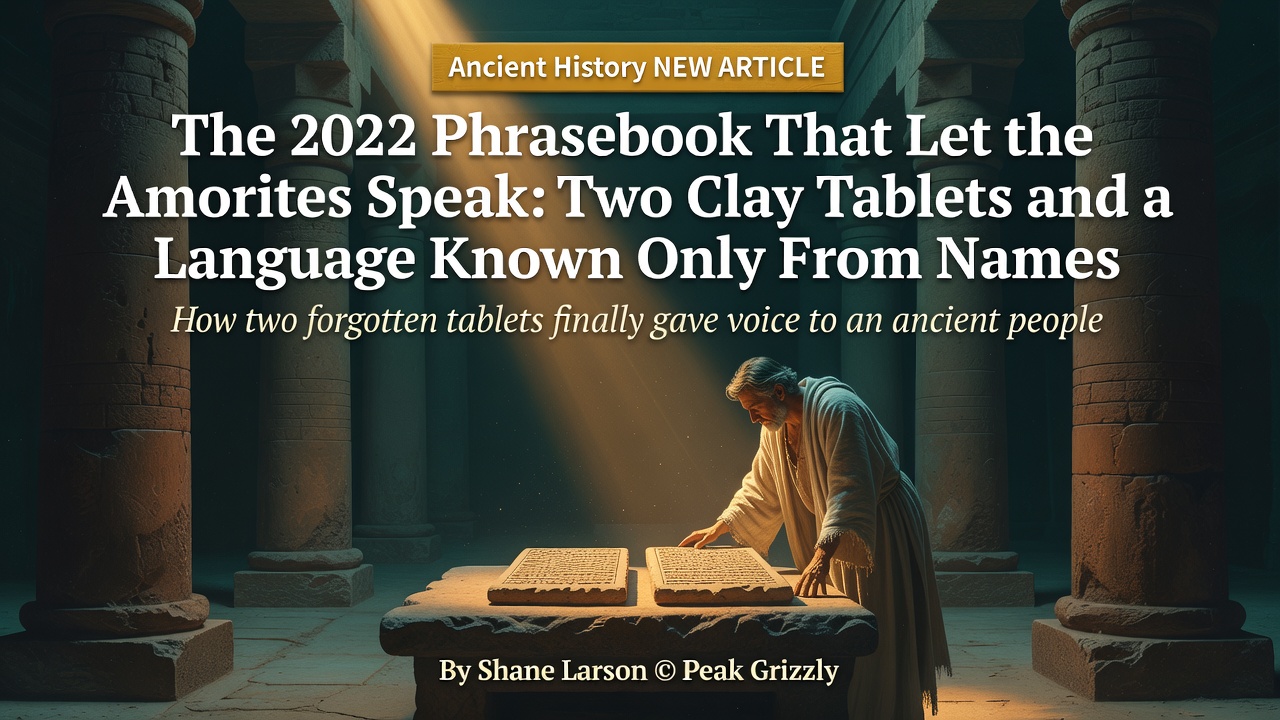
In 2022 the Revue d'Assyriologie published an article whose title ended in an exclamation mark. In a journal read almost entirely by people who decipher cuneiform for a living, that is roughly a front-page headline, and the two authors, Andrew George of SOAS in London and Manfred Krebernik of the University of Jena, had earned it. They had identified two clay tablets from the Old Babylonian period, the four centuries or so after 2000 BC, that carried text in two columns. One column was Akkadian, the Semitic language of Babylon, which scholars have read fluently for a century and a half. The other was in a language that had ruled Mesopotamia for three hundred years and that nobody had ever read a phrase of.
The language was Amorite. The tablets were, roughly speaking, phrasebooks.
A ruling class with no voice
To see why that mattered, it helps to know how odd the Amorite situation was. Mesopotamia is the best-documented region of the ancient world by a wide margin. Hundreds of thousands of cuneiform tablets survive in Sumerian, Akkadian, Eblaite, Hurrian, Elamite and Hittite. Some of those languages are known from only a few hundred texts, but they are known from texts: sentences with verbs in them, written by people who spoke them.
Amorite was different. From roughly 1900 to 1600 BC, in the conventional middle chronology, its speakers held nearly every throne between the Mediterranean and the Persian Gulf, at Babylon, Larsa, Mari, Aleppo, Qatna and Eshnunna, and for a generation at Assur. Hammurabi, who reigned at Babylon from about 1792 to 1750 BC, was an Amorite. So was Shamshi-Adad, who assembled the first great kingdom of northern Mesopotamia. And not one of these kings, nor any of their officials or scribes, left a single document written in Amorite. They wrote in Akkadian, and for ceremonial purposes in Sumerian, exactly as the kings they had displaced had done.
What they left instead was their names.
A language reconstructed from the labels on the jars
An Amorite personal name is very often a short sentence. Yasmah-Addu, the name of Shamshi-Adad's younger son, means something like Addu has heard, Addu being the storm god. Zimri-Lim, the last king of Mari, carries the name of the god Lim. Hammurabi itself is Amorite, and its parts can be read, though scholars argue about exactly how.
Because Mesopotamian administration recorded by name the people it paid, taxed, conscripted and received at court, thousands of these names survive embedded in documents written in other languages. Ignace Gelb catalogued several thousand of them in 1980; Michael Streck's study of the Amorite name-stock around the turn of this century refined the analysis considerably. From the names alone, scholars worked out a surprising amount. Amorite was Semitic. It belonged to the Northwest Semitic branch, alongside later Ugaritic, Phoenician and Hebrew, rather than to the East Semitic branch that Akkadian belongs to. It had a verb system unlike Akkadian's. Its speakers worshipped Addu, Dagan, El, Lim and others. A scatter of loanwords in Akkadian texts added a little more: a word for pasture-land, nawum, is one of them.
That is a great deal to extract from a list of names, and it is a tribute to the people who did it. It is also the linguistic equivalent of reconstructing a cuisine from the labels on the jars. A loanword is a word in someone else's sentence. Until 2022, nobody had read an Amorite phrase.
What the tablets are, and what they are not
The word phrasebook is a fair shorthand, but it can suggest the wrong thing, so it needs care. The tablets are not monuments. Nothing about them suggests a king commissioned them or that they were meant to last. They are bilingual lists of the kind Old Babylonian scribes used, with Amorite on the left and an Akkadian rendering on the right. One opens with word lists, gods first and then everyday vocabulary, and goes on to longer phrases. The other is made up of phrases for ordinary social exchange. Why someone wrote them is not known, but a lesson in the speech of Amorites is the obvious guess: someone in a Babylonian city, around the time of Hammurabi or a little before or after, thought that need worth writing down.
The comparison with a traveller's pocket phrasebook holds in one more way. A phrase list exists because the other side matters. Nobody bothers to record phrases in a language whose speakers do not count.
The Amorites
One thing has to be said plainly about these tablets, because it shapes how much weight they can bear. Nobody knows where they came from. They are unprovenanced, which means they were not recovered in a controlled excavation; one is now in the Rosen Cuneiform Collection and the other in a private collection. The findspot, the layer of earth, the other tablets that lay beside them, the date that archaeology could have fixed: all of that is gone for good. Scholars care about provenance for reasons that are partly ethical, since the market in unprovenanced antiquities is what pays for the looting of ancient sites, and partly evidential, since a tablet without a context has to prove its own authenticity and date from the clay, the handwriting and the language alone. George and Krebernik made that case, and the field has broadly accepted it. But two tablets from nowhere are a beginning, not a grammar.
Why anyone was learning Amorite at all
The more interesting question is not what the tablets say but why they exist. If, as seems most likely, someone in Babylonia was learning to talk to Amorites, why?
The answer is the story of one of the great transformations of ancient history, and one of the least understood. The Sumerians had a word for these people: MAR.TU, which means the west, or westerner. Before it named a people it was simply a direction. A Sumerian poem about the god Martu, who stands for the whole people, describes him as a man who lives in a tent, digs up truffles in the hills, eats his meat raw, has no house in his lifetime and is not brought to burial when he dies. The kings of Ur, in the last century of the third millennium BC, gave one of their frontier walls a name that translates as the one that keeps the Tidnum away, the Tidnum being one of the Amorite groups. When Ur fell in 2004 BC, later tradition remembered the westerners among the forces that had broken it.
Within two centuries of that fall, the descendants of the tent-dwellers were the kings of the cities. Within three, they had produced the most famous lawgiver of the ancient world. The old explanation was an invasion: nomads pour out of the Syrian steppe, overwhelm the Sumerian cities, and set themselves up on the ruins. The evidence as it now stands does not support it, or not in that form. Amorites turn up inside the Ur III state as soldiers, messengers, labourers and guests at court for generations before the state fell. The kings who later ruled the cities kept tribal titles and genealogies, and the tribes they belonged to lived in tents and in towns at the same time. A climate crisis around 2200 BC may have pushed herders toward the rivers, or may not have; that argument is one of the sharpest in the field.
Whatever the mechanism, by the eighteenth century BC the Amorites were the establishment: the herders whose flocks came down to the stubble fields after harvest, the soldiers in the garrison, the tribesmen the palace counted and taxed, and the kings. A scribe who could not speak to Amorites would, sooner or later, be unable to do his job. That is the most likely reason the lesson existed.
The two columns
Look at the tablet one more time. On one side is Akkadian, the language in which every Amorite king issued every order he ever gave. On the other is Amorite, the language of the tent and the genealogy and the name, which a member of the establishment, most probably a scribe, is learning so that he can speak to the people it now belongs to. The outsiders' language is written in the insiders' script, as a lesson, by a member of the civilization the outsiders ran.
For four thousand years the Amorites were described entirely by others: by a Sumerian poet who thought they ate their meat raw, by a king of Ur who built a wall, by an Assyrian clerk who copied their ancestors into his king list, by a biblical writer for whom their name meant a people of Canaan, and by a century of scholars reconstructing a language from names. Then, in a journal that rarely makes news, they said something in their own words. What we heard was ordinary speech, written down for someone who needed it.
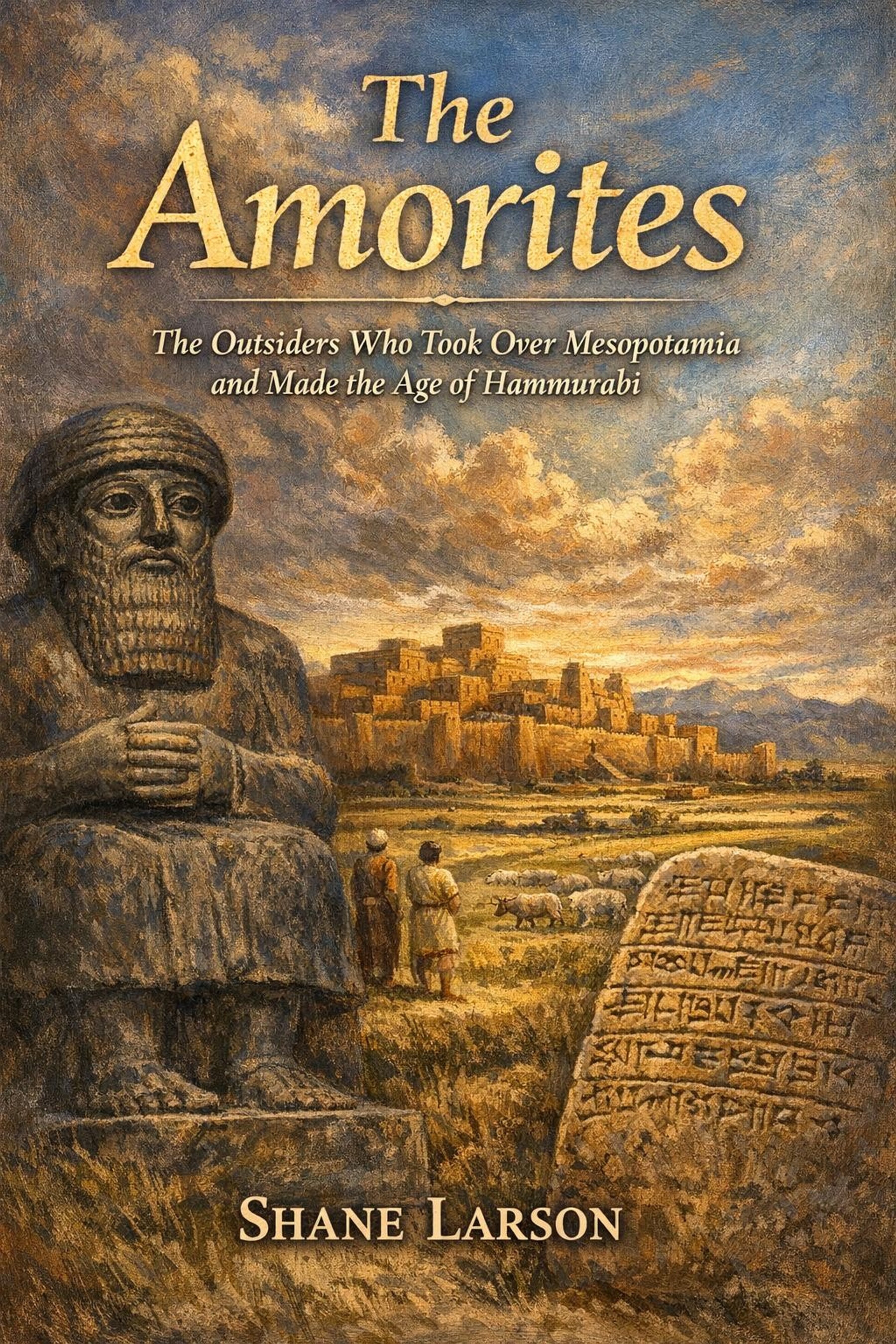
*The Amorites: The Outsiders Who Took Over Mesopotamia and Made the Age of Hammurabi* opens on those two tablets and follows the people who spoke the language from the Syrian steppe to the throne of Babylon: their service inside the empire of Ur, the wall built against them, the fall of Ur and the climate debate around it, the kingdoms they founded from Aleppo to Larsa, Hammurabi's unification, the Hittite raid of 1595 BC that closed their age, and the afterlife of their name in Egypt and in the Bible. The contested questions, invasion or integration above all, are laid out as the debates they are.
The Amorites
New posts and releases, straight to your inbox. No spam, unsubscribe anytime.