"An Eye for an Eye" Came With a Price List
September 8, 2026 · 7 min read
Ask anyone what the Code of Hammurabi says and you will get one line back: an eye for an eye. It is usually produced as evidence of how brutal the ancient world was — the bad old law that civilization eventually outgrew. Almost nobody who cites it has read it, which is a shame, because the actual provision is far more revealing than the slogan.
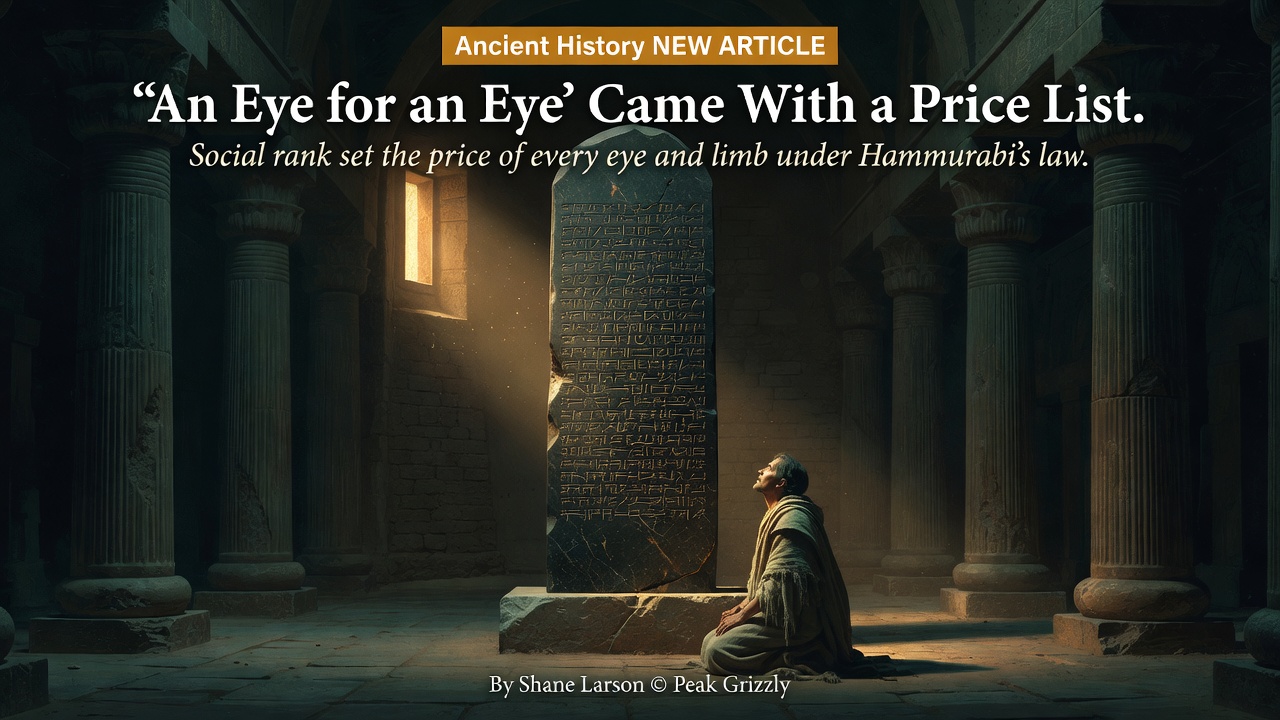
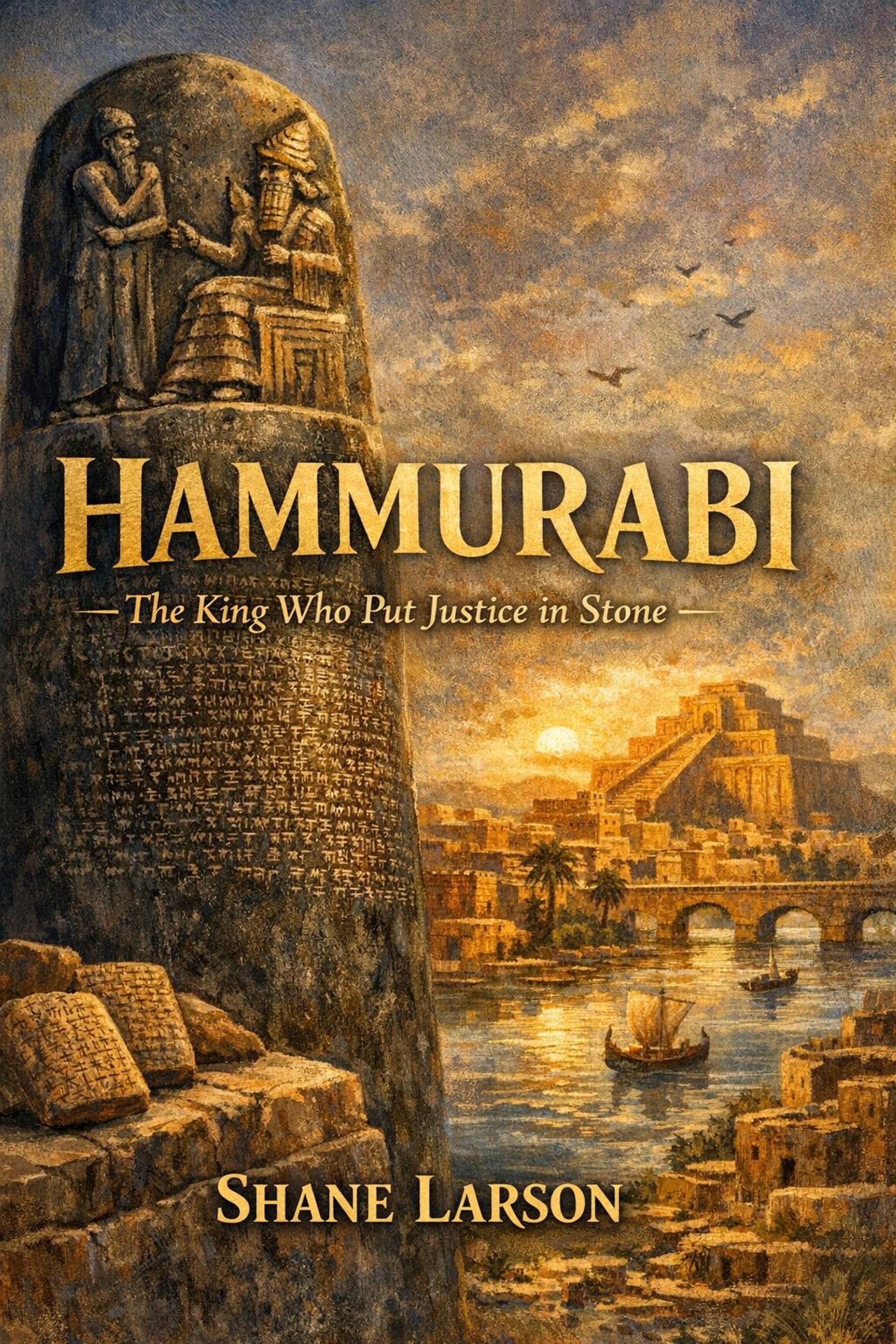
The stele — seven feet four inches of black diorite, carved in Babylon around 1750 BC and now standing in the Louvre — carries roughly 282 provisions in the standard modern numbering. The famous one is number 196. In L. W. King's 1915 translation, it says exactly what everyone thinks it says:
If a man put out the eye of another man, his eye shall be put out.
But that is the penalty for one class of victim only. The next provisions run straight down the social ladder. Put out the eye of a commoner and no one touches your eye — you pay a fine, one mina of silver. Put out the eye of a slave and you pay his owner half the slave's value, the way you would compensate a man for damage to his ox.
"An eye for an eye" turns out to be a rule about whose eye. Babylonian society had three legal ranks — the awilum, a free man of full standing; the mushkenum, a dependent commoner; and the wardum, a slave — and the Code prices the same injury three different ways depending on which rank the victim held. There is nothing hidden about this. The stele states the scaling as plainly as it states the price of hiring an ox, which is itself in there. The most famous law code in history is not a charter of equal justice, and it never claimed to be. It wrote its society's stratification into statute, explicitly, in a public place. That is the single most clarifying fact about the document, and the slogan buries it.
What the other 281 provisions actually cover
The second surprise is what the Code spends its time on, because it is overwhelmingly not eyes. It is a working world: fees, contracts, liability, water rights, family property. Some of the highlights.
A builder answers for his building with his life. In Robert Francis Harper's 1904 translation:
If a builder build a house for a man and do not make its construction firm, and the house which he has built collapse and cause the death of the owner of the house, that builder shall be put to death.
The provisions that follow scale the principle with a consistency that is genuinely startling: if the collapse kills the owner's son, the builder's son is put to death; if it kills a slave, the builder replaces the slave; if it only wrecks property, he rebuilds at his own cost. There is no permit office in this world and no inspector — only the result, and a penalty that mirrors the harm rank for rank.
Surgeons were paid by result and punished by it. A successful major operation on an awilum earned ten shekels of silver — a substantial fee, several months of a laborer's wages. The same operation on a commoner or a slave earned less, because the fee, like the eye, scaled by rank. And if the patient died under the bronze knife, the surgeon's hand was cut off. Payment by outcome, enforced by mutilation.
A bad harvest could wash out a debt — literally. Farming between the rivers meant borrowing against the harvest, and the Code addresses the year the harvest fails: if the storm god floods the field or the grain does not grow for want of water, the debtor owes nothing that year and, in King's rendering, "washes his debt-tablet in water." The contract was a clay tablet; dissolving it dissolved the obligation. The image is so good it feels invented, and it is right there in the text.
Debt-slavery ran on a clock. A man who could not pay could give his wife, his son, or his daughter into bondage to the creditor — and the Code sets a limit: three years of service, freedom in the fourth. Do not read that limit as gentleness. It is evidence of how routine the practice was; a society does not regulate the term of a thing that rarely happens. Debt was the grinding pressure of the whole economy, and Babylonian kings — Hammurabi among them — periodically had to cancel debts outright by royal proclamation to keep the countryside from sliding wholesale into bondage.
Hammurabi
There are provisions for boat collisions (a moving boat that rams a moored one is at fault — the Bronze Age already understood right of way), for a field left unfarmed (the idle tenant pays grain as if he had farmed it), for wet-nurses (a nurse whose charge dies and who secretly takes on another infant loses her breasts), and for a wife's dowry, which the Code protects with remarkable elaboration: it remains her property through marriage, divorce, and widowhood, and passes to her children, not her husband's family.
And there is the accusation nobody can prove. The Code's very first provisions deal with it. Accuse a man of murder and fail to prove it, and the death penalty falls on you. An accusation of sorcery — inherently unprovable — went to the river: the accused leapt into the Euphrates, and the god of the river decided. If he drowned, the accuser took his house. If he survived, the accuser was put to death. A procedure like that looks absurd until you notice what it is for: it makes an unprovable accusation mortally expensive to bring.
The king behind the stone
The man who published all this is usually remembered as a bearded lawgiver in the abstract. The actual king inherited a minor city in 1792 BC, hemmed in on every side by stronger states, and spent roughly thirty years giving no one any reason to fear him. He dug canals. He built city walls and repaired temples, and named his years after those works the way other kings named years after victories. Then, in the last third of his reign, he conquered essentially all of Mesopotamia in about a decade — and died in 1750 BC, leaving an empire that barely outlived him. His son spent the following decades losing most of it.
The stele had better luck, and it survived by being stolen. Around 1158 BC an Elamite king, Shutruk-Nahhunte, plundered Babylonia and hauled its monuments home to Susa, in what is now southwestern Iran. His masons ground several columns off the stele's base to make room for an inscription of his own that was never carved. The stone stood in the thief's capital, then lay in its ruins, until French excavators dug it up in 1901. Had it stayed in Babylonia, it would almost certainly have been broken up or burned for lime a thousand years before anyone could read cuneiform again.
Here is the strangest fact of all: tens of thousands of legal documents survive from Hammurabi's Babylonia — contracts, lawsuits, verdicts, receipts — and essentially none of them cites the Code. The courts were busy; the stele stood in public; and the paperwork of daily justice goes about its business as if the monument were not there. Whether the Code was a working statute, a royal advertisement, or a monument to an ideal that practice only partly honored is a genuinely open question. But the stele itself tells you what the king wanted it to be. In the epilogue, in King's translation, Hammurabi extends an invitation:
Let the oppressed, who has a case at law, come and stand before this my image as king of righteousness; let him read the inscription, and understand my precious words: the inscription will explain his case to him; he will find out what is just, and his heart will be glad.
The rules, written down, in public, where a wronged farmer could have them read to him. Whatever else the Code was, that idea was new at this scale — and it outlived the empire, the dynasty, and the city.
The full story — the thirty years of canals, the decade of conquest, the captured royal archive of Mari, and the Code tested provision by provision against the contracts and court records of the people who actually lived under it — is the subject of my book Hammurabi: The King Who Put Justice in Stone. If you have only ever heard the one line, the other 281 provisions are waiting.
Hammurabi
New posts and releases, straight to your inbox. No spam, unsubscribe anytime.