Nobody Knows When Anne Boleyn Was Born, What She Looked Like, or Where She Lies
October 27, 2026 · 8 min read
Walk into the Chapel of St Peter ad Vincula, inside the Tower of London, and you will be shown a marble tile in the chancel floor with Anne Boleyn's name and arms on it. Visitors stand on it. Some leave flowers. It is the nearest thing she has to a grave, and the honest thing to say about it is that it marks the spot where, in 1876, some workmen found some bones.
That is not a quibble, and it is not the only one. The woman who is probably the most written-about queen in English history is, in the plain documentary sense, barely there. Three facts that would open any ordinary biography, when she was born, what she looked like, where she is buried, are missing from hers. I spent a book on her, and I want to set those three gaps out here, because each of them is an argument rather than an absence, and the arguments explain a good deal about how her story has been told.
When was Anne Boleyn born?
Nobody wrote it down. The two candidate years are 1501 and 1507, and the six years between them are not a detail.
If she was born in 1501, she was a woman of about twenty-five when Henry VIII began to pursue her in the mid-1520s, with the better part of a decade in the courts of the Netherlands and France behind her, and about thirty-two when she married him in early 1533. A sixteenth-century court would have considered a bride of thirty-two to be near the end of her childbearing years, which bears directly on the pressure she was under to produce a son, and on what the losses of 1534 and January 1536 meant to the king. If she was born in 1507, she was nineteen when the pursuit began, twenty-five at her marriage, and a child of six when she was sent abroad.
The case for 1501 rests on that last point. In 1513 Anne was placed in the household of Margaret of Austria, regent of the Netherlands, at Mechelen, and a letter survives in her own hand, in French, written to her father from there. The letter is the earliest document she produced. Historians who favour the earlier date argue that a six-year-old does not write it, and that a position as a maid in the regent's household was not given to small children. The case for 1507 rests mainly on a marginal note by the Elizabethan antiquary William Camden, writing some eighty years after her death, and on the recollections of people who knew her daughter's court. Neither side has a baptismal record, because there is none.
The order of the Boleyn children is tangled up in the same question. Whether Anne or her sister Mary was the elder has been argued from a petition made by Mary's grandson in 1597, from the order in which the sisters were placed and married, and from the Carey family's claims, and the answer one gives tends to follow from the birth year one has already chosen. The two arguments lean on each other.
What did Anne Boleyn look like?
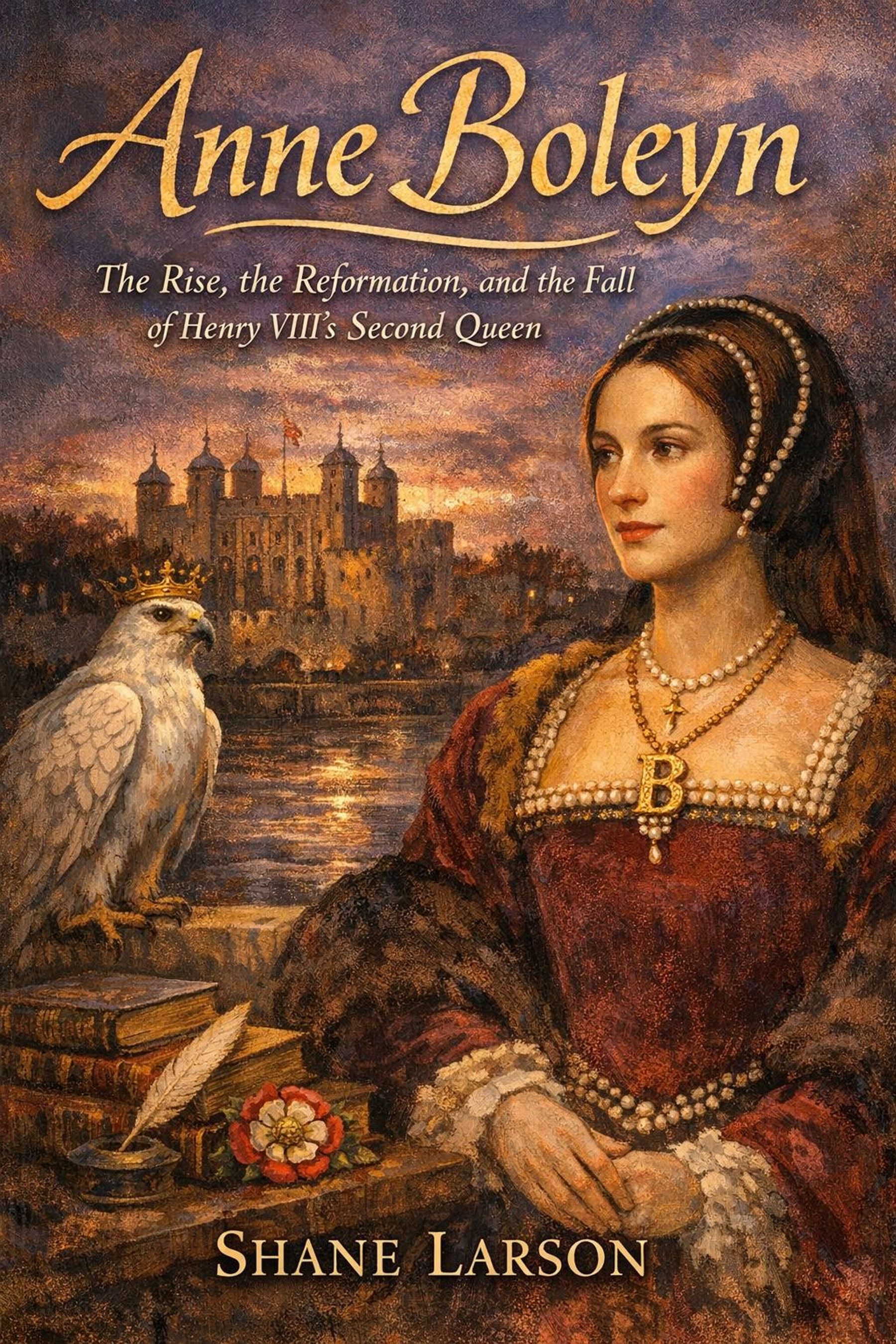
Everyone knows her face: dark eyes, a French hood, a B hanging from a string of pearls. The trouble is that no portrait of Anne Boleyn can be shown to have been painted while she was alive.
The familiar image survives in copies made decades after her death, when it had become first safe and then fashionable to hang a picture of Elizabeth I's mother, and the copies do not agree with one another. Whatever original they descend from, if there was one, is lost. The single image made in her lifetime is a lead medal struck in 1534, now in the British Museum. It was probably made in anticipation of the son she was expected to bear that year, who was not born. The face on it is badly damaged. Its legend gives her motto as queen, The Most Happy.
Written descriptions exist, and they come with the usual Tudor problem of who was writing and why. A Venetian diplomat reporting home in 1532 thought her not among the handsomest women in the world: of middling height, dark-complexioned, with a long neck and a wide mouth, and nothing remarkable about her except the king's appetite and her eyes, which he thought black and beautiful. He had no reason to flatter and none to insult, which makes him about as neutral a witness as she has. The sixth finger, the growth on her neck and the rest of the catalogue of deformities come from Nicholas Sander, a Catholic exile writing in 1585 to persuade Europe that the English schism had been the work of a monster. No one who saw her mentions any of it, and a king who had his pick of the women of Europe did not spend six years and the unity of the Western Church on a woman with a visible deformity in an age that read deformity as a judgement of God. Sander is evidence of what Catholic Europe wanted to believe about her fifty years later. He is not evidence of her face.
Anne Boleyn
There is one more candidate, and it is a small one. A ring made for Elizabeth I in about 1575, now at Chequers, opens to reveal two enamel portraits, one of Elizabeth and one of a woman in a French hood. Tradition says the second is Anne. Tradition may be right; it cannot be proved.
Where is Anne Boleyn buried?
She was executed inside the Tower on the morning of 19 May 1536, by a swordsman sent for from Calais, and buried that afternoon in the chancel of St Peter ad Vincula. No coffin had been ordered, so the body was placed in an elm chest made to hold arrows. Nothing marked the place for three hundred and forty years.
In 1876 Queen Victoria ordered a restoration of the chapel, and the floor came up. At the spot where tradition placed her, the workmen found the remains of a woman. A surgeon, Dr Frederic Mouat, examined them and described a delicate frame, a well-formed skull and a short, slender neck, belonging to a woman aged between twenty-five and thirty. The bones were reburied under the marble tile that visitors now stand on, and Mouat's age estimate has been cited ever since as evidence that Anne was born in 1507.
Look at that argument for a moment. The bones are identified as Anne's partly because they fit her age. Her age is argued from the bones. The identification supports the birth date only if the date is already known, and the date supports the identification only if the identification is, and the chancel of that chapel had received the Tower's dead for two centuries after her, including at least one other queen and several women of rank. It may well be her. It is also entirely possible that the tile sits over somebody else, and that Anne Boleyn lies a few feet away under a part of the floor nobody disturbed.
Why the gaps are the story
A woman without a certain birth year, face or grave is unusually easy to make into whatever a later age needs. That is what happened, and it began within a generation of her death. The Protestant martyrologist John Foxe gave England a godly patron of the gospel brought down by papists. Sander gave Catholic Europe a six-fingered seductress who had pulled a king into schism. The Victorians made her a romantic victim, the stage and the screen made her a tragic queen, and the novels of the last twenty-five years have made her, for most readers, a character in somebody else's story. Each version fills the three blanks differently, and each needs the blanks to be there.
The sources that do survive have the same problem in a different form. The richest witness to her reign is the Emperor's ambassador, Eustace Chapuys, who never called her anything but the concubine in his dispatches and whose reports are a running argument that she would come to a bad end. He is indispensable and he is hostile, and the two things have to be held together every time he is used. The English chronicler who covers the same years adored the king. The one man who recorded what she herself said in the Tower, in the seventeen days between her arrest and her death, was the Constable, writing to Thomas Cromwell, and his letters were burned around the edges in a library fire in 1731, so that the most important sentences end in holes.
None of this makes her unknowable. From about 1527 onward almost everything she did was a matter of state and was written down by people who cared about it, and the documented record of her rise, her queenship and her fall is unusually full. What it means is that the famous facts about her have to be handled with the question "who says so, and why?" asked before each one, and that the right answer to "when was Anne Boleyn born?" is still a date range and a fight.
*Anne Boleyn: The Rise, the Reformation, and the Fall of Henry VIII's Second Queen* is the second volume of a series on the six queens of Henry VIII, each written to the same scale. It opens on 29 January 1536, the day the first queen was buried and the second miscarried a son, and ends on 20 May, the morning the king was betrothed again. The swordsman who came for her was sent from Calais, England's last foothold in France and the prize that outlasted *The Hundred Years' War*. The ebook is available now from Apple Books, Kobo, Barnes & Noble and other retailers, with the paperback and audiobook to follow.
Anne Boleyn
New posts and releases, straight to your inbox. No spam, unsubscribe anytime.