The Most Feared Lawman in the West Was Born a Slave — And History Almost Erased Him
June 27, 2026 · 6 min read
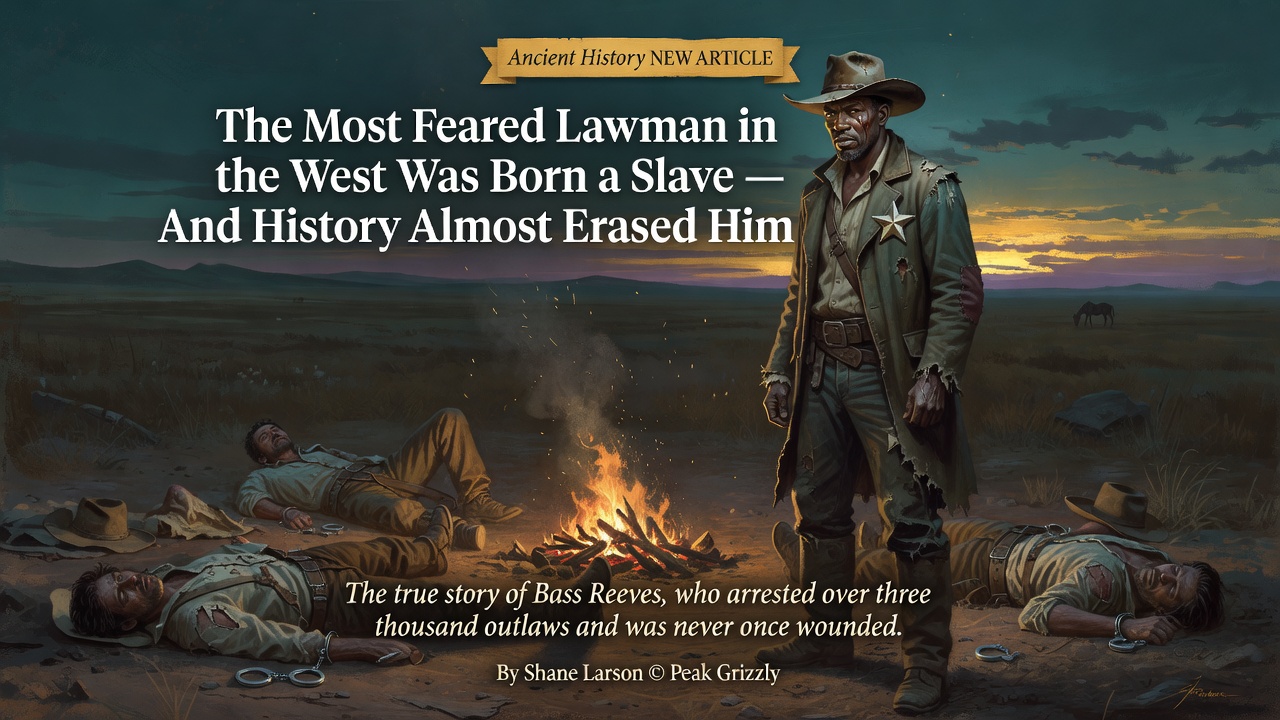
At dusk on a back road in the Indian Territory, a ragged tramp shuffled toward an outlaw camp. His hat was caved in. His boots were worn through. Three cartridges showed through the holes in the brim — the look of a man down to his last nothing. The hard men around the fire took pity on the wanderer and waved him in. They passed the bottle. They bragged about the marshals they had eluded. Eventually they slept.
When they woke, the tramp had handcuffs on their wrists, a five-pointed star under his rags, and a federal warrant with their names on it. The wanderer was Bass Reeves, deputy U.S. marshal. And that morning's work — two fugitives taken without a shot fired — was an ordinary day in a career that lasted thirty-two years.
If you have never heard of Bass Reeves, that is not an accident. It is the result of a long, deliberate forgetting. This is the story the record actually supports — and why it matters that we are finally telling it again.
Born the Property of Another Man
Bass Reeves came into the world enslaved in Crawford County, Arkansas, around 1838. While he was still a boy, the family that owned him carried him west into Texas, to Grayson County near the Red River. He grew up as an enslaved body servant — and, by every account that survives, an extraordinary physical specimen: unusually tall, powerfully built, a natural horseman and a crack shot with rifle and pistol both.
Those skills were noticed. They were also, in the brutal arithmetic of slavery, simply another form of value owned by someone else. For the first two-plus decades of his life, everything Bass Reeves was and could do belonged to another man.
Then the Civil War came, and Reeves vanished.
Into the Territory
The likeliest account — and Reeves himself told versions of it in later years — is that he fought the man who held him, beat him down over a card game, and fled north and west across the Red River into the Indian Territory. Whether the fight happened exactly that way or not, the outcome is documented by what came after: a young, enslaved man disappeared into the one place in America where the law could not easily follow.
The Indian Territory — the lands of the Cherokee, Creek, Seminole, Choctaw, and Chickasaw, the so-called Five Tribes — was a jurisdictional maze. No single authority reached everywhere. That made it a sanctuary for every kind of fugitive, including a man running from bondage.
Reeves lived in that country for years. He learned the languages of the tribes who sheltered him. More important for what came later, he learned the land itself — every creek crossing, every blind canyon, every spring, every place a hunted man might hide. When emancipation finally made him a free man, he came out of the Territory owning something rarer than freedom: he knew the most lawless ground in America better than the outlaws who used it.
He married, settled near Van Buren, Arkansas, and farmed. He might have stayed a farmer. Instead, the federal government came looking for exactly the kind of man he had become.
Judge Parker Needs a Manhunter
In 1875, Judge Isaac Parker took the bench of the federal court at Fort Smith, Arkansas. His jurisdiction was staggering: roughly 74,000 square miles of the Indian Territory, and a mandate to impose order on it. To do that he needed deputy marshals who could ride into the worst country in America and come back alive.
A Black man who spoke several Native languages, knew the Territory cold, could shoot with either hand, and feared almost nothing was not a candidate the era's prejudices welcomed easily. He was, however, exactly the candidate the job required. Reeves was deputized — sworn to arrest white, Native, and Black fugitives alike, across a Reconstruction-era landscape where federal authority was thin and resentment ran thick.
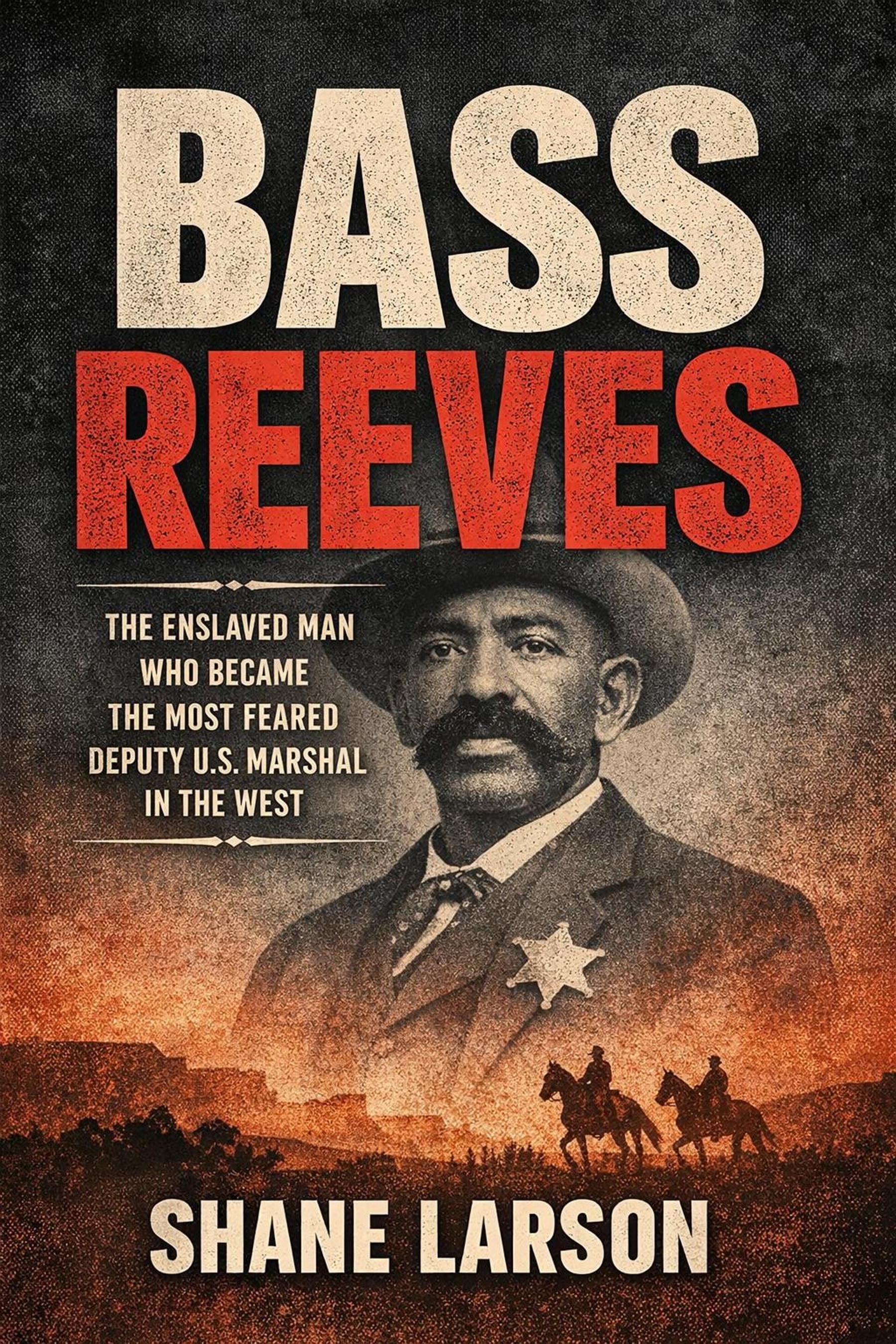
Bass Reeves
It was dangerous, contingent power. But it was real. And Bass Reeves used it better than almost anyone who ever wore the star.
The Method: Patience, Disguise, and Reading Men
Reeves could not read. So every morning, before a day's work, he had the warrants read aloud to him, and he committed the names and descriptions to memory — matching each one to a face when the moment came. A man who could not write his own name carried the law of the United States in his head, and never, by the record, served the wrong warrant.
His real genius was patience and disguise. Where other lawmen kicked in doors, Reeves walked through them in costume. He came as a tramp, a farmer, a cowboy, a fellow outlaw down on his luck. He would sit at a wanted man's own fire, eat his food, earn his trust — and then, at the chosen moment, produce the cuffs. Hardened killers let him close because he never looked like what he was. By the time they understood, it was over.
Over thirty-two years, by the figures that have come down to us, Reeves arrested more than 3,000 men and women. He killed about fourteen in the line of duty — and, remarkably, was never once wounded himself. He far preferred the handcuffs to the gun, and the record shows a man who used violence as a last resort, not a first.
The Cost of the Badge
It would be easy to tell this as a tale of pure triumph. The truth is harder and better.
Reeves enforced the law without fear or favor, and that principle cost him. He arrested friends. And in the most wrenching episode of his career, a murder warrant was issued for his own son, Bennie. Reeves did not hand it to another deputy. He asked for the warrant himself, rode out, and brought his own son in to face the court.
He was not above the law he served, either. When his camp cook, William Leach, died, Reeves himself was charged with murder and tried at Fort Smith. He was acquitted — but the experience put the great manhunter on the other side of the dock, a Black man whose life depended on a frontier jury. It is a part of the story the legends usually skip. It belongs at the center.
Erased — and Recovered
When Oklahoma achieved statehood in 1907, federal jurisdiction over the Indian Territory dissolved, and the old marshal's job dissolved with it. Reeves, by then nearly seventy, pinned on a Muskogee city policeman's badge and walked a beat in a modern town until illness forced him to stop. He died in 1910.
And then, for most of a century, America forgot him on purpose.
The Western canon that formed in the dime novels and the early film era had room for white gunfighters and made legends of men who accomplished a fraction of what Reeves did. A Black federal lawman who out-arrested all of them did not fit the story that Jim Crow America wanted to tell about its frontier. He was written out — not lost by accident, but left out by design.
That he is known at all today is thanks to the patient work of historians — most importantly Art T. Burton — and to Reeves's own descendants, who kept the memory alive. In recent years the recovery has accelerated: statues, a bridge in Muskogee bearing his name, the Bass Reeves Legacy Initiative, a television series. With the revival has come a familiar problem — the legend now sometimes runs ahead of the evidence, including the widely repeated but unprovable claim that Reeves was the inspiration for the Lone Ranger.
The honest approach is to lay out the parallels and the gaps and let readers judge. The real record needs no inflation. A man born into slavery, who could not write his name, built the greatest arrest record in the history of the federal marshals. That is not a tall tale. That is the documented truth — and it is more than enough.
Bass Reeves
New posts and releases, straight to your inbox. No spam, unsubscribe anytime.