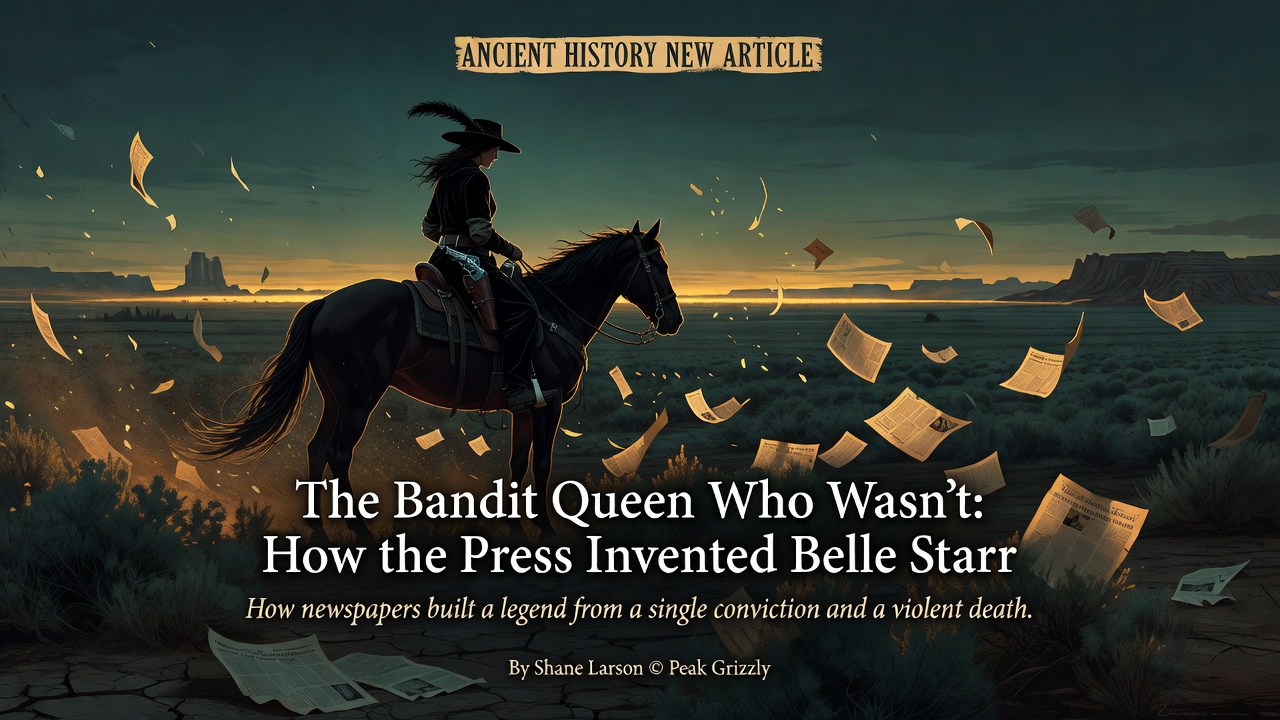
The Bandit Queen Who Wasn't: How the Press Invented Belle Starr
June 29, 2026 · 6 min read
Picture the Bandit Queen. You already can, even if you've never read a word about her: a dark-eyed woman in velvet and a plumed hat, sitting a horse with a brace of revolvers on her hips, ruling a hidden kingdom of thieves somewhere in the badlands of the Old West. She takes outlaw lovers. She outshoots lawmen. She is the Female Jesse James.
Now throw almost all of it away.
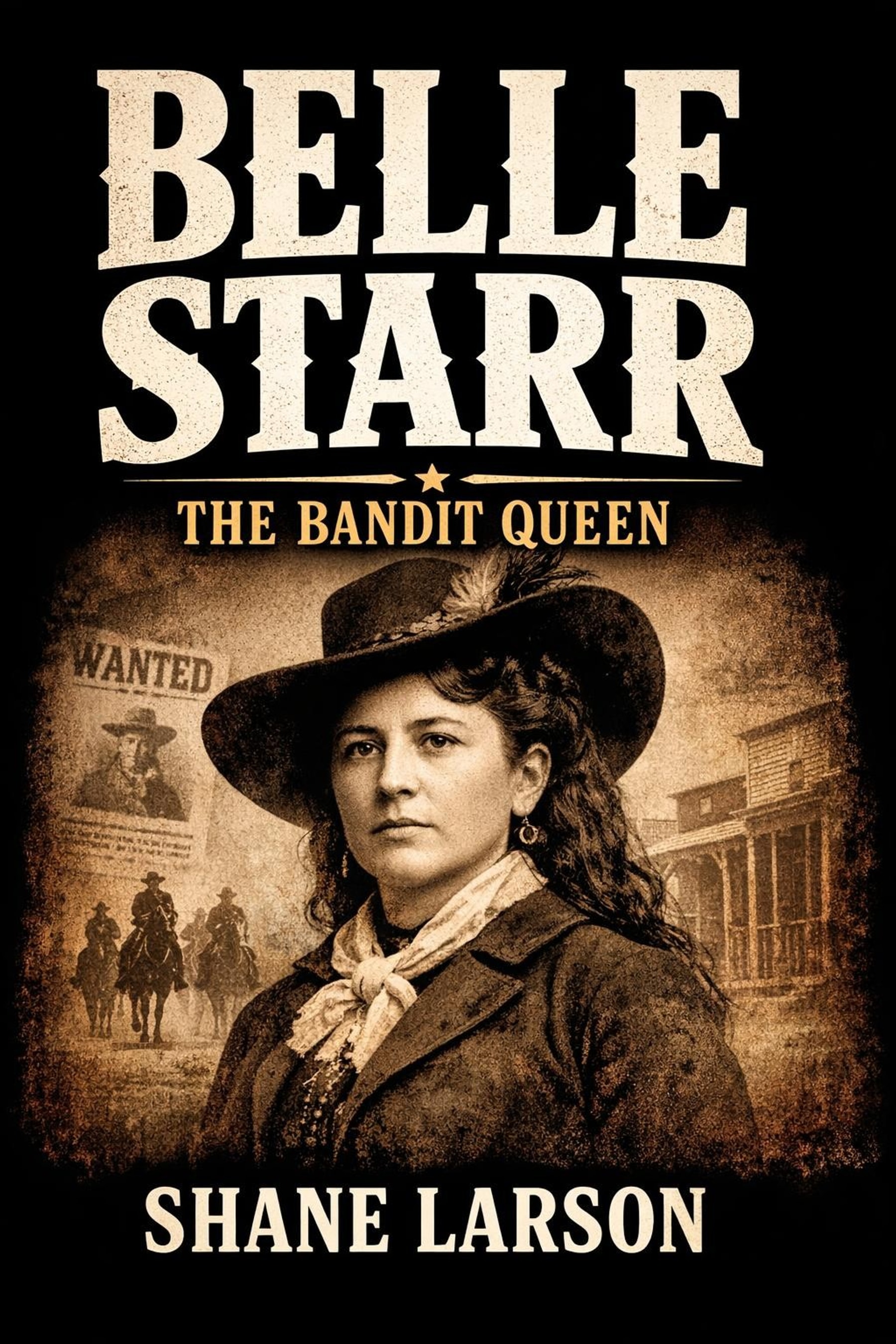
The woman that image is supposedly based on was named Myra Maybelle Shirley. Over the course of an actual, documented life, she was convicted of exactly one crime — horse theft — for which she served about nine months in a Detroit prison. She organized no gang. She robbed no trains and no banks. She was murdered in 1889 in a case that was never solved. And the "Bandit Queen" you just pictured was, in large part, manufactured by newspapermen and a dime novelist in the weeks after she was already in the ground and could no longer say otherwise.
That gap — between the woman the documents support and the legend the press sold — is one of the most revealing stories in the history of the American West. It's the subject of my new book, and it's worth walking through here, because it's really a story about how reputations get built, and who profits from them.
A daughter of the Border War
Start with where she actually came from, because the legend usually skips it.
Myra Maybelle Shirley was born in 1848 near Carthage, in Jasper County, Missouri. Her family was prosperous, slaveholding, and Confederate in sympathy — and that placed them directly in the path of the most vicious guerrilla war in American history. Western Missouri in the early 1860s was bushwhackers and Jayhawkers, ambush and reprisal, neighbors burning out neighbors. It was the same furnace that forged Frank and Jesse James and the Younger brothers.
It forged the Shirleys, too. Maybelle's adored older brother Bud rode with the Confederate guerrillas and was killed in 1864. Carthage burned. The family, ruined, pulled up and resettled at Scyene, near Dallas, Texas. And here is the crucial, unglamorous fact the dime novels turned into something operatic: the Shirley place became a way station for old Missouri associates passing through. Displaced families, men on the run, names that would later become famous. An ordinary woman didn't go looking for outlaws. The wreckage of a war deposited them on her doorstep.
That's how Myra Maybelle Shirley's life came to thread through Cole Younger, through the outlaw Jim Reed — her first husband and the father of her two children — and eventually through the Cherokee Sam Starr, whose name she took and whose land in Indian Territory became her home.
The lawless seam
That home, "Younger's Bend," sat on the Canadian River in the Indian Territory, in a place that mattered enormously to her story: a jurisdictional no-man's-land where United States, Cherokee, and Choctaw authority overlapped and frequently canceled each other out. For a fugitive, it was a refuge. For a lawman, it was a headache. Deputy U.S. marshals — including the legendary Bass Reeves — rode out of Fort Smith, Arkansas, into a territory designed by accident to frustrate them.
In that environment, Belle Starr did do some real and illegal things. The evidence that she fenced stolen stock and gave shelter to fugitives is genuine. But sheltering fugitives and fencing horses is a long way from leading a gang of desperadoes, and the documented record never crosses that line. She was an accessory and a host, not a chieftain.
Her one trip across the line into a courtroom came in 1883, when she and Sam Starr were charged with horse theft and tried before Judge Isaac Parker — the "Hanging Judge" — at Fort Smith. Both were convicted. Belle served roughly nine months at the Detroit House of Correction. Strip away the legend and that single case is the entire criminal record of the woman the press would soon call the most dangerous female desperado in America.
A body on the road
On the morning of February 3, 1889, two days short of her forty-first birthday, Belle Starr was riding home alone along a muddy bottomland road when a shotgun blast fired from behind a fence knocked her from her horse. A second load of buckshot was fired into her as she lay in the mud. She died within hours.
No one was ever convicted of the killing.
The suspect list reads like a family tragedy rather than a Western shootout: Edgar Watson, a tenant she'd quarreled with over land, who had a dark Florida past he didn't want examined; her own son, Eddie Reed, whom she'd reportedly beaten and who had a violent streak; her younger new husband, Jim July; and assorted neighbors with grudges. There was an inquest. There were arrests. There was no resolution. It is a genuine cold case — and in the book I treat it like one, weighing the suspects honestly rather than reaching for the most cinematic answer.
The legend had an author
Here's the part that makes Belle Starr more than a frontier footnote.
A killing like that — a woman, the frontier, guns, the whiff of sex, and a sensational unsolved murder — was, to the editors of 1889, not a tragedy. It was a product. Almost immediately, the National Police Gazette and a flood of dime novelists seized the combination and produced a lurid little book whose very title tells you everything about the marketing strategy: Bella Starr, the Bandit Queen, or the Female Jesse James. It welded a few real facts to an enormous amount of invention.
The woman who rode sidesaddle with revolvers and ruled Younger's Bend by the gun was, to a remarkable degree, born on the page — after the real woman was dead and silent. And because the legend was profitable, it kept getting rebuilt. Wild West shows borrowed her. Pulps multiplied her outlaw lovers for effect. By 1941 Hollywood had her, and a century of film and television reinventions followed, each era's Belle quietly reshaped to fit that era's anxieties about women who wouldn't stay in their assigned box — was she a feminist heroine, a fallen woman, a victim, a vamp? She was whatever sold.
What got crowded out, every single time, was Myra Maybelle Shirley: an intelligent, unlucky, sometimes hard woman who lost a brother and a home to a guerrilla war, made some bad marriages and some real but petty crimes, exercised more autonomy than her era knew how to read, and died violently with the case unsolved.
Why it still matters
It would be easy to tell this as a simple debunking — actually, she was boring — but that misses the point, and it isn't even true. The real story is stranger and sadder than the dime novel, and it carries a lesson the dime novel never could.
Belle Starr is a case study in how a legend gets manufactured: with a specific author, a specific date, and a specific profit motive, on a foundation of fact just solid enough to seem plausible. We like to think that's a quaint nineteenth-century problem. It isn't. The machinery that turned a horse thief into the Bandit Queen — sensation sells, the dead can't issue corrections, and a good story beats a true one every time — is running right now, on faster equipment.
That's why I keep coming back, across this whole series, to outlaws and the people who mythologized them. Jesse James tells the story of the Border War network Belle came out of. The Dime Novel West dissects the exact publishing machine that built her. Belle Starr is where those two threads cross: a real woman from a real war, turned into a fantasy by a real industry.
If you've ever wondered how much of what "everybody knows" about the Old West was sold to them on purpose, she's the place to start.
New posts and releases, straight to your inbox. No spam, unsubscribe anytime.