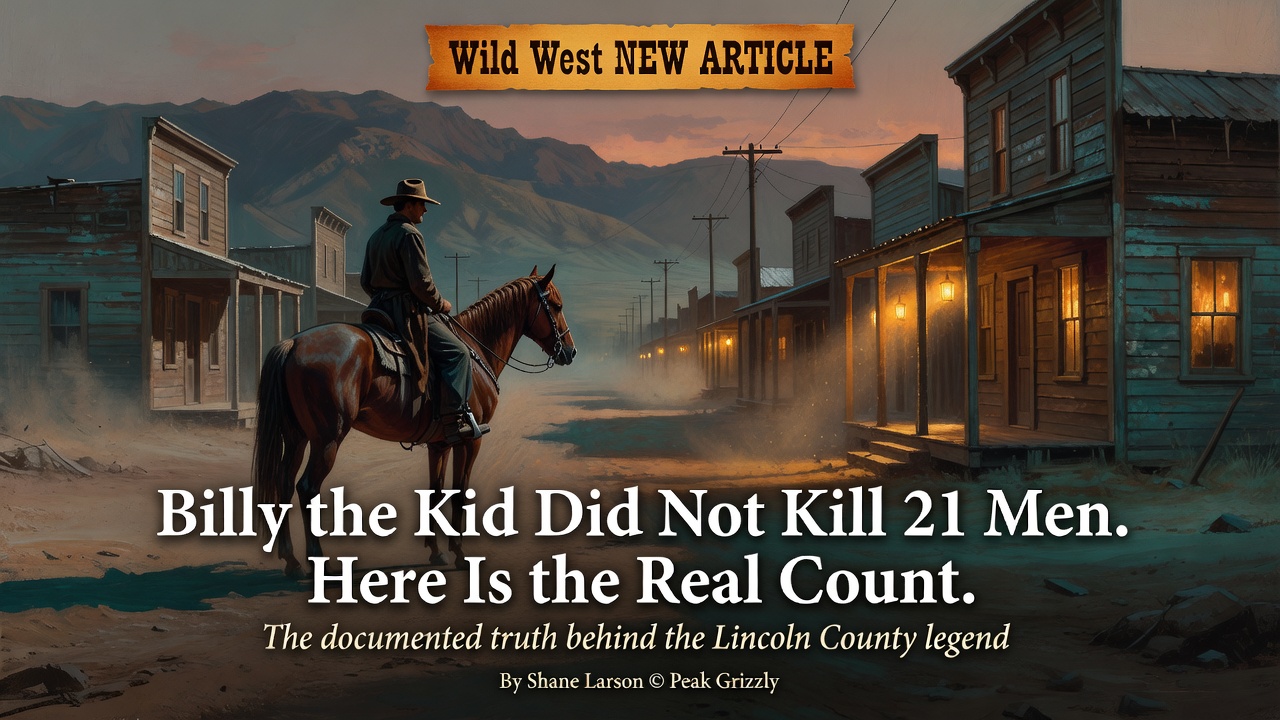
Billy the Kid Did Not Kill 21 Men. Here Is the Real Count.
June 26, 2026 · 6 min read
It is the most durable statistic in American outlaw history: Billy the Kid killed twenty-one men, one for every year of his short life. You have seen it on movie posters, in documentary narration, and on the placards of roadside museums across the Southwest. It is clean, it is symmetrical, and it is almost entirely false.
The real number is closer to four men killed by the Kid alone, and a handful more shared with others in the chaos of a range war — somewhere between four and nine, depending on how you count the battles where many guns fired at once. That is not a small correction. It is the difference between a remorseless serial killer and a young man caught in a violent feud he did not start. The gap between those two figures is also a near-perfect case study in how American legends are manufactured, and it is worth walking through, because the true story is the better one.
Where the Number 21 Came From
Billy the Kid was famous before his body was cold. He died a little after midnight on July 14, 1881, shot by Sheriff Pat Garrett in a dark bedroom at Fort Sumner, New Mexico. Within a year, Garrett himself — with the help of a ghostwriting newspaperman named Ash Upson — had published a biography that did as much to invent the Kid as to record him. The cheap "dime novel" presses of the East seized on the story and ran. They needed a monster, and the symmetry of "a man for every year" was too good to resist.
None of this was constrained by evidence. The dime novelists had never been to Lincoln County. They were writing entertainment for readers in Boston and New York who would never check, and the number grew in the retelling the way these numbers always do. By the time the twentieth century arrived, "twenty-one men" had hardened into something people simply knew, the way they knew the earth went around the sun.
Doing the Actual Math
When you set the novels aside and work from the documented record — court testimony, the inquest, military reports, and the period newspapers like the Las Vegas Gazette and the Santa Fe New Mexican — the picture changes completely.
The first killing usually laid at the Kid's feet was a blacksmith named Frank "Windy" Cahill, at Camp Grant, Arizona, in 1877. Cahill, a grown man, had been bullying and manhandling the teenager; the Kid shot him in a scuffle and ran. Even that one is closer to a deadly fight than a murder.
Most of the rest happened inside the Lincoln County War of 1878, and that is the crucial context. The Kid did not go looking for a body count. He took a job with a young English rancher named John Tunstall, came to admire him, and then watched a sheriff's posse — working for Tunstall's business rivals — gun the unarmed Englishman down on a road. The law did nothing, because the law was bought. The Kid and a group of others got themselves deputized as "Regulators" and went after the killers.
What followed were group actions, not solo executions: the street ambush that killed Sheriff William Brady and a deputy, the running gunfight at Blazer's Mills, and the climactic Five-Day Battle in Lincoln, where Alexander McSween's house was besieged and burned and the Kid shot his way out through the flames into the dark. In several of these, multiple Regulators fired at the same targets. Honest historians count those as shared, because that is what the evidence supports. Assign every shared killing to the Kid and you might reach nine. Count only the deaths the record ties to him alone and you are down around four.
Billy the Kid
Why the Smaller Number Is the Bigger Story
It would be easy to treat all of this as trivia — a pedant's correction to a fun legend. It is not. The inflated body count does real damage to the history, because it erases the thing that actually made Billy the Kid.
What made him was not bloodlust. It was a place and a moment: Lincoln County, New Mexico Territory, where a commercial monopoly known as "the House" — run by Lawrence Murphy and James Dolan and protected by the corrupt Santa Fe Ring — controlled the beef, the dry goods, and the government contracts of an entire county. When that monopoly was challenged, it killed to defend itself, and it used the sheriff's office and the courts to do it. The Kid became an outlaw in large part because the legal system was the criminal enterprise. He was, by the end, the only Lincoln County combatant ever actually convicted of anything — a monument to selective prosecution, not to justice.
The "twenty-one men" legend hides all of that. It turns a story about institutional corruption and a powerless orphan into a story about an unusually murderous individual. It lets us feel comfortable, because monsters are comfortable; they are nothing like us, and their world is nothing like ours.
The Boy Behind the Poster
The documented Henry McCarty is harder and sadder and far more interesting than the grinning killer of the posters. He was probably born in New York City around 1859, the son of an Irish immigrant mother who carried him west to Indiana, to Kansas, and finally to the silver-mining town of Silver City, New Mexico. She died of tuberculosis when he was about fifteen, and his stepfather wanted nothing to do with him. His first arrest was for stealing laundry. He escaped jail by climbing up a chimney, and from that first flight his life became a chain of escapes, aliases, and second chances that always collapsed.
He was also charming, bilingual, and loyal. The Hispanic families of the Pecos Valley — the paisanos whom most accounts treat as background scenery — hid him and fed him to the very end, at real risk to themselves. That detail alone tells you more about who he was than any body count. Anglo authorities hunted him; the Spanish-speaking communities of the territory sheltered him. He lived across a cultural line, and that is a large part of how he survived as long as he did.
He was a thief and a killer who died at about twenty-one in a war he did not start. He was also a beloved young man failed at every turn by the institutions that were supposed to protect him. Both of those things are true at once, and you do not have to choose between them. The legend asks you to choose. The history does not.
Read the Real Story
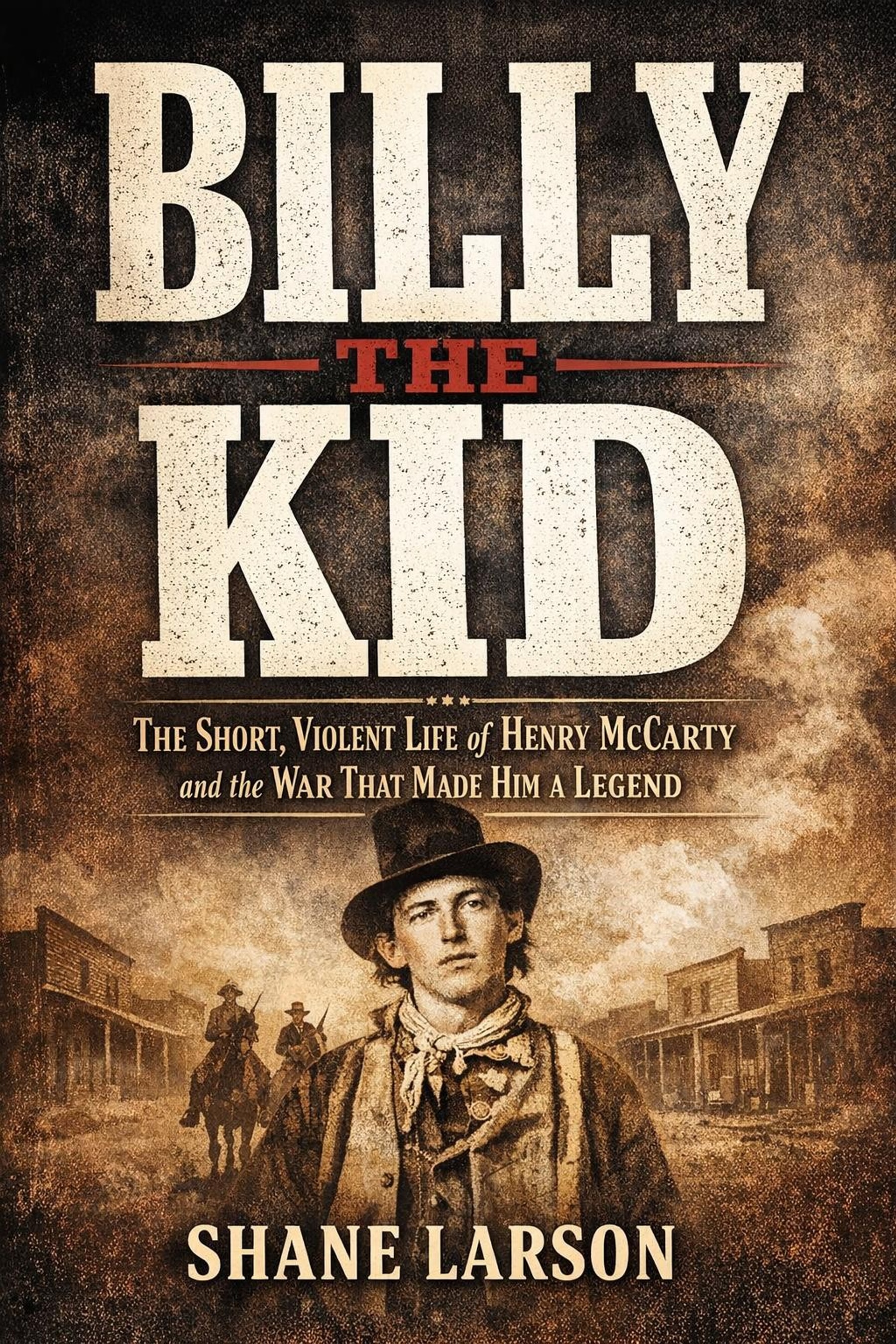
I wrote Billy the Kid: The Short, Violent Life of Henry McCarty and the War That Made Him a Legend to put the documented young man back in front of the reader — the orphan, the corrupt war, the Hispanic families who sheltered him, the honest accounting of the killings, and the dark room at Fort Sumner where it ended. It is short, it is accurate, and it shows its work. It is the first book in The Wild West series, alongside the companion volumes Pat Garrett and The Lincoln County War. If you want the truth instead of the poster, start here.
Billy the Kid
New posts and releases, straight to your inbox. No spam, unsubscribe anytime.