The Black Death Killed Half of Europe — and Made the Modern World Possible
June 14, 2026 · 6 min read
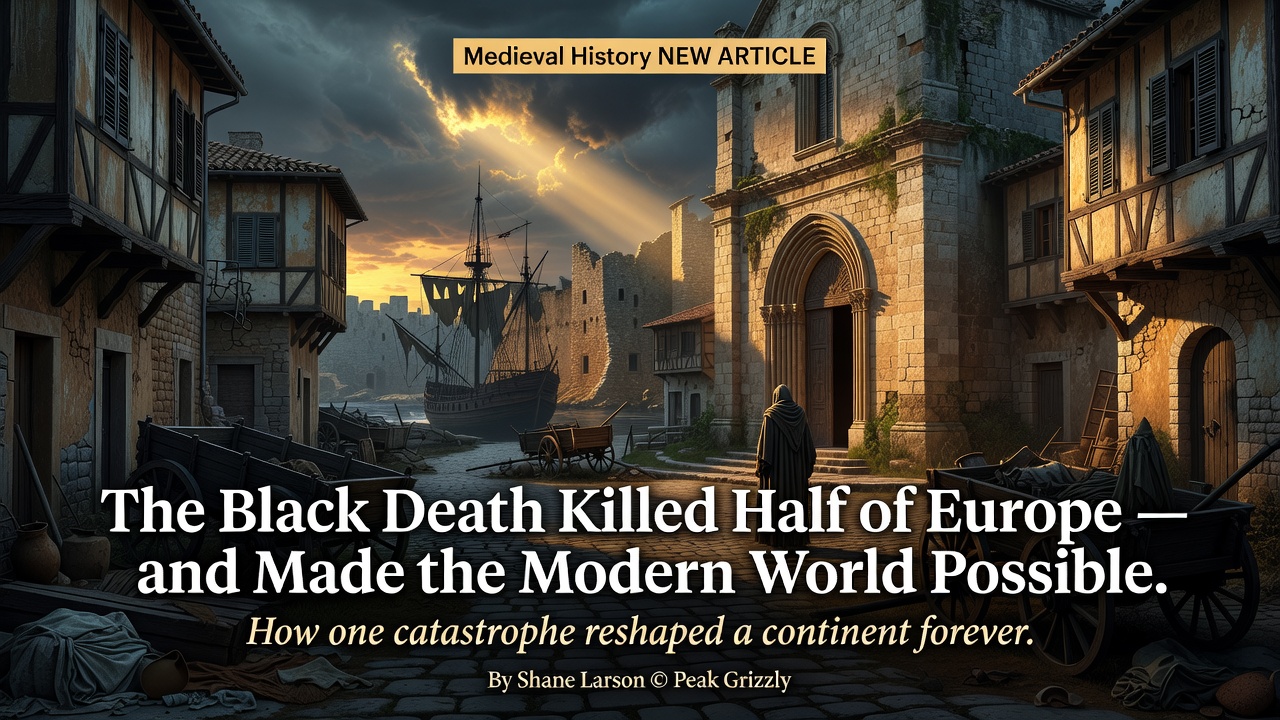
In October 1347, twelve galleys out of Genoa worked their way into the harbor at Messina, on the northeast corner of Sicily. They were a routine sight — and they were horribly wrong. Almost no one was working the rigging. When the harbor crews climbed aboard, they found most of the sailors dead at their stations and the survivors burning with fever and covered in black, oozing swellings the size of eggs. The authorities of Messina understood quickly that something monstrous had arrived, and they ordered the ships back out to sea.
It made no difference. Whatever the ships carried was already ashore, and it could not be expelled with the sailors. Within five years, that thing would kill somewhere between a third and a half of every human being in Europe.
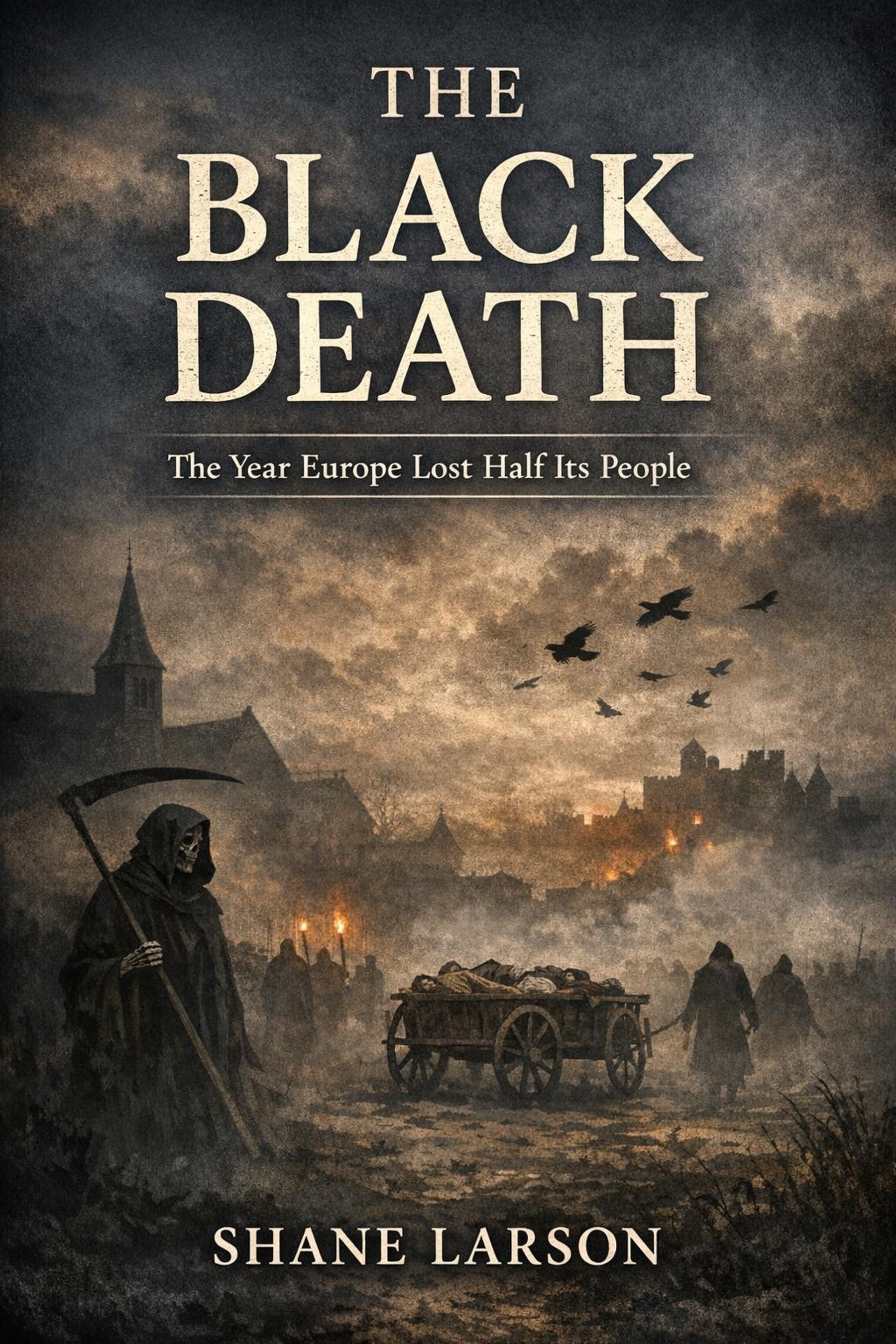
Sit with that number for a moment, because it is almost impossible to hold. A continent of perhaps seventy-five million people lost twenty-five to forty-five million of them — neighbors, parents, children, the priest, the miller — in about half a decade, to a disease nobody understood and nobody could stop. Nothing else in the recorded history of the West has killed on that scale, that fast, across that much ground. And yet here is the genuinely strange thing, the thing that turns the Black Death from a horror story into one of the most important episodes in the making of the modern world: the survivors ended up, in cold material terms, better off than their parents.
How a catastrophe became a turning point
To see why, you have to understand what serfdom actually was. In the Europe of the early 1300s, most people were peasants bound in one way or another to the land and to a lord. There were far more workers than there was good land or paying work, which meant labor was cheap and the people who did it had almost no leverage. A peasant could not easily demand higher pay or better terms, because there were ten more peasants ready to take his place. The social order had pinned most people in place at birth for centuries, and there was no obvious reason it would ever change.
Then a third to a half of everyone died.
The land was still there after the plague. The tools were still there. The livestock was still there. What was suddenly, catastrophically scarce was people to work it all. And scarcity is leverage. For the first time in living memory, a surviving laborer could look his lord in the eye and say: pay me more, or lower my rent, or I will walk down the road to someone who will. And there was always someone who would, because every lord in Europe was now desperate for hands.
Wages rose. Rents fell. Peasants left the manors they had been tied to and went looking for better terms, and found them. The lords and kings of Europe understood exactly what was happening and tried to stop it by law — England passed the Statute of Labourers in 1351, trying to freeze wages at pre-plague levels and force people to work for the old pay. It didn't hold. You cannot legislate away the law of supply and demand, and the supply of labor had just collapsed. When the authorities pushed too hard — with wage controls and, later, hated new taxes — the result was explosive: the Jacquerie in France in 1358, and the great English Peasants' Revolt of 1381, when a peasant army marched on London. The revolts themselves were crushed. But the underlying shift could not be. The slow death of serfdom in Western Europe had begun, and it began in the graveyards of the 1340s.
The Black Death
The world the plague broke open
The labor revolution is the clearest example, but it was not the only wall that came out of the structure. A society does not lose a third of its people without nearly everything shifting.
The medieval church, which had an answer for everything, had no answer for this. It taught that the plague was God's punishment for human sin — and then watched its own priests die at higher rates than anyone, because their duty took them to the bedsides of the dying. Prayers failed. Processions failed (and, by gathering crowds, often spread the disease). The gap between what the church promised and what was happening in the streets opened a quiet crack in religious authority whose echoes would still be sounding when Martin Luther was born. Out of the same desperation came the Flagellants, bands of penitents who marched from town to town whipping themselves bloody to atone for the sins of the world — a movement so popular and so uncontrollable that the Pope condemned it.
And the same terror produced one of the darkest episodes in the long history of European antisemitism. A population frantic for an explanation seized on a lie: that the Jews had caused the plague by poisoning the wells. It was false — Jewish communities were dying of the plague too — and it was lethal. Across 1348 and 1349, Jewish communities were massacred in city after city, most horrifically at Strasbourg in February 1349. The Pope himself issued formal declarations that the accusation was false and the killing must stop. In many places it didn't. It is a part of the story that has to be told plainly, as the atrocity it was.
Why it's worth reading now
We are, for grim reasons, better prepared than most generations to read this history with the right kind of attention. We have watched, on a vastly smaller scale, how a society behaves when an invisible killer arrives faster than understanding — the fear, the rumors, the hunger for someone to blame, the strain on every institution, the fights over how far to go to stop the spread. The scale is not remotely comparable; no modern pandemic has approached the share of humanity the Black Death took. But the human dynamics rhyme across seven centuries, and the medieval experience offers something genuinely useful: perspective, and a hard-won humility. People have faced the very worst of this before, and come through it changed.
There is one more thing worth knowing. We now know exactly what killed them. In the last two decades, scientists have recovered the DNA of the bacterium Yersinia pestis from the teeth of skeletons buried in medieval plague pits, ending centuries of debate about the agent. And that same bacterium is not gone. It still lives in wild rodent populations on several continents, and it still occasionally infects a human being. The difference between then and now is not that the organism was defeated. It wasn't. It's that we finally understand it — and a course of antibiotics, caught in time, now does what all the prayers and processions of the fourteenth century could not.
The galleys came into Messina with the dead at the oars, and a world ended. Another one — harder-won, freer, and not yet imagined by anyone alive in that harbor — was already beginning.
The Black Death
New posts and releases, straight to your inbox. No spam, unsubscribe anytime.