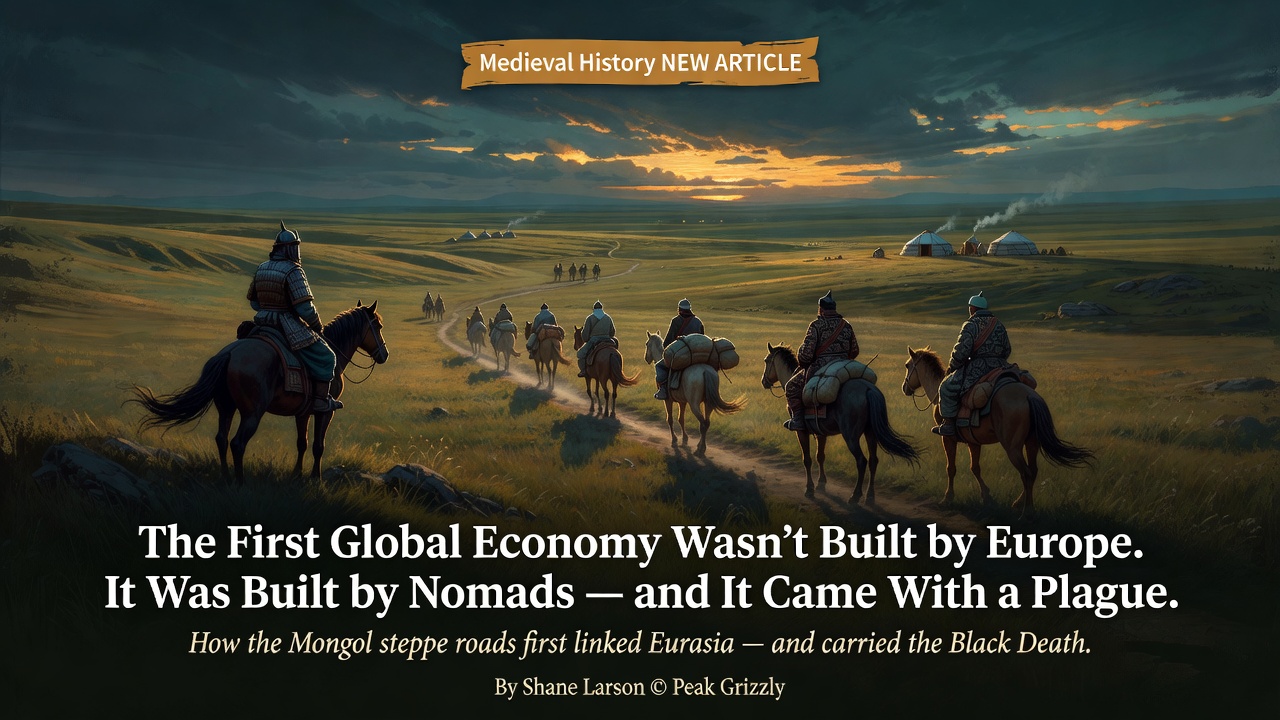
The First Global Economy Wasn't Built by Europe. It Was Built by Nomads — and It Came With a Plague.
June 17, 2026 · 7 min read
There's a story we like to tell ourselves about how the modern world began. It usually starts in Europe, somewhere around 1492, with caravels and compasses and a man from Genoa sailing west. The world gets connected, the argument goes, when Europeans go looking for it. Trade routes open. Money flows. Ideas cross oceans. Globalization is born.
It's a tidy story. It's also about two and a half centuries late.
The first time the major civilizations of Eurasia were genuinely wired together — when a merchant could move from the Yellow Sea to the Black Sea under a single body of law, when a letter could cross a continent on a relay of fresh horses, when Chinese printing and Persian astronomy and European silver all moved along the same highways — was not the work of European sailors. It was the work of nomads on horseback. It happened in the 13th century. And it was built by the most unlikely empire-builders in history: the Mongols.
A boy left to die
It's worth remembering how improbable this was. The man we call Genghis Khan was born Temüjin, and his early life reads like a survival story, not an origin myth. His father was poisoned. His clan abandoned his family on the open steppe, which on the Mongolian plateau is close to a death sentence. He spent part of his youth in captivity, wearing a wooden collar. He was, by any reasonable measure, a nobody — a starving outcast in a land of feuding tribes who spent more energy raiding each other than threatening anyone else.
The steppe in the late 1100s was not a superpower in waiting. It was a chaos of small tribes, blood feuds, and shifting alliances. The settled empires to the south — the Jin in northern China, the Xia, the wealthy Khwarazmian realm in Persia and Central Asia — regarded the nomads the way a homeowner regards wasps: occasionally dangerous, fundamentally beneath notice.
What Temüjin did over the next thirty years was not just conquer. It was organize. He broke the old tribal structure and rebuilt the Mongols around loyalty and merit instead of birth. He promoted commanders who had once been his enemies because they were good at their jobs. He banned the looting of a battlefield until the fighting was actually won, because greed had a way of turning a victory into a rout. He gave a sprawling oral culture a written script and a written law. By 1206, when an assembly of the tribes proclaimed him Genghis Khan — universal ruler — he had turned a collection of warring clans into something the settled world had never faced: a disciplined, mobile, meritocratic war machine that thought in terms of continents.
The army that didn't lose
The conquests that followed are staggering in scope, and it would be dishonest to soften them. The Mongols could be catastrophically brutal. Cities that resisted were sometimes erased — populations massacred, irrigation systems wrecked, regions depopulated for generations. The fall of Baghdad in 1258, when Genghis's grandson Hülegü ended the five-century Abbasid Caliphate and put the great libraries and scholars of the Islamic Golden Age to the sword, was one of the genuine catastrophes of the medieval world. None of that should be romanticized, and the book this post comes from doesn't.
But the military story is also genuinely astonishing on its own terms. Under Genghis and then his successors, the Mongol army beat everyone it met: the Jin, the Xia, the Khwarazmians, the Russian principalities, and — in 1241 — the combined chivalry of Hungary and Poland, fielded by Batu and the brilliant general Subutai. European knights, the apex predators of their own world, were outmaneuvered and destroyed by an enemy that fought on horseback, communicated faster than they could, and treated the whole campaign as a single coordinated system rather than a series of duels.
Europe was, frankly, saved less by its armies than by an accident of timing. When the Great Khan Ögedei died, the princes of the empire turned back east to settle the succession. The storm broke against Europe and then simply receded.
The roads in between
Here's the part that gets left out of the conquest narrative, and it's the part that matters most.
The Mongol Storm
Once the fighting stopped, the Mongols held an unbroken stretch of Eurasia — and they ran it like a network. Historians call the result the Pax Mongolica, the "Mongol Peace," and the name undersells it. For roughly a century, the roads were safe in a way they had never been before. The Mongols maintained a continental postal relay, the yam, with stations and fresh horses spaced a day apart. They protected merchants because merchants paid taxes and carried information. They were religiously pluralistic to a degree that would have scandalized contemporary Europe — Christians, Muslims, Buddhists, and shamanists all operated inside the same system.
And so things moved. Silk and porcelain west. Silver and horses east. But also: technologies and ideas. Gunpowder traveled out of China toward Europe along these roads. So did printing, the blast furnace, paper money, advances in cartography and astronomy. Persian doctors worked in China. A European friar, William of Rubruck, traveled to the Mongol capital at Karakorum and met a French silversmith already living there. Marco Polo's whole improbable journey was only possible because the Mongols had made it possible.
This is what historians mean when they call the Mongol Empire the first "world-system." For the first time, the major centers of the Old World — East Asia, the Islamic world, and Europe — were not just dimly aware of each other. They were connected by a functioning, governed, continent-spanning network of exchange. The world we think of as modern — global, interconnected, where a thing invented in one place quickly appears everywhere — was first sketched out on horseback in the 13th century.
The plague rode the same roads
And then comes the twist that makes the whole story tragic rather than triumphant.
The same network that carried silk and silver and gunpowder also carried something else. In the 1340s, plague — almost certainly moving along the trade arteries the Mongols had built and protected — traveled west out of Central Asia. It reached the Black Sea, then the Mediterranean, then everywhere. We call it the Black Death. It killed something on the order of a third to half of Europe, and comparable shares elsewhere.
The connection that made the medieval world richer and smarter also made it lethal. The roads that moved ideas moved pathogens just as efficiently. This is not a footnote to the Mongol story; it is the Mongol story. Connection was the achievement and connection was the catastrophe, running down the very same paths.
If that sounds familiar, it should. We are living inside a hyper-connected version of the same bargain. The networks that move goods and ideas around the planet at the speed of fiber optics also move shocks — financial, biological, informational — at exactly that speed. The Mongols learned the lesson first, and the hard way: you cannot build the upside of connection without also building the downside. They come down the same road.
Why this still matters
It's tempting to file the Mongols under "barbarian conquerors" and move on. That's a mistake. Strip away the romance in either direction — the bloodthirsty horde of the old textbooks, the enlightened nation-builders of the revisionist swing — and what's left is more interesting than either. A people who scaled an institution faster than anyone in history thought possible. Who governed difference instead of erasing it. Who connected a planet's worth of civilizations and, in doing so, both enriched them and exposed them to a catastrophe none of them could have caused alone.
The modern world did not begin in 1492. The wiring was already there. Europeans, when they finally went looking, were sailing toward a world the nomads had already connected.
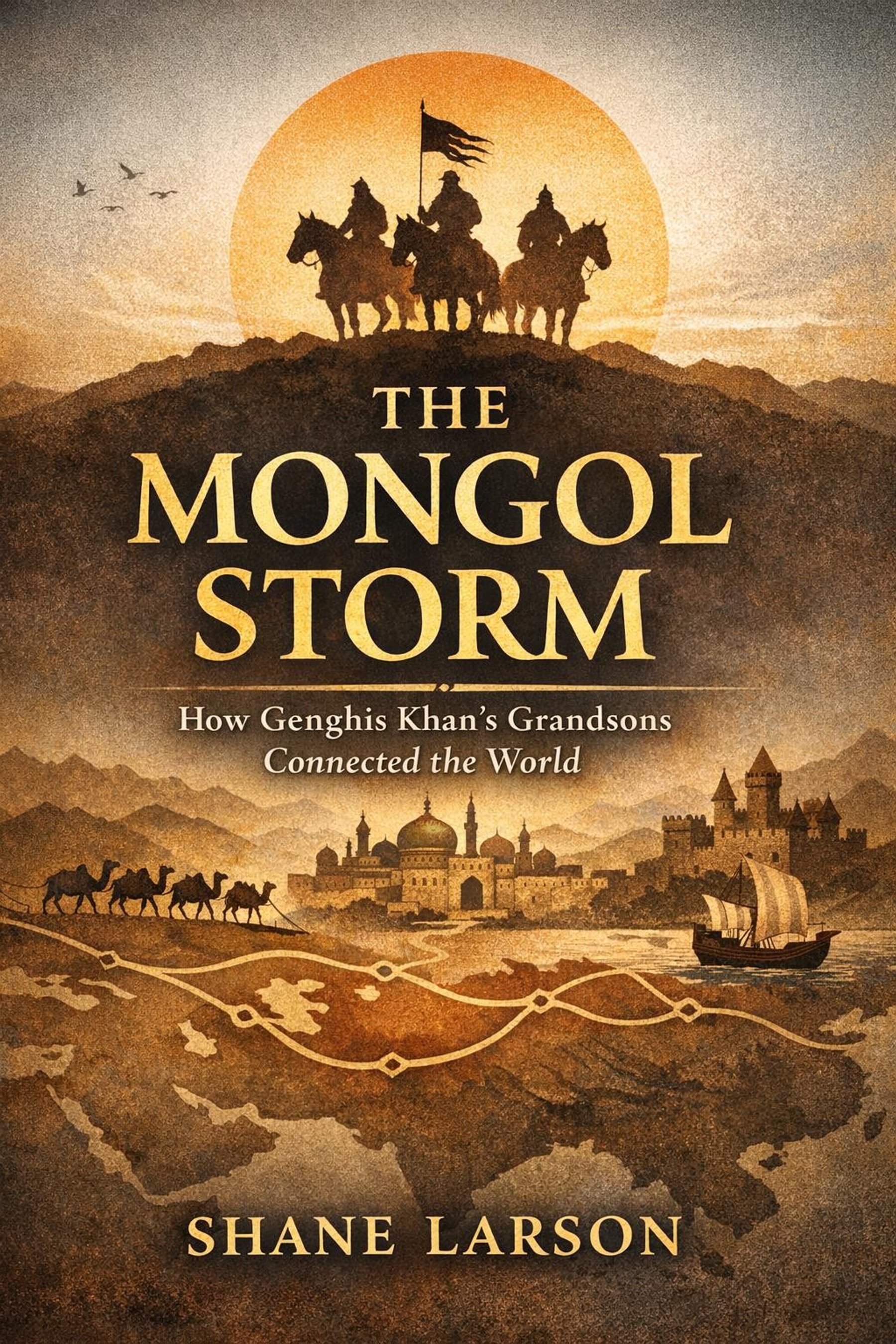
This post is adapted from my new book, The Mongol Storm: How Genghis Khan's Grandsons Connected the World — the full story of the Mongol century, from Temüjin's rise to Kublai's throne, told honestly about both the achievement and the cost. It's out now on Kindle for $3.99 and free on Kindle Unlimited.
If you like this kind of history, you might also enjoy my earlier books on the ancient world — Alexander's Generals and Hannibal's War — and you can find everything I've written, plus more essays like this one, at shanelarson.com.
The Mongol Storm
New posts and releases, straight to your inbox. No spam, unsubscribe anytime.