There Is a Bronze Age Superpower Whose Capital City Has Never Been Found
September 23, 2026 · 6 min read
Everyone knows the ancient world has lost cities. Troy was one, until Schliemann dug it up. Hattusa, capital of the Hittite Empire, was another — a rumor in Egyptian records until tablets started coming out of a hillside in central Turkey and an entire great power walked back into history. We tend to file these stories under solved: the romantic nineteenth-century phase of archaeology found the famous places, and what remains is refinement.
Except that one of them is still missing. Not a legendary city, not a place of disputed existence — the working capital of a first-rank empire, a city that ran diplomacy with the pharaohs of Egypt as an equal for the better part of a century. It was called Washukanni. It was the seat of the kingdom of Mitanni. And nobody can tell you, with evidence in hand, where it was.
The empire you've never heard of
In the fourteenth century BC, the Near East was run by a small club of great powers whose kings addressed one another as brothers. Egypt belonged to it. So did the Hittite Empire in Anatolia, Babylonia, and — elbowing its way in mid-century — Assyria. The fifth member was Mitanni, a kingdom of Hurrian-speakers ruled from upper Mesopotamia, which at its height controlled everything from the Zagros mountains to the Mediterranean coast.
This was not a marginal player. Mitanni fought the Egypt of Thutmose III — the most formidable military power on earth at the time — to a two-generation standstill over Syria, then converted the stalemate into an alliance sealed the Bronze Age way: three Mitanni princesses married three successive pharaohs. When Amenhotep III fell ill, the king of Mitanni shipped him the statue of a healing goddess, and the paperwork suggests it was the goddess's second trip to Egypt. Mitanni's horse trainers wrote the oldest surviving conditioning manual in the world, a seven-month program the Hittites valued enough to copy into their own archives. When a delivery of promised solid-gold statues from Egypt turned out, on arrival, to be wood under gold leaf, the Mitanni king Tushratta sent the pharaoh a long, wounded letter of complaint — and that letter still exists, because Egyptian clerks filed it at Amarna, where it was dug up in the 1880s.
Which points at the strange part. Almost everything we know about Mitanni survives that way: in other people's archives. Egypt kept the letters it received. The Hittites kept the treaties they imposed. The Assyrians, who eventually swallowed the kingdom's remnant, kept campaign accounts. Mitanni's own records — the outgoing correspondence, the treaty copies, the royal library that a power of this rank certainly maintained — have never been recovered. They presumably sat in the capital. And the capital is the hole in the map.
What we actually know about Washukanni
The name is secure. Washukanni appears in Hittite treaties and campaign narratives; the Hittite king Suppiluliuma reached it during the blitz that broke Mitanni's power, and later Assyrian records mention the city in its diminished afterlife. So this is not a question of whether the place existed. It existed, it mattered, and armies visited it.
The texts even yield constraints. Washukanni belongs in the Khabur triangle — the fan of rivers and streams in the northeastern corner of modern Syria, one of the best-watered and most tell-studded landscapes in the Near East. Itineraries, campaign sequences, and the general geography of the kingdom all point there. One later Assyrian source associates the region's cult center with the headwaters of the Khabur itself.
That is where the leading candidate sits. Tell Fekheriye is a large mound at the Khabur's springs, near the modern Syrian-Turkish border, and it has a lot going for it: the right size, the right location, the right water supply, and later occupation layers that show the site remained important for centuries. It has been dug repeatedly — American teams in the 1940s, German-led expeditions in the 2000s. Excavators have found substantial Mitanni-period remains there. What no one has found is proof.
The Mitanni
Why "proof" is the hard part
Here is the piece most people never think about: how does an archaeologist actually know the name of the place being excavated? The mound doesn't say. Ancient cities did not post signage that survives, and a ruin in a landscape with hundreds of ruins is anonymous by default. In practice, identification comes from writing found in the ground — ideally a tablet or inscription that names the city it was written in. Hattusa was confirmed because tablets excavated there kept referring to the place itself. Ugarit, on the Syrian coast, was confirmed the same way. Until a text does that, an identification is an argument, not a fact — a probability built from geography, size, and dating.
For Washukanni, that clinching text has never turned up. Tell Fekheriye has produced writing, including a famous later inscription in Aramaic and Assyrian, but nothing that unambiguously says the Bronze Age city at this spot was Mitanni's capital. And the deeper problem is structural: the Mitanni levels of any candidate site lie under a thousand-plus years of later city, which means the layers that could settle the question are the deepest, most expensive, and slowest to reach. Excavation in the region has also been repeatedly interrupted — by the world wars of the twentieth century and, in recent years, by the conflict in Syria, which has made sustained fieldwork in the Khabur basin impossible for long stretches. The tells that could answer the question have barely been touched at the scale the problem requires.
There is also a sobering possibility that the search is haunted by: Washukanni may not be under the biggest, most obvious mound. Capitals of the second millennium BC were sometimes more modest than their political weight suggests, especially for a kingdom that governed through a web of vassal kings rather than a heavy central bureaucracy. The city could be a middling tell nobody has prioritized.
What finding it would change
This is not treasure hunting; the stakes are textual. When Hattusa gave up its archives, Hittite history went from a shadow to a fully documented great power within a generation — kings, treaties, laws, prayers, the works. Washukanni is the last place on earth where a find of that magnitude is plausibly still waiting. If the city is identified and any part of its chancellery survived — and fire, the destroyer of cities, is paradoxically the preserver of clay tablets, baking them hard — then an entire great power gets its voice back. The wars with Egypt told from the northern side. The king list corrected from the kings' own records. Perhaps even an answer to one of ancient history's oddest puzzles: why the ruling elite of this Hurrian-speaking kingdom bore Indo-Aryan names and swore treaty oaths by Mitra, Varuna and Indra — gods of the Vedas, a thousand miles from India.
One tablet naming the city would do it. That is the razor's edge the whole subject sits on: a superpower reconstructed entirely from its neighbors' filing cabinets, one routine excavation find away from telling its own story.
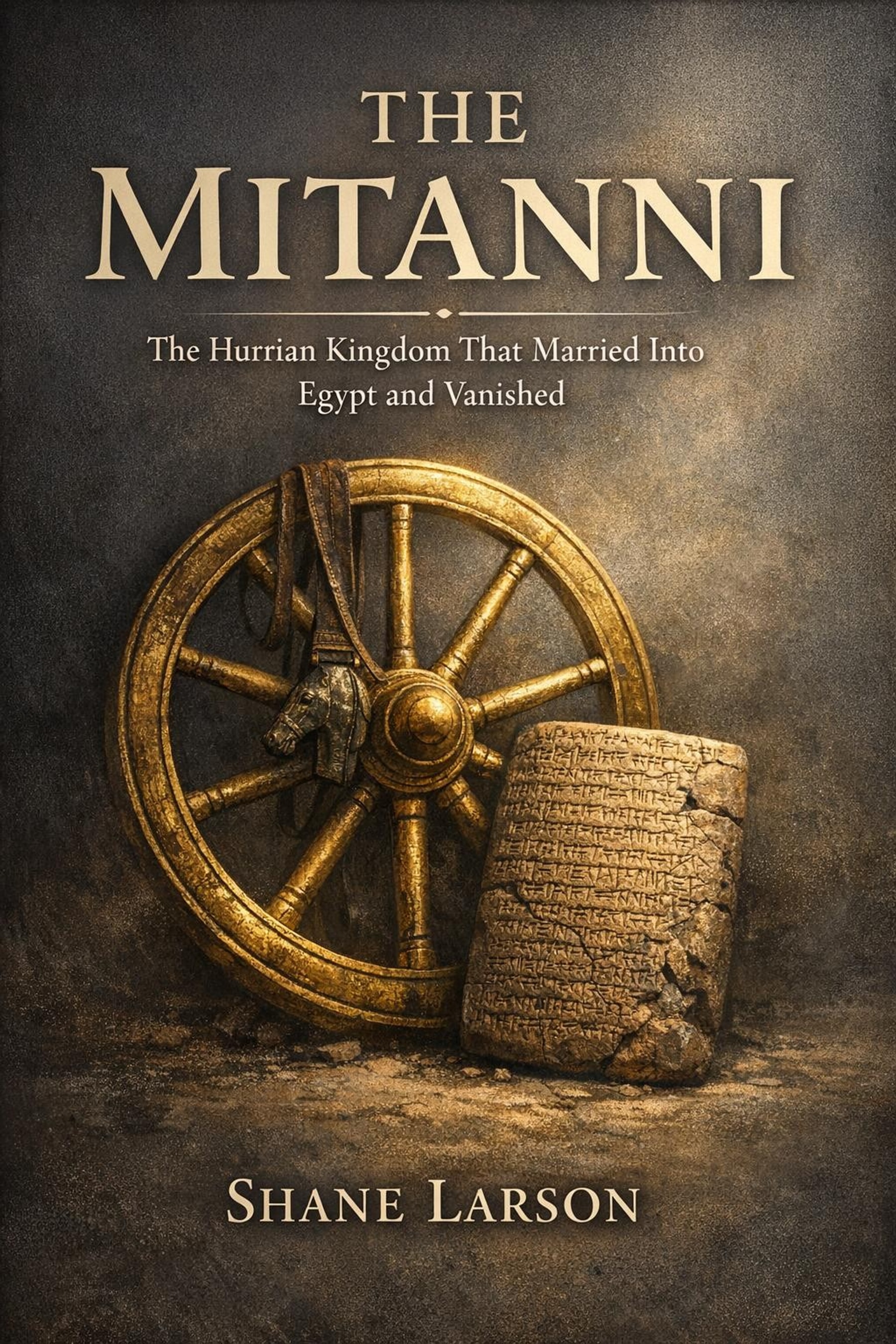
Shane Larson's The Mitanni: The Hurrian Kingdom That Married Into Egypt and Vanished reconstructs the fifth great power of the Bronze Age from the letters, treaties, and lawsuits its neighbors kept — and follows the search for Washukanni to its current state of play. The ebook is available at Books2Read and the paperback is on its way. It joins his Bronze Age shelf alongside The Amarna Letters, The Hittite Empire, Akhenaten, Nefertiti, and Assyria.
The Mitanni
New posts and releases, straight to your inbox. No spam, unsubscribe anytime.