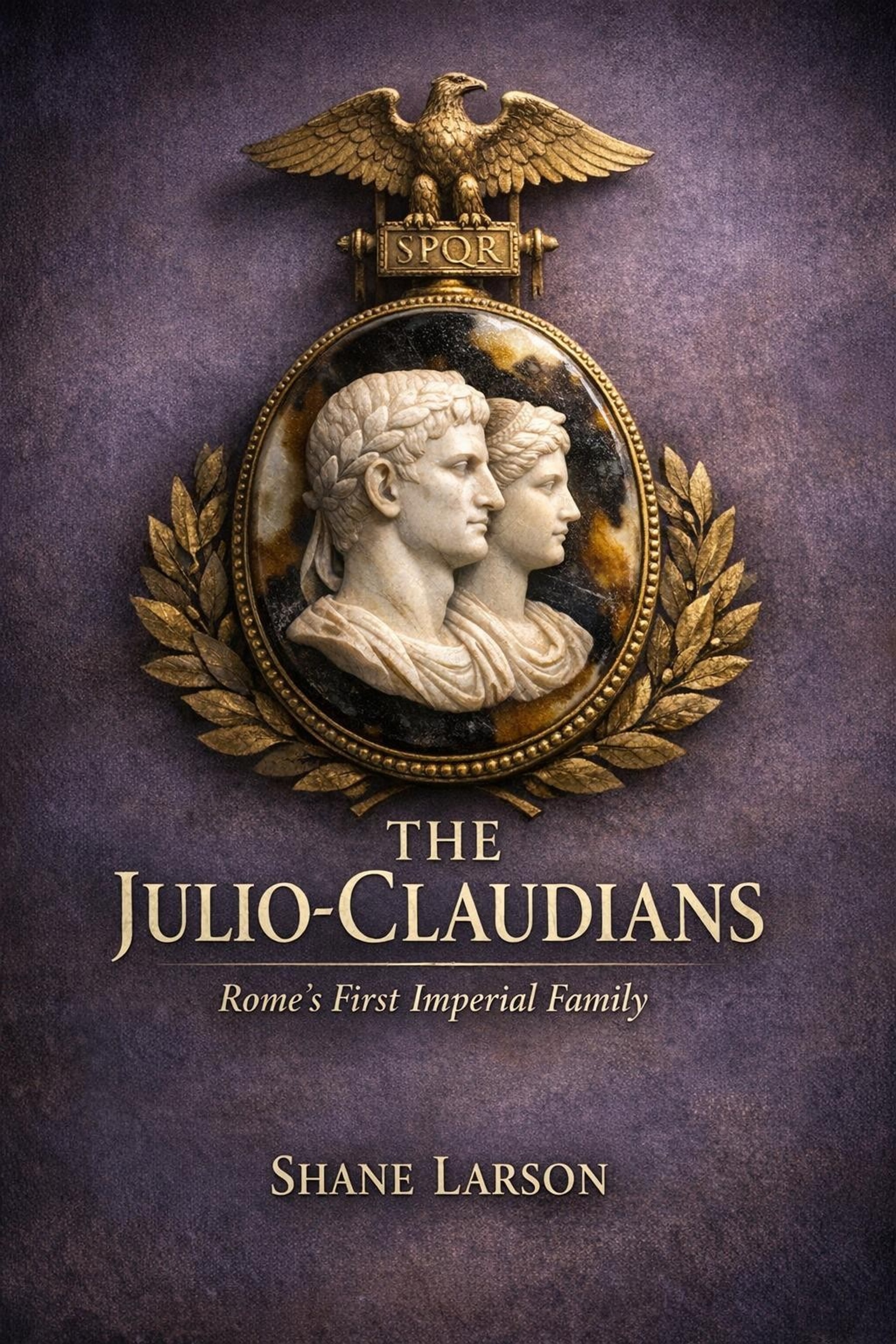
The Julio-Claudians
Rome's First Imperial Family
By Shane Larson · Rome: From Village to Empire (Book 8)
About This Book
On the afternoon of 24 January, AD 41, a soldier looting the imperial palace pulled back a door-curtain and found a middle-aged man trembling behind it. The emperor Caligula lay dead in a covered corridor a few hundred yards away, killed by the officers of his own bodyguard. On the Capitoline hill, the Senate was debating the restoration of the Republic — actual speeches, an actual watchword issued by the consuls, the first hours of a world without emperors. The man behind the curtain was Claudius: fifty years old, lame, stammering, the acknowledged embarrassment of Rome's ruling family, alive chiefly because nobody had ever thought him worth murdering.
The soldiers did not kill him. They carried him to their camp and made him emperor, and by the next evening the Republic's restoration had dissolved for a simple, unanswerable reason: nine thousand praetorian guardsmen understood that a republic would have no use for them. Claudius promised each of them fifteen thousand sesterces — roughly fifteen years of a legionary's pay — and the transaction was complete. The throne of the Roman world had been openly bought from the men holding it, and every usurper for the next four centuries kept the receipt.
That afternoon is the Julio-Claudian dynasty in miniature: an office with no rule for filling it, a family with no way to protect its own members from each other, and an empire that carried on regardless.
The Argument
The Julio-Claudian dynasty is usually told as a portrait gallery of monsters — the recluse, the madman, the fool, the matricide. This book tells it as a single story with a single cause. Augustus built supreme power out of a bundle of offices and honors that never once said king, and the evasion that made his position acceptable also made it undefinable. Nothing said how it passed to the next man. Nothing said what its holder could not do. Nothing said how Rome could lawfully get rid of him. Every catastrophe of the next fifty-four years — the treason trials, the palace murders, the guard's auction, the extinction of the family itself — runs downstream from the job description that was deliberately never written.
Because the succession had no rule, it was decided inside one household, by marriage, adoption, and elimination. That handed real power to the people who ran the household: Livia, Messalina, Agrippina the Elder and Younger — women barred from every magistracy in Rome, working the one lever the system left them, and uniformly remembered by hostile sources as poisoners. This book treats them as what the structure actually made them: politicians, operating without titles in the only arena that mattered.
And running underneath the whole story is the fact the portrait-gallery version leaves out: the empire worked. While the Palatine consumed itself, Spain and Gaul and the East were governed well and cheaply. Claudius put Gauls in the Senate and counted nearly six million citizens. The machine Rome had been building since the asylum on the Palatine — turning outsiders into Romans — ran straight through the dynasty's worst years. The Julio-Claudian paradox is that Rome's worst government coincided with some of Rome's best governance, and this book keeps both in view at once.
What's Inside
- The two days without an emperor — the assassination of Caligula, the Senate's one real debate on restoring the Republic, and the arithmetic of nine thousand guardsmen that settled it.
- The trial we can check — the Senate's own bronze verdict on the death of Germanicus, dug out of Spanish soil in the 1980s, read side by side with Tacitus's version of the same trial.
- The Caligula problem, worked in the open — every famous story (the horse, the seashells, the bridge of boats) sorted by who reports it, when, and what they could actually have known.
- An eyewitness in the room — Philo of Alexandria's account of standing before Caligula, the only surviving record of a personal audience with a Julio-Claudian emperor.
- The emperor's own words, in bronze — Claudius's speech admitting Gauls to the Senate survives at Lyon, rambling and pedantic and making the argument this whole series is built on.
- Messalina and the wedding nobody can explain — the empress's public marriage to another man in AD 48, weighed as coup, ceremony, or the sources' revenge on a powerful woman.
- The mushrooms, the boat, and the method — every alleged poisoning and murder judged by the same standard: what is claimed, by whom, how they could know, and what else explains the death.
- The fire of AD 64 and its scapegoats — what the archaeology shows, what Nero actually did, and the first state violence against the Christians.
- The end of the line — Vindex, Galba, the night the palace guard walked away, and the villa where the last man of Caesar's blood died.
Why I Wrote This
Seven books into this series, I finally hit the stretch of Roman history everybody already knows — or thinks they do. Caligula's horse, Nero's fiddle. What hooked me was discovering how thin the floor is under those stories: nearly everything we know about this family was written by its enemies, decades later, and the handful of things we can actually check — a bronze tablet in Spain, a speech cut into metal at Lyon, the coins — keep catching the famous historians shading the record. I wanted to write the version where the reader gets to watch that checking happen. And I kept being pulled in by the women. Livia and the Agrippinas ran an empire through the only door Rome left open to them, and the sources called every one of them a poisoner for it. Sorting the evidence from the revenge turned out to be the best detective work in the ancient world.
Frequently Asked Questions
Do I need to read the earlier books in the series first?
No. Every volume stands alone. The introduction recaps what the principate was, why it had no succession rule, and who this family is — everything a reader starting here needs. If you want the story of how the position was invented, that is Book Seven, Augustus, but nothing in this book assumes you've read it.
Is this a biography of Nero or Caligula?
No — it's the story of the family system that produced them. The catalog has a full biography of Nero already, and this book deliberately wraps around it: Nero's reign is told here as the dynasty's last act, and readers who want the full portrait are pointed to that book. Caligula gets something different — a chapter dedicated to how historians decide what parts of his legend to believe.
How much of the horrible stuff in the sources is actually true?
That question is this book's method. Tacitus, Suetonius, and Dio all wrote under later dynasties, from the senatorial class these emperors persecuted, and none of them witnessed what they describe. Where documents survive — bronze inscriptions, coins, an eyewitness pamphlet — the book sets them against the tradition in the open. Sometimes the tradition holds up. Sometimes it visibly doesn't. The honest answer is often "unprovable," and the book says so when it is.
Does it cover the women of the dynasty — Livia, Messalina, Agrippina?
Extensively — they are the book's continuous thread. Because the succession was decided inside the family, the women who ran the family held real power, and the chapters on Messalina and Agrippina the Younger treat their careers as the political operations they were, not the morality tales the sources made of them.
How long is the book?
About 100,000 words — seventeen chapters in four parts, one per reign, plus three appendices: a who's-who of the family, a plain-language guide to how the principate worked, and a reader's guide to the ancient sources.
If You Liked This, You Might Like
- Nero — the full biography of the dynasty's last emperor; this book tells you where he came from, that one tells you everything else.
- Boudica — the revolt that nearly cost Rome its newest province appears here as one chapter's crisis; her whole story gets its own book.
- Pompeii — the world the Julio-Claudians built, preserved in a single day eleven years after the dynasty ended.
- The Founding of Rome — where this series begins: the asylum, the kings, and the city that would one day be run from behind a door-curtain.
Four emperors, one family, and no rule for what happens next — this is the half-century that taught Rome who really chooses its rulers. Book Eight of Rome: From Village to Empire.
Included with Kindle Unlimited — read it free if you're a member.
New Ancient History releases and free chapters — no spam, unsubscribe anytime.
More in Rome: From Village to Empire
View series →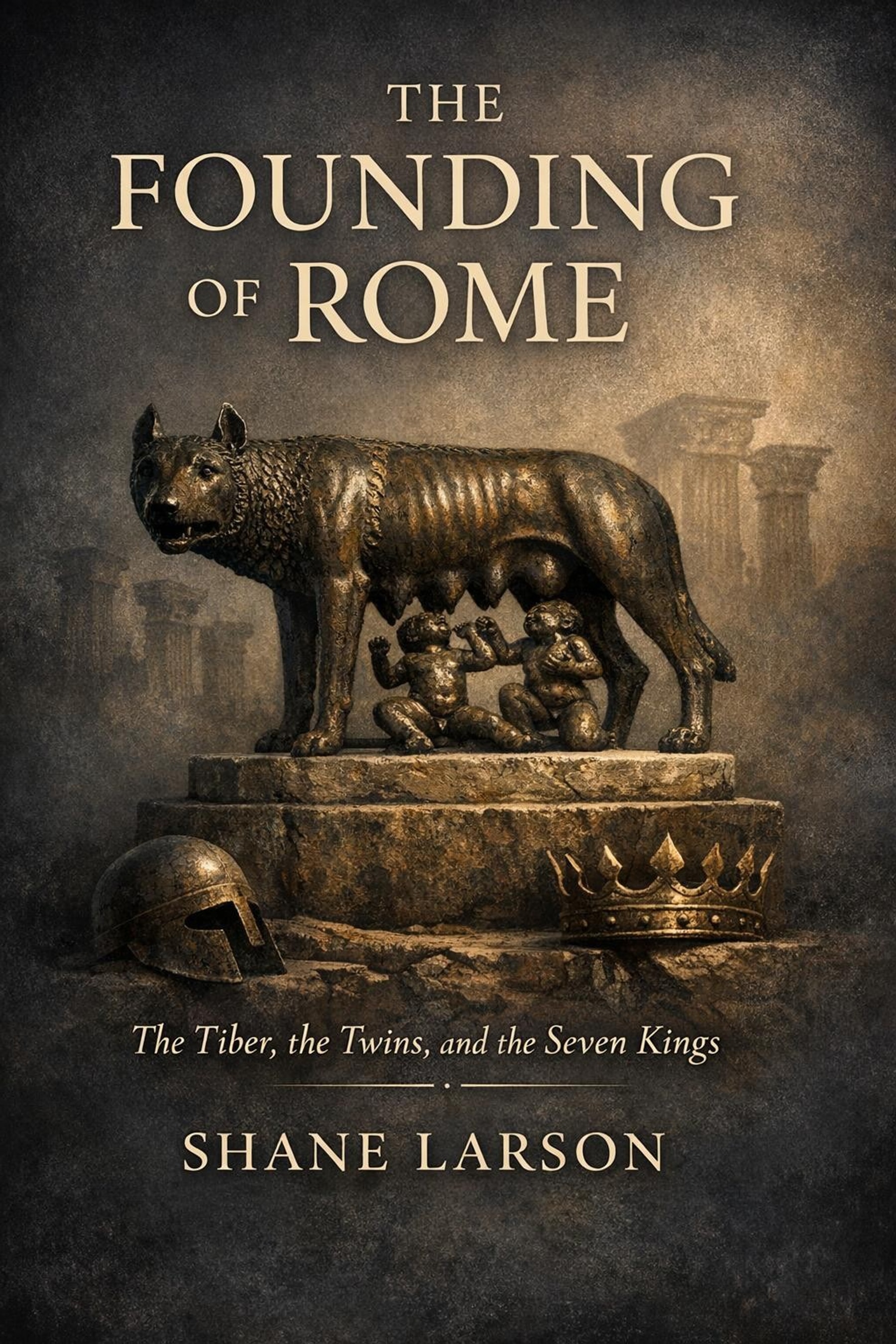
More in This Genre
View all →