The Order That Lost the Vietnam War Was Given Verbally, in One Morning, and Never Written Down
November 21, 2026 · 8 min read
At about ten past two on the morning of March 10, 1975, North Vietnamese sappers blew the wire at Ban Me Thuot, a market town in the southern Central Highlands, and behind the sappers came tanks. The defenders were rear installations, territorial troops, and part of one regular regiment, because South Vietnamese intelligence had placed the enemy's main strength a hundred kilometers north — exactly where a two-month deception campaign had put it. The town fell in about two days.
That was a serious defeat. It was not a fatal one, and the distinction is the whole story of the war's ending. On the morning of March 14, the ledger still showed twelve of thirteen divisions intact, the entire coast, every port, and the capital. II Corps still existed as a fighting formation. The enemy's own campaign plan — this is in the North's published military history — anticipated a general offensive in 1976. A state with a million men under arms had lost a town, a province, and part of a division. Armies absorb worse and fight on. This one had, three years earlier.
Fifty-five days after the sappers blew the wire, a North Vietnamese tank pushed through the gate of the Independence Palace in Saigon and the Republic of Vietnam ceased to exist. What happened in between was not, for the most part, a military campaign. It was a chain reaction — and the first link in the chain was forged not on a battlefield but at a meeting.
One morning at Cam Ranh Bay
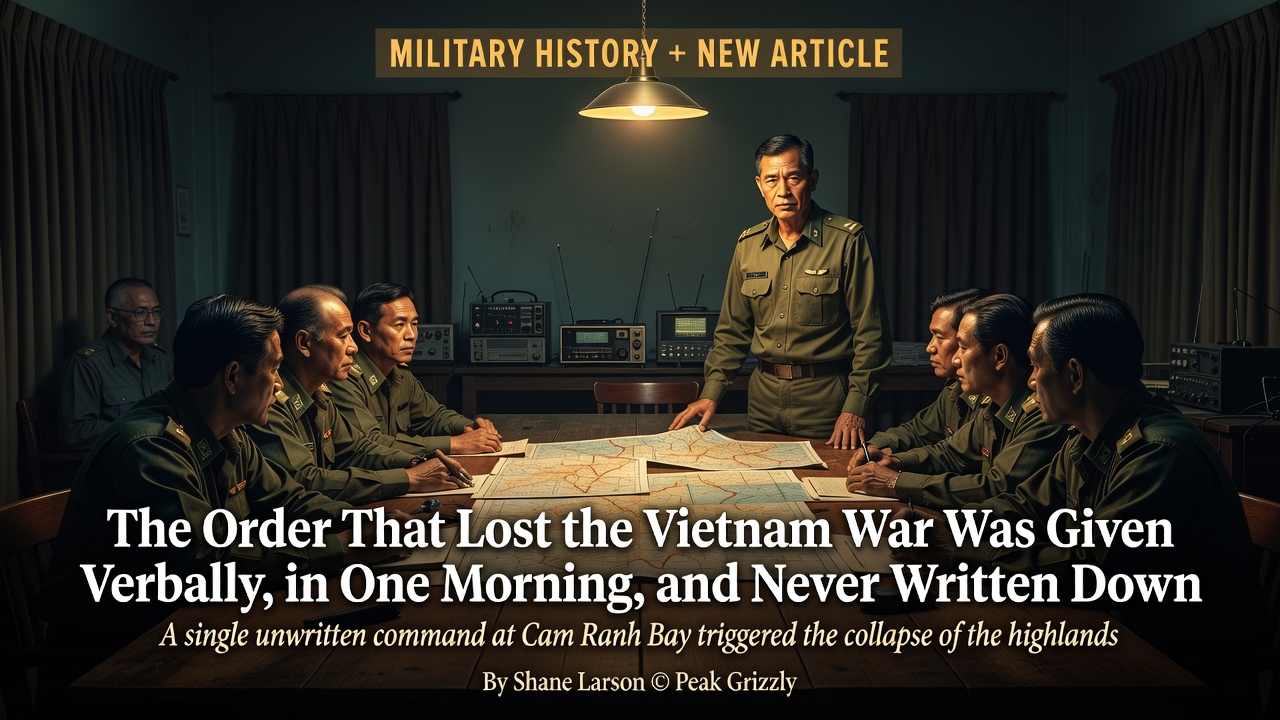
On March 14, four days after Ban Me Thuot was attacked, President Nguyen Van Thieu met his senior commanders at Cam Ranh Bay and ordered the Central Highlands abandoned.
Set aside whether the decision was right — a case can be made that some strategic contraction had become unavoidable, and serious historians make it. Look instead at how it was made, because the how is what turned it lethal.
The order was verbal. There was no written directive, no staff study, no phased plan. The province chiefs whose provinces were being given up were not told; they and the populations they governed would learn of the abandonment by watching the army leave. The withdrawal route chosen for two divisions and their equipment was Route 7B — an interprovincial road effectively derelict for years, with a river crossing that had no bridge — and no one had reconnoitered it. And because this army's soldiers' families lived beside its garrisons, the families went into the column with the troops. A military movement and a refugee exodus were fused into a single body on a road nobody had scouted.
What followed took less than a week. The column stalled at the unbridged river at exactly the point a pursuing division could reach it, and II Corps — some twenty thousand regular troops, a military region's fighting strength — dissolved on that road without fighting a battle of its own choosing. The losses among the civilians in the column have never been counted and cannot be; estimates span an order of magnitude, and no honest account chooses a number.
And then the destruction traveled faster than the enemy did. The knowledge that the government had surrendered two provinces without telling the people who lived in them reached the northern cities ahead of any North Vietnamese soldier. Hue was given up when its line could no longer be manned. Da Nang, a city of nearly two million with a garrison inside it, was lost at the end of March in forty-eight hours, essentially without a defense. By then the panic was not responding to orders; it was the orders. A government that had abandoned its citizens once, unannounced, had told every city on the coast what its guarantee was worth.
A defeat became a collapse because of how the response to it was made.
Why the plan didn't exist
The natural question is how a state at war for a generation came to order its most consequential redeployment with no plan on paper. The answer is on the record, and it is worse than negligence: the plan was forbidden.
Since 1973, official strategy had been the "four no's," of which the operative one was no surrender of territory — every district town in a thousand-kilometer country was to be held. Under that doctrine, planning a withdrawal from the highlands was politically unsayable, and so it was never staffed, never rehearsed, never mapped. Proposals to shorten the line deliberately — militarily orthodox, raised repeatedly across 1973 and 1974 while there was a year in which to act — died on the same rock. When the question was finally asked in a form that produced a decision, it was over breakfast on March 11, in the fifth day of the offensive. So when the moment came, the only version of the decision available was the worst one: immediate, verbal, and improvised from the top of a system whose bottom hadn't been told.
The Republic Falls
There is a general lesson here, and it deserves to be stated once, plainly, because it travels well beyond 1975. An organization's response to a reverse is frequently more destructive than the reverse itself, and the mechanism is nearly always the same: a decision taken quickly, at the top, without a plan, and communicated to the people who must execute it only as an instruction to move. The reverse costs what it costs. The unplanned response costs the system's coherence — every unit downstream discovers that the assumptions its position was built on have been revoked without notice, and each improvised reaction revokes someone else's. That is what a cascade is. Ban Me Thuot cost a province. Cam Ranh cost the army's belief that anyone was steering.
The same army, three weeks later
If the story ended there, it would license a lazy conclusion — that this army simply would not fight — and the record refuses the conclusion emphatically.
In early April, on Route 1 about forty miles east of Saigon, the 18th ARVN Division stood at the town of Xuan Loc. The 18th was not an elite formation — not the Airborne, not the Marines — and it carried an unfashionable reputation inside its own army. For roughly two weeks it held against a force several times its size, broke assault after assault, and then withdrew at night, in contact and in order, one of the harder feats in conventional war.
Same army. Same month. Same pay, same schools, same rationed ammunition. A corps dissolved on Route 7B without a battle, and three weeks later a middling division fought one of the finest defensive actions of the entire war. Any explanation that reaches for morale or national character has to explain both results with the same material, and it cannot — the men were the same men. What differed between the road and the town was, item by item, an output of command: at Xuan Loc there was a plan made in advance and written down, orders communicated to the units that had to execute them, a fortnight used for preparation, a civilian population evacuated before the battle instead of swept into it, and a headquarters that stayed where it was supposed to be. Whether this army fought depended, to a degree remarkable even by the standards of armies, on whether it was being commanded. That cuts in both directions, and it should not be flattened in either.
The argument about the money
Standing behind all of this is the most politically loaded dispute in American military history: whether the collapse was caused by the American aid cuts — appropriations that fell by three-quarters in real terms across two years, landing on an army built around American consumption rates — or was built into the state's architecture from the start, with the cuts setting only the timing. Both cases marshal real evidence; each, read closely, assumes part of the other. The book this article draws on declines to settle the question, on the ground that the evidence doesn't settle it, and instead prints the figures — appropriations against actual expenditure, ammunition rates, aircraft availability, the Soviet and Chinese deliveries with the disagreements between sources shown rather than averaged — in an appendix, so the reader can check the arithmetic instead of taking anyone's word for it. What the figures cannot do, on either reading, is buy back Route 7B: that movement, conducted in that manner, would have destroyed the best-supplied army on earth.
The eighth instance
The war ended on April 30, 1975. About 130,000 people left in the evacuation of the final weeks; the great majority of those the American mission's own estimates placed at risk did not, and what began for them afterward — the camps, the boats, the two decades of departures — belongs to a record their community is still writing.
This is the final volume of an eight-book series that has followed America's war in Vietnam from the French collapse to the embassy roof, and across eight volumes the finding has held steady: institutions under time pressure, acting on incomplete information they had themselves shaped, failed in ways that are perfectly visible afterward and were mostly available to see at the time. Very little in these books was unforeseeable. Most of it was foreseen, by people inside the institutions concerned, whose warnings sit in the record, dated before the events they warned of. The fifty-five days of 1975 are the last and starkest instance, and the meeting at Cam Ranh is their hinge: the moment a government discovered, at the worst possible time, the cost of every question it had refused to permit while there was still time to answer it.
This article draws on the research behind The Republic Falls: From the Paris Accords to the Embassy Roof, 1973–1975, the eighth and final volume of The Vietnam War Chronicles from Peak Grizzly Publishing. The book covers the two-year ceasefire war almost nobody reads about, the meeting at Cam Ranh and the road that followed it, the fall of the coast, the stand at Xuan Loc, and the last days in Saigon — with two chapters written from Hanoi's side of the hill. Contested figures are given as ranges with a named source at each end, nothing is invented, and the appropriations record is printed in an appendix so the reader can check the arithmetic without taking anyone's word for it — including this book's.
The Republic Falls
New posts and releases, straight to your inbox. No spam, unsubscribe anytime.