In 1979, China Invaded Vietnam to Punish It for Stopping a Genocide — and the Story Vanished in a Month
November 22, 2026 · 8 min read
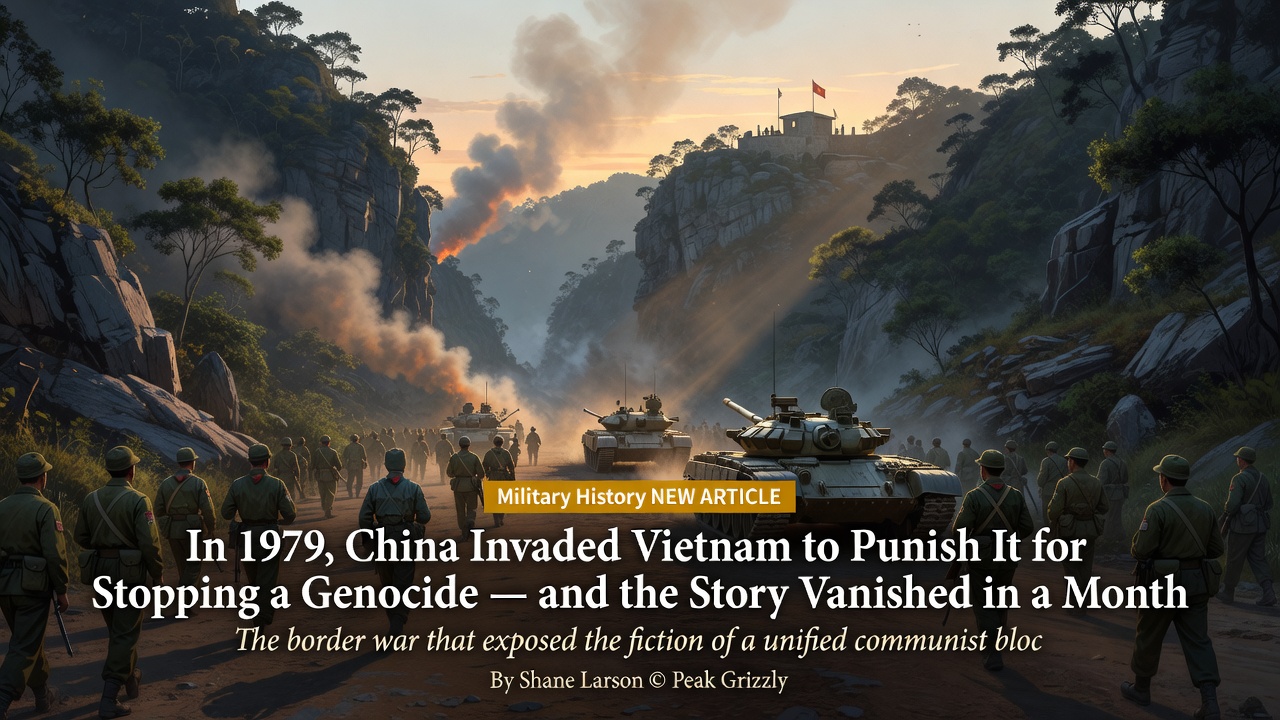
Before dawn on February 17, 1979, Chinese artillery opened along the whole length of the Vietnamese border, and several hundred thousand troops — the exact number is one of many figures from this war that no two sources agree on — came across it at more than two dozen points. Within three weeks they had taken the provincial capitals of Lang Son, Cao Bang, and Lao Cai, at a cost in lives that neither government has ever published in a form the other accepts. Then, in mid-March, China announced that the lesson had been delivered, destroyed nearly everything of value on its way out, and withdrew.
Two communist states, one of them four years removed from defeating the United States, the other about to normalize relations with it, had just fought a conventional war against each other — the largest Chinese military operation since Korea. It ran on the front pages of the world's newspapers for about a month. Then it vanished, so completely that most educated Western readers today could not say it happened. That vanishing is not an accident of attention. It was assisted, at both ends, and the reasons it was assisted are the most instructive thing about it.
Ten weeks, three governments, two invasions
The war of February 1979 was the second act of a sequence that had begun ten weeks earlier, and the sequence has to be taken whole or not at all.
On December 25, 1978, Vietnam invaded Cambodia. The proximate cause was two years of Khmer Rouge raids across the border into Vietnamese villages, and behind that a hostility between the two revolutionary movements that long predated either one's victory. Phnom Penh — a capital the Khmer Rouge had emptied of its own population within days of taking it in April 1975 — fell on January 7, 1979, after roughly two weeks. The regime Vietnam drove into the western hills had, in under four years, killed a fraction of Cambodia's population so large that the argument over its true size has filled an academic literature and is still not finished. Vietnam's invasion ended that. It also installed a client government in Phnom Penh and began a military occupation that would last ten years.
China was the Khmer Rouge's patron, and it answered. Deng Xiaoping toured the United States at the end of January 1979 — the first visit by a leader of the People's Republic — and told his hosts, more or less openly, that Vietnam was going to be taught a lesson. Less than three weeks after he flew home, the artillery opened. The declared war lasted twenty-seven days. The actual war did not end with the withdrawal: the two armies faced each other across that border for another decade, and Vietnamese conscripts went on dying in the hills at Vi Xuyen deep into the 1980s, in a conflict commemorated today on the scale of none of Vietnam's other wars.
Then came the third act, which was not fought with armies. Every autumn from 1979 onward, the United Nations General Assembly voted on who held Cambodia's seat, and every autumn for eleven consecutive years the seat went to the regime Vietnam had removed — first to Democratic Kampuchea outright, then, from 1982, to a coalition assembled around it to make the arithmetic more comfortable. The votes were organized by China and ASEAN and supported by the United States and most of Western Europe. For over a decade, the flag of the government that had emptied Phnom Penh flew in New York, while the state that had stopped the killing sat under embargo and diplomatic siege until it was destitute.
Four facts, then. Vietnam invaded Cambodia and ended a genocide. The invasion was an invasion, and it installed a decade of occupation. China invaded Vietnam to punish it. And the West spent the following decade keeping the removed regime's seat occupied. All four are true. None of them cancels the others, and every comfortable account of the period gets comfortable by dropping at least one.
What February 1979 actually refuted
The American war in Vietnam had been fought, publicly and at every level from presidential address to draft-board pamphlet, on a premise: that the communist states of Asia constituted a single hostile bloc, directed from a common center, and that the fall of one country to that bloc would tip its neighbors in sequence. Men were conscripted on that premise. The bombing tonnages were justified on it. It organized two decades of American policy, and its own architects had gone quiet on it before the war even ended — Nixon was in Beijing in 1972 precisely because the split between Moscow and Beijing had grown too large to ignore.
The War That Followed
But policy quietly abandoning a premise is one thing. History refuting it in public is another, and that is what the winter of 1978–79 did. Within four years of the last American helicopter leaving Saigon, the supposed members of the bloc were at war with one another — Cambodia raiding Vietnam, Vietnam invading Cambodia, China invading Vietnam, and the Soviet Union backing Vietnam against them both. The dominoes, left entirely to themselves, fell on each other. No argument, no memoir, no thirty-year retrospective could have said it more plainly than the event itself said it. It is worth stating once and then leaving alone: the war's premise was not disproven by its critics. It was disproven by its supposed beneficiaries, with tanks, within a presidential term of the war's end.
Why the story vanished
A month of front pages, and then almost nothing — no shelf of histories, no film, no place in the curriculum, barely a paragraph in most general accounts of the Cold War. The disappearance had help from every direction, which is exactly why it worked.
China had declared victory over a campaign that went badly enough that its own military spent the next decade being reformed in the light of it; the details served no one in Beijing. Vietnam had won a defensive war on its own soil and then spent ten years being bled by the occupation of Cambodia and the embargo; its official history, which runs on the theme of one war and one victory, has little room for a war against a fraternal socialist state. And in the West, the story was simply unusable. It flattered no position. For those who had supported the American war, the spectacle of the bloc devouring itself was an embarrassment to the founding premise. For those who had opposed it, Vietnam's occupation of its neighbor and the condition of postwar Indochina were unwelcome complications. And the UN arrangement — Western votes, year after year, for the credentials of a regime whose record was by then documented beyond dispute — was the kind of policy that functions best when nobody narrates it. A story that embarrasses all sides equally does not get suppressed. It just never gets assigned, and the result is the same.
Counting in a room full of interested parties
Nearly every number in this period is contested, and contested by parties with something at stake: two governments that have never agreed on the 1979 casualty figures, a Cambodian death toll argued up and down for reasons that were often about something other than Cambodia, a Vietnamese state with registers it has kept shut, and estimates of every kind produced by institutions that needed them large or needed them small. The book this article draws on applies one rule to all of them, without exception: every major figure is given source by source, with the method behind each estimate stated and the interest of the party that produced it named — who needed this number bigger, and who needed it smaller. No figure is averaged. None is picked as the book's own. Where the honest answer is that a number cannot now be known, the book says so and explains why the records that could have decided it were never made or are being withheld. Naming an interest is not an accusation — an interested party can be right — but a figure whose method cannot be stated is not evidence, whoever finds it useful. For a reader tired of being handed a confident number with nothing under it, this is the alternative: the range, the methods, and the motives, laid out for audit.
A history in which Americans are mostly an absence
Half of the volume behind this article is Vietnamese and Cambodian history in which Americans scarcely appear — and when they do, it is mostly as an absence: an aid program that had stopped, a fleet that did not return, an embargo, an empty chair. That is not a gesture toward balance. Between 1975 and about 1990, the largest events of this story — the reeducation camps, the remaking of the southern economy, the exodus by sea that founded a diaspora now counted in the millions, Democratic Kampuchea and the wars it set off — happened to Vietnamese and Cambodians, were decided by Vietnamese and Cambodians, and would have run much the same course whatever was said in Washington. An account that keeps Americans at the center of those years must either inflate what America did or shrink what happened. The American memory of the war ends in 1975; the war did not, and the twenty years that followed belong mostly to the people who lived them.
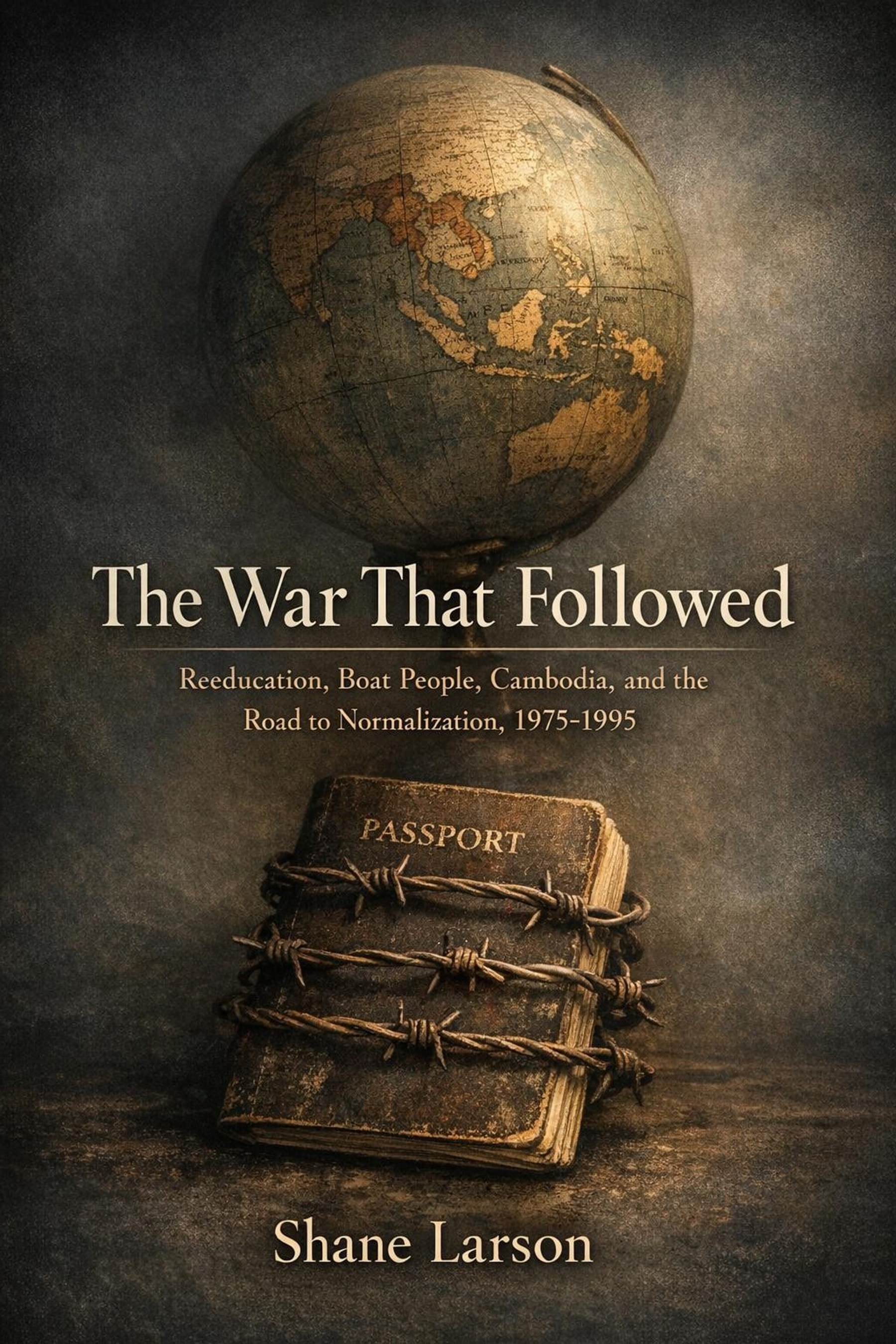
This article draws on the research behind The War That Followed: Reeducation, Boat People, Cambodia, and the Road to Normalization, 1975–1995, the ninth volume of The Vietnam War Chronicles from Peak Grizzly Publishing. The book covers the new Vietnam after 1975, the Third Indochina War from the documents of all three states that fought it, the American reckoning — the veterans, the memorial, the missing, the herbicide — and the long road to the normalization of 1995. Half of it is Vietnamese and Cambodian history in which Americans appear mostly as an absence; every contested figure of the period is given source by source, with the method and the interest behind each estimate named, so the reader can check the arithmetic without taking anyone's word for it — including this book's.
The War That Followed
New posts and releases, straight to your inbox. No spam, unsubscribe anytime.