The Most Famous Speech of Henry VIII's Reign Was Written Down Twenty-Five Years Later
October 27, 2026 · 7 min read
On the morning of 21 June 1529, in the Parliament Chamber of the Dominican friary at Blackfriars, two cardinals sat down to decide whether the King of England had ever been married. Thomas Wolsey sat on one side as papal legate. Lorenzo Campeggio, sent from Rome the previous autumn and crippled with gout, sat on the other. The king sat under a cloth of estate at the upper end of the room. The queen's chair was set lower, across the floor from him.
Nothing like it had happened in England before. A reigning king and queen had been cited to appear in person before a church court, in their own capital, to answer a question about their own bed.
The crier called the king, and Henry answered that he was present. The crier called Catherine, Queen of England, to come into the court. She did not answer from her chair. She stood, crossed the open floor, and knelt at her husband's feet.
If you know one thing about Catherine of Aragon, it is probably this scene, and you probably know it with words attached. She asks Henry what she has done to offend him. She reminds him that she came to England a stranger, without friends or counsel of her own choosing. She says she was a true wife to him for twenty years and bore him children whom God chose to take. She says she came to him a maid, and leaves it to his conscience whether that is so. She asks to have her case heard in Rome, and if he will not grant that, she commends her cause to God. Then she curtsies, walks out on the arm of her receiver-general, and does not come back when she is called.
I spent a book on the twenty-four years behind that morning, and the thing I want to set out here is the smallest and firmest part of it: who wrote the scene down, when, and how much of it is theirs.
Two witnesses, a quarter-century apart
The speech survives because two men who were in London that summer put it on paper. They agree about what happened. They disagree about what it sounded like, and the disagreement is the whole of the story as later centuries have told it.
The first is George Cavendish. He was Wolsey's gentleman usher, a member of the cardinal's household, and he stood close enough to the bench to see faces. His is the version everyone knows: the fullest, the most moving, the one in which Catherine calls herself, in his words, a poor woman and a stranger born out of the king's dominion. It passed through Holinshed's chronicle into Shakespeare's Henry VIII, which is how most people who know the scene at all came to know it.
Cavendish wrote his Life of Wolsey in the mid-1550s. That is roughly twenty-five years after the morning he was describing. He wrote in retirement, during the reign of Catherine's daughter Mary, and his book is a tragedy with a villain in it, Anne Boleyn, and a wronged woman, the queen. He was a careful and affectionate writer. He was also recalling a speech from memory a quarter of a century later, and he gave it the shape a speech ought to have. The manuscript circulated privately and was not printed until the 1640s.
The second witness is Edward Hall, a London lawyer and member of Parliament, whose Chronicle was printed in 1548, the year after Henry's death. Hall was a Tudor loyalist who thought the king was right about most things, and his account of the court is shorter and cooler. His Catherine is less pathetic and more lawyerly. She tells the court she will not accept its judgment, and she appeals to Rome. The king's reply, as Cavendish records it after she had gone, praised his wife as a woman of as much nobility and gentleness as any living, and said he had no complaint of her, only of his own conscience.
Read them side by side and the structure is identical. She knelt. She spoke to Henry rather than to the judges. She refused the court's competence. She left and would not return. What differs is tone, and tone is what the dramas have been built on ever since.
What the words were for
The question of who wrote it down belongs in the story, not in a source note, because the speech was not a lament. It was a legal act, and both witnesses, in their different registers, record it as one.
Catherine of Aragon
An appeal to a higher authority, once lodged, was meant to suspend the court below it, and the highest authority was Rome. By kneeling and asking, in English, before the king and two legates and a room full of bishops, to have her cause heard by the Pope, Catherine was putting her appeal on the record in the most public form available. By walking out, and by refusing to return when summoned, she was declining to recognise the court's competence to judge her at all. The legates declared her contumacious. The court sat on without her for a month, and then, in July, Campeggio adjourned it, and the case was called back to Rome, where it could not be won by anyone, because the Pope was in her nephew's power. But it begins here, with a woman on her knees who had worked out exactly what kneeling would do.
That is the version that gets lost when the scene is told as a tragedy. Cavendish's Catherine is a wronged wife. Hall's Catherine is a litigant who knows the rules. Both are true, and the second one is the one that explains the next seven years.
The arithmetic nobody does
Here is the other thing the scene tends to hide.
Catherine was Queen of England from 11 June 1509, when she married Henry at Greenwich, until 23 May 1533, when Thomas Cranmer, sitting at Dunstable, pronounced the marriage null. That is a few days short of twenty-four years. The other five wives run as follows. Anne Boleyn, about three years and four months. Jane Seymour, seventeen months. Anne of Cleves, six months. Catherine Howard, sixteen months. Catherine Parr, three and a half years. Put them together and they come to something over ten years. Catherine of Aragon alone held the title for more than twice as long as all five combined.
She is not remembered that way. In the popular telling the six wives are a procession, and she stands at the head of it as the one who has to be got out of the way before the story can begin: older, Spanish, devout, barren of sons, the woman in the dark hood who could not understand why she was being set aside.
The woman who knelt at Blackfriars was the daughter of Isabella of Castile, who had led an army in the field for ten years and taken Granada when Catherine was six. She had been widowed at sixteen and had spent seven years as a hostage for her own dowry, pawning her plate to pay her household. In 1513, while Henry was in France, she had governed England as regent, raised the northern army, and sent her husband a piece of the Scottish king's coat from the field at Flodden. Erasmus thought she was better read than her husband. She had been doing this for a long time, and she knew what a court was.
The sentence she would not say
One more thing the two witnesses agree on, and it is the one that matters most. She was offered a way out, repeatedly, from the autumn before Blackfriars to the winter she died, and the way out was always the same word. Accept that the marriage was invalid, and keep your dower, your honour, your daughter's standing and the king's gratitude. She refused every time, in the same terms. She was his true wife. She had come to him a maid. No court but Rome's could say otherwise.
Whether she was right about the facts of her first marriage is one of the things the book lays out rather than rules on, because the evidence on both sides was given by people with reasons to give it. But nobody who knew her thought she was lying, and the king's own lawyers never seriously argued that she was. They argued it made no difference. And the refusal had a price, which fell on her daughter and not on her, and a biography that admires the refusal without counting that cost is a devotional work, not a history.
The crier at Blackfriars called for Catherine, Queen of England, to come into the court. She answered by walking out of it. The words she used on the way are, to a degree we cannot now recover, the words of a gentleman usher writing in the 1550s. What she did is not in doubt at all.
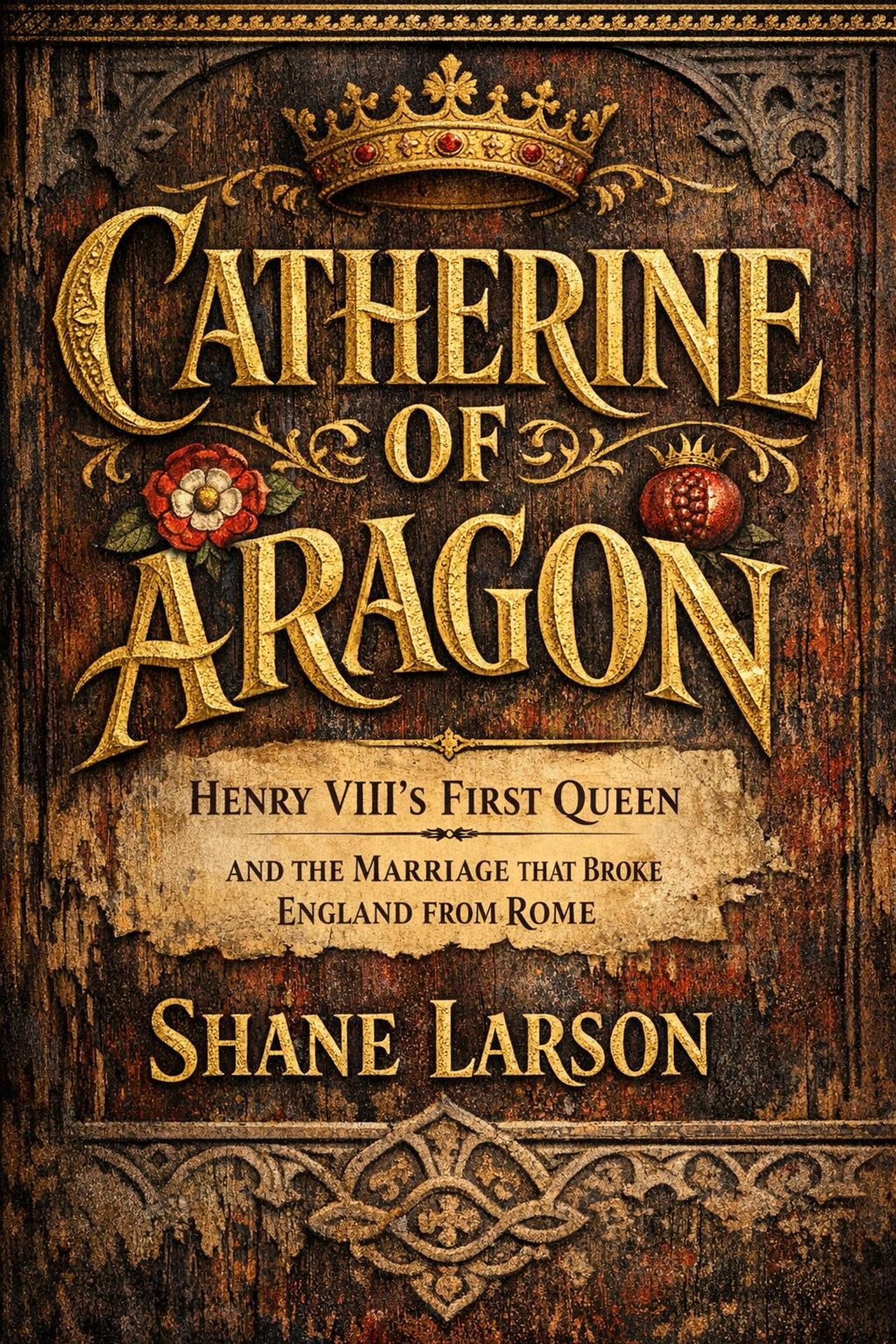
*Catherine of Aragon: Henry VIII's First Queen and the Marriage That Broke England from Rome* is the first volume of a series on the six queens of Henry VIII, each written to the same scale. It begins in Granada, in a court at war, the years that close *Al-Andalus*, and ends at Peterborough on 29 January 1536, the day Catherine was buried and the day Anne Boleyn miscarried a son. The second volume, *Anne Boleyn*, picks up on the day of Catherine's funeral. Both are available as ebooks from Apple Books, Kobo, Barnes & Noble and other retailers.
Catherine of Aragon
New posts and releases, straight to your inbox. No spam, unsubscribe anytime.