The Ancient Americans Who Built Highways — and Had Nothing to Drive on Them
August 18, 2026 · 6 min read
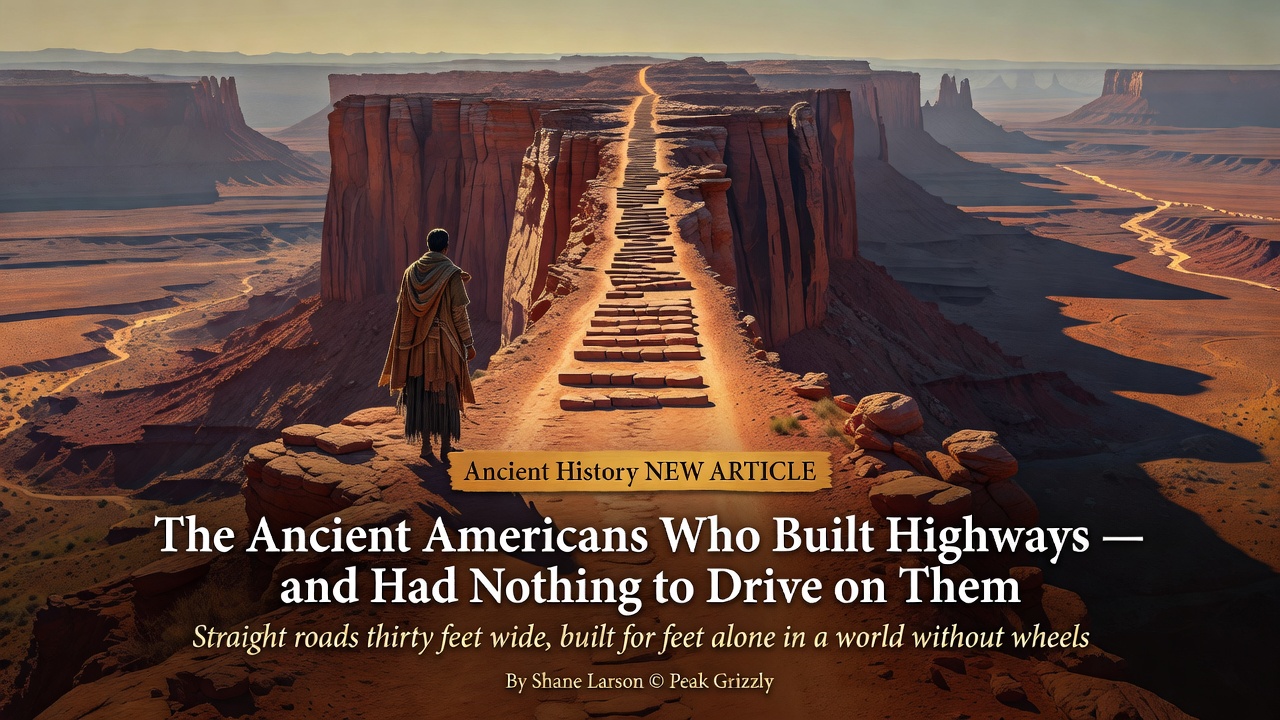
There is a road in northwestern New Mexico that runs north out of a dry canyon and keeps going, straight, for more than thirty miles. It does not curve around hills. Where a mesa stands in the way, the road climbs it — sometimes on stairways cut directly into the cliff face — and continues on the far side along the same bearing, as if the builders had snapped a chalk line across the landscape and refused to negotiate. In places it is thirty feet wide, which is wider than a modern two-lane county road. In places it runs as two parallel roads, side by side, a few dozen yards apart, going to the same place.
It was built roughly nine hundred years ago by people who had no wheels, no carts, no horses, no oxen — no wheeled vehicles or draft animals of any kind. Every human being who ever traveled that road walked.
Archaeologists call it the Great North Road, and it is one of hundreds of miles of engineered roads radiating from Chaco Canyon, the strangest place in ancient North America. Nobody knows what the roads were for. That is not a rhetorical flourish. It is the honest state of the field — and the argument over the answer turns out to be one of the most interesting in American archaeology.
The place the roads lead to
Chaco Canyon is, by any agricultural logic, a terrible place to build anything. It gets about nine inches of rain a year. It has no permanent river. Summer frosts trim an already short growing season, and the nearest good timber grows on mountains fifty miles away.
In this place, between roughly AD 850 and 1150, Ancestral Puebloan people built more than a dozen "great houses" — enormous masonry buildings of a scale not seen anywhere else north of Mexico. The largest, Pueblo Bonito, rose four and five stories and contained somewhere around 650 rooms. Its walls, built from shaped sandstone laid in distinctive banded patterns, were engineered like modern structures: three feet thick at the base, tapering as they rose, designed in advance to carry upper stories. Nothing taller was built in North America until the nineteenth century.
The roof beams alone tell you something extraordinary happened here. The great houses of the canyon consumed some two hundred thousand timbers — spruce, fir, and ponderosa pine that do not grow anywhere near the canyon. Chemical fingerprints in the wood (strontium isotopes, which vary from mountain range to mountain range) show the beams came from peaks around fifty miles away. Each one — up to sixteen feet long, weighing hundreds of pounds — was felled with stone axes, seasoned, and then carried to the canyon by hand. The beams show no drag scars. People walked them in, over two or three days, by the tens of thousands.
Here is the problem: the canyon could not have fed the workforce that did this. The soil and rainfall cannot support the population the buildings imply. And when archaeologists looked closely at the great houses themselves, the mystery got worse — hundreds of rooms, but very few hearths, very few burials, and surprisingly little of the ordinary domestic trash that people generate by living somewhere. The greatest buildings on the continent appear to have been, for most of the year, mostly empty.
An instrument, not a city
So what was Chaco? The buildings offer clues, and they are strange ones.
Pueblo Bonito's main walls align to the cardinal directions with a precision that required real astronomical observation. High on a butte in the canyon, three sandstone slabs channel a dagger of sunlight across a carved spiral at the summer solstice — a device now known as the Sun Dagger. And at an outlying site in Colorado, ninety miles from the canyon, a Chacoan great house sits on a ridge where the moon, at the extreme of a cycle that takes 18.6 years to complete, rises exactly between two natural stone spires. The building's roof beams date to the years of that lunar standstill. Someone was watching the sky across generations, keeping records, and encoding the results in architecture.
Chaco Canyon
The trade evidence is stranger still. Chemical residue inside tall cylinder jars found at Pueblo Bonito revealed cacao — chocolate, grown no closer than a thousand miles south, in Mesoamerica. Skeletons of scarlet macaws, tropical birds from the same distant world, have been found in the canyon's rooms; DNA analysis suggests most of them descended from a single breeding population, maintained somewhere along the route, specifically to supply the trade. Turquoise moved through Chaco in industrial quantities.
Put it together and Chaco starts to look less like a city and more like an instrument — a ceremonial center at the middle of a world, a place people traveled to, periodically and in large numbers, along roads built less for hauling than for arriving. On this reading, the roads' extravagant width and dead-straight bearings were the point. You do not need a thirty-foot-wide road to walk to a granary. You might build one for a procession.
That is one reading. There are others — Chaco as a regional political capital extracting tribute, Chaco as a pilgrimage destination, the roads as monuments to cosmology rather than routes for anyone at all — and the evidence has genuine problems for every one of them. Some roads connect outlying communities to the canyon. Others run to springs, to odd landforms, or, as far as anyone can tell, to nothing.
The ending nobody expects
Whatever Chaco was, its ending may be the most remarkable thing about it.
In the early 1100s, after nearly three centuries of continuous building, construction stopped. Tree-ring dates — which in the American Southwest can pin a roof beam to the calendar year it was cut — show the last major timbers going up around 1125. A brutal fifty-year drought began around 1130, and it clearly mattered. But the sequence is not what you would expect from a starving population fleeing a failed homeland.
The doorways of the great houses were sealed — filled in with careful masonry, as if the buildings were being closed up rather than left. Great kivas, the huge circular ceremonial chambers, were burned in ways that look deliberate: roofs stripped or collapsed inward, fires set at the heart of structures that had been maintained for centuries. A room full of precious cylinder jars was smashed and burned in place. Then the people left — gradually, in order, taking what mattered and formally retiring what didn't.
They did not vanish. Their descendants live today in the Pueblo communities of the Rio Grande, at Zuni and Acoma, and on the Hopi mesas, and their traditions remember the movement away from that world. What they never did — anywhere, in the nine centuries since — was build anything like Chaco again. The knowledge didn't die; the descendants went on building kivas and towns and thriving. The scale was renounced. Whatever Chaco had been — whatever combination of religion, power, and obligation raised five-story buildings in a desert that couldn't feed the builders — the people who knew it best chose not to carry it forward.
That choice might be Chaco's real lesson. We are used to civilizations that end in collapse: invasion, famine, catastrophe. Chaco looks like something rarer and more unsettling — a monumental system that the people inside it evaluated, wound down, and walked away from, closing the doors politely behind them.
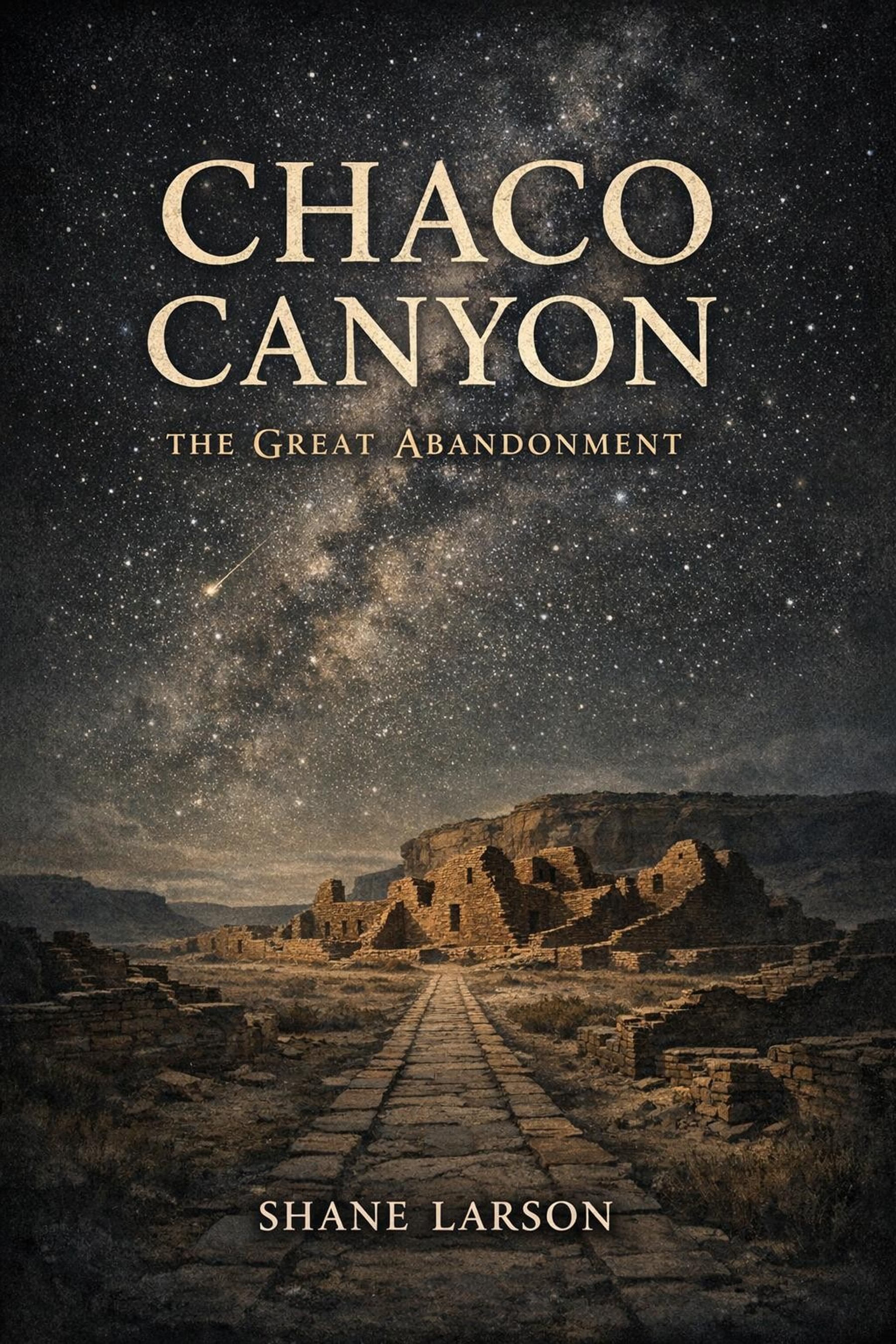
Shane Larson's new book, Chaco Canyon: The Great Abandonment, reconstructs the full story — the buildings, the roads, the astronomy, the macaws, the burials, and the evidence for why it ended — for readers who want the real archaeology without the mystery-mongering. It joins his companion history Cahokia: The American City Bigger Than London in exploring the lost monumental cities of ancient North America.
Chaco Canyon
New posts and releases, straight to your inbox. No spam, unsubscribe anytime.