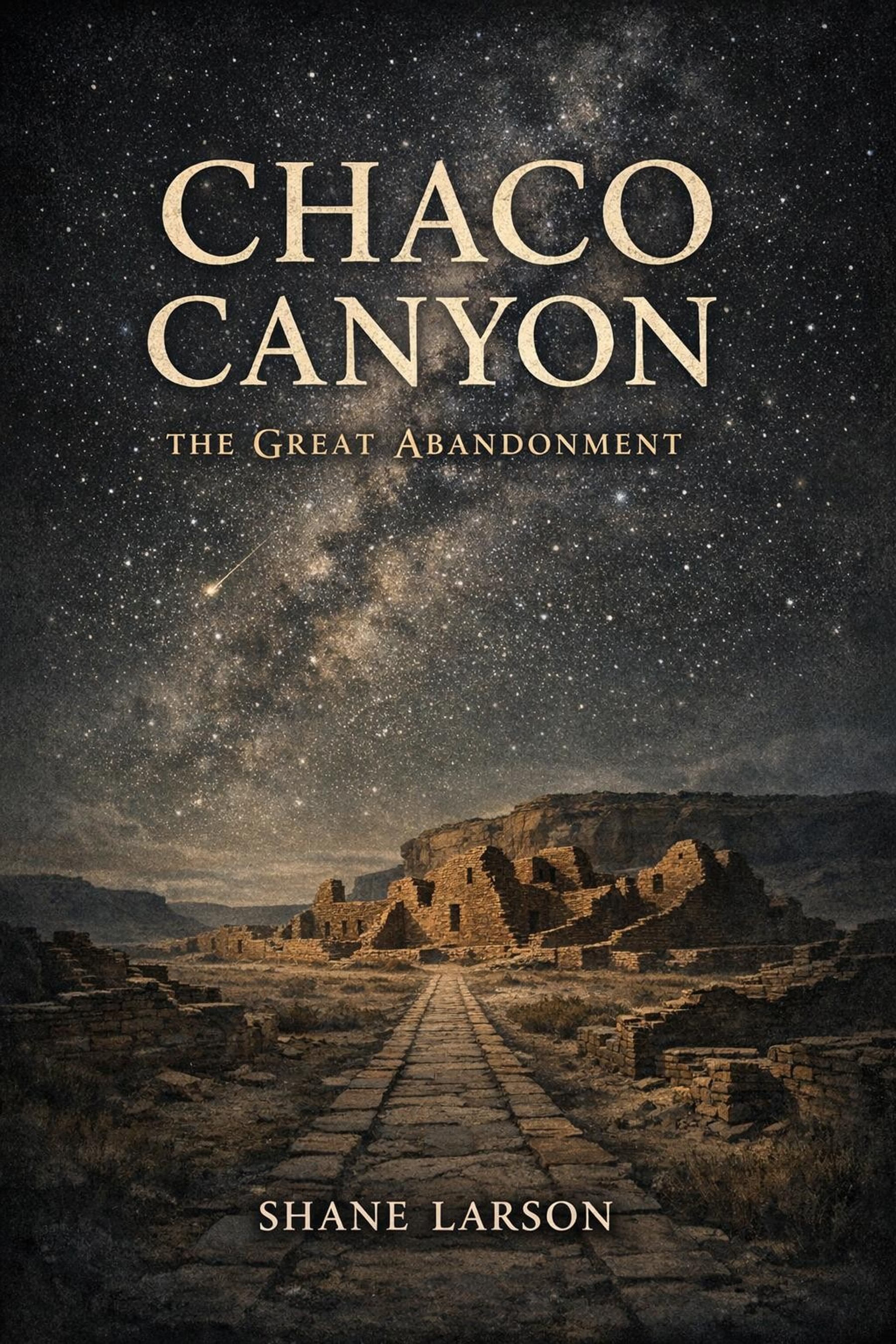
Chaco Canyon
The Great Abandonment
By Shane Larson
About This Book
Sometime around the year 1130, in a canyon in what is now northwestern New Mexico, somebody stood in a doorway of the largest building in North America and closed it forever — not by locking it, but by filling it with masonry. Course after course of shaped sandstone, fitted and finished, until a passage people had walked through for generations was a wall. It was done carefully. It was done well. And it was happening all over the canyon.
Great ceremonial chambers maintained for centuries were stripped and deliberately burned. A room holding more than a hundred rare ceramic jars — vessels that chemical analysis would later show once held chocolate carried from a thousand miles south — was smashed and torched in place. Then the people of Chaco Canyon gathered what mattered and walked out of the greatest architectural achievement the continent had ever seen. They never came back. And in nine centuries since, no one in the Pueblo world has built anything like it again.
This is a book about what they were closing.
The Story
For roughly three hundred years, Chaco Canyon was the center of the ancient Southwest — and it had no business existing at all. The canyon gets nine inches of rain in a good year. It has no river, thin soil, killing frosts, and no usable timber for miles. Yet between roughly AD 850 and 1150, Ancestral Puebloan builders raised more than a dozen monumental "great houses" there, the largest of which, Pueblo Bonito, stood five stories tall with around 650 rooms. The two hundred thousand roof beams in the canyon's buildings were carried by hand — no wheels, no pack animals — from mountains fifty miles away. We know because the chemistry of the wood still remembers which mountains.
Everything about the place is like that: too big, too precise, too far from anything, and too well documented to dismiss. Roads thirty feet wide run dead straight across the desert, cutting stairways into cliffs rather than bending, sometimes running in parallel pairs, sometimes ending at nothing anyone can find. Walls align to the cardinal directions and to the solstices. One outlying great house sits exactly where the moon rises between two stone spires at the extreme of a cycle that takes 18.6 years to observe — and its construction dates match the standstill years. Scarlet macaws from tropical Mesoamerica lived and died in the canyon's rooms. A single back room in Pueblo Bonito held the richest burials in the ancient Southwest, and DNA shows the people in it belonged to one maternal line that persisted for three hundred and thirty years.
Then it ended — and the ending is the strangest evidence of all. The tree rings say construction stopped before the great drought of the mid-1100s reached its worst. The buildings say the leaving was orderly: sealed doorways, ritually closed chambers, no massacre, no sack, no flight. Chaco Canyon: The Great Abandonment follows the evidence through the whole arc — the building of an impossible place, the system that sustained it, the arguments over who ruled it and how, and the deliberate, coordinated decision to shut it down — and then follows the people themselves, whose descendants still live in the Pueblo communities of New Mexico and Arizona and still tell the story of the leaving.
What's Inside
- A doorway-by-doorway reconstruction of the end — what sealed rooms, burned kivas, and smashed cylinder jars actually look like in the archaeological record, and why the evidence reads as ceremony rather than catastrophe.
- The beams that testify. How tree-ring science dates Chacoan construction to the calendar year, and how strontium isotopes traced a quarter-million timbers to specific mountain ranges fifty miles from the canyon.
- The road system in full — thirty feet wide, hundreds of miles mapped, engineered through mesas rather than around them — and the three-way scholarly fight over whether the roads served transport, pilgrimage, or cosmology.
- The sky instrument. The Sun Dagger of Fajada Butte, the cardinal walls of Pueblo Bonito, and the lunar standstill encoded at Chimney Rock — the real, measured archaeoastronomy, cleanly separated from the ancient-aliens noise that infests this subject.
- Chocolate, turquoise, and parrots. The residue chemistry and ancient DNA that turned Chaco from a regional curiosity into a node in a continental trade network reaching deep into Mesoamerica.
- Room 33 and the question of power — the wealthiest burials in the ancient Southwest, the 330-year matriline they preserve, and the unresolved ethics of the study that revealed it.
- The hard chapters, handled honestly: the population puzzle of buildings with no residents, the drought arithmetic, and the cannibalism controversy — presented as the live disputes they are, with the strongest case on each side.
- Where they went. The migrations to Hopi, Zuni, Acoma, and the Rio Grande, what Pueblo oral traditions say about the leaving, and why "lost civilization" is precisely the wrong phrase.
Why I Wrote This
After I finished my book on Cahokia, one detail from the Southwest kept bothering me: the sealed doorways. Civilizations are supposed to end badly — invasion, famine, fire, some catastrophe you can point to. Nobody is supposed to end a world neatly. But at Chaco the rooms were closed like someone finishing a ceremony, and the more I read, the clearer it became that the ending was the least mysterious part — the people simply decided, and their descendants will tell you so. What hooked me was everything upstream of that decision: why anyone built the largest buildings in North America in a desert that couldn't feed the builders, and what kind of authority moves two hundred thousand beams without a wheel, a mule, or, as far as we can tell, a king. I wrote this book to lay out that evidence the way the field actually holds it — disputes included.
Frequently Asked Questions
Do I need to read Cahokia first?
No. The two books are companions — both about monumental North American cities most people were never taught about — but each stands completely alone. If you read one and want the other, the readthrough works in either direction.
Is this a travel narrative or a history book?
A history book, organized as an investigation of the place — buildings, roads, astronomy, trade, power, collapse — anchored in physical evidence rather than a personal journey. If you have visited Chaco Culture National Historical Park, or plan to, it will change what you see there.
Does the book take the "ancient mysteries" angle seriously?
It takes the genuine mysteries seriously and the manufactured ones apart. The real puzzles — roads to nowhere, empty great houses, a coordinated regional exit — are stranger than anything the pseudo-archaeology industry has invented, and the book treats the alignments and engineering as documented human achievements, because that is what they are.
Did cannibalism really happen at Chaco?
There is a real scholarly controversy, and the book gives it a full chapter — the disturbing assemblages, the biochemical evidence from Cowboy Wash, and the serious objections and alternative readings. What it does not do is sensationalize: the violence evidence clusters mostly outside Chaco's peak years, and the debate is presented with the care owed to a question that involves the ancestors of living communities.
What happened to the people who left?
They are still here — that is one of the book's central points. Chaco's population moved to the Rio Grande valley, the Hopi mesas, Zuni, and Acoma, where their descendants have lived ever since. The final chapters follow the migrations, the oral traditions that remember them, and the modern fight over protecting the Greater Chaco landscape.
If You Liked This, You Might Like
- Cahokia — the designed companion volume: North America's other forgotten monumental city, on the Mississippi instead of in the desert.
- The Maya Collapse — another sophisticated American civilization that walked away from its cities, for reasons that reward a close look at the evidence.
- Lost Civilizations of the Ancient World — the wide-angle tour of societies that vanished, if you want the survey before the deep dives.
- The Collapse Pattern — the framework book: how complex societies come apart, and Chaco is the rare case where the coming-apart looks voluntary.
The buildings are still standing, the roads still run straight to nowhere, and the people who built them are still telling the story. This book brings all three together.
What You'll Learn
- A doorway-by-doorway reconstruction of the end — what sealed rooms, burned kivas, and smashed cylinder jars look like in the archaeological record, and why the evidence reads as ceremony rather than catastrophe
- How tree-ring science dates Chacoan construction to the calendar year, and how strontium isotopes traced a quarter-million timbers to specific mountain ranges fifty miles away
- The road system in full — thirty feet wide, engineered through mesas rather than around them — and the three-way scholarly fight over transport, pilgrimage, or cosmology
- The Sun Dagger of Fajada Butte, the cardinal walls of Pueblo Bonito, and the lunar standstill encoded at Chimney Rock — measured archaeoastronomy, cleanly separated from the ancient-aliens noise
- The residue chemistry and ancient DNA that turned Chaco into a node in a continental trade network reaching deep into Mesoamerica — chocolate, turquoise, and scarlet macaws
- Room 33 and the question of power: the wealthiest burials in the ancient Southwest, the 330-year matriline they preserve, and the unresolved ethics of the study that revealed it
- The hard chapters handled honestly — the population puzzle, the drought arithmetic, and the cannibalism controversy, presented as the live disputes they are
- Where they went: the migrations to Hopi, Zuni, Acoma, and the Rio Grande, and why "lost civilization" is precisely the wrong phrase
Included with Kindle Unlimited — read it free if you're a member.
New Ancient History releases and free chapters — no spam, unsubscribe anytime.