Charlemagne Could Barely Write His Own Name. That Is Why We Still Have Cicero, Virgil, and Tacitus.
June 14, 2026 · 7 min read
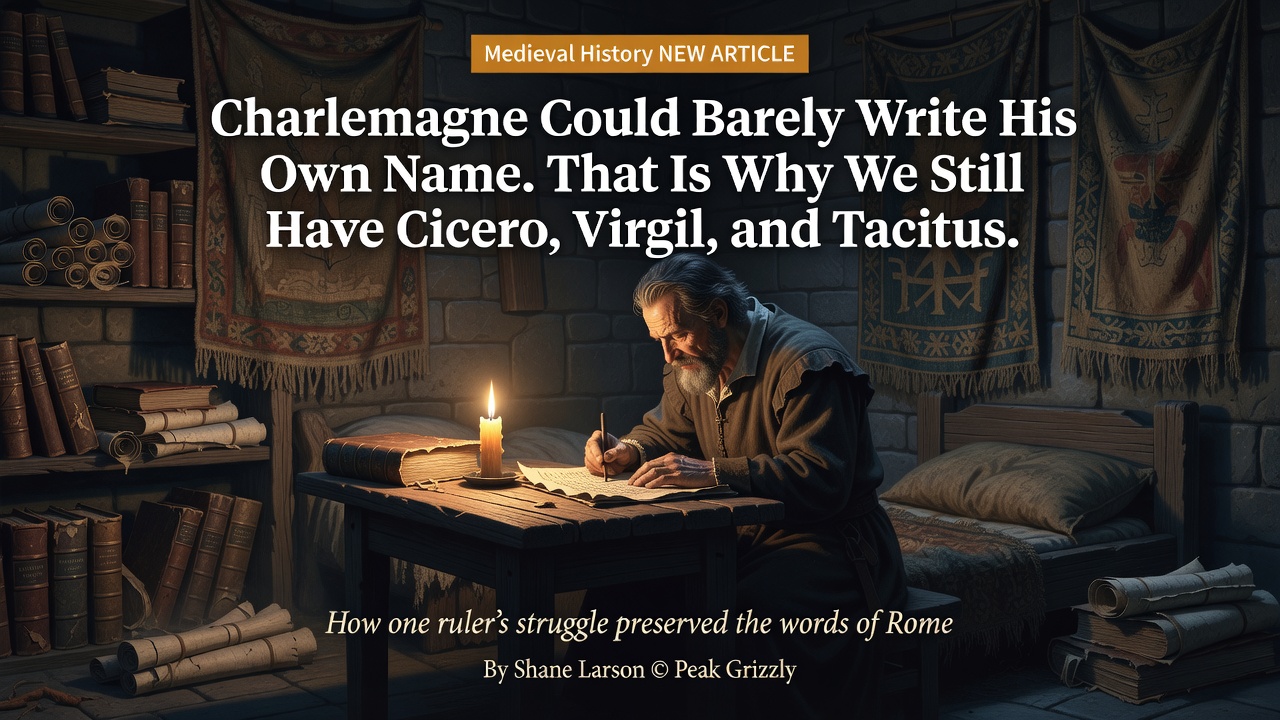
The most powerful man in the West, in the year 800, kept a writing tablet under his pillow.
According to his biographer Einhard, Charlemagne would lie awake at night and practice forming letters, tracing them with his finger so that when he had a free moment he might learn to write. He never really did. He could read, after a fashion. He could speak Latin and understand Greek. But the act of putting pen to parchment defeated him to the end of his life.
Hold that image for a second: the man who reassembled most of the old Roman West, who was crowned Emperor of the Romans by the Pope himself, who summoned the finest scholars in Europe to his court — quietly failing at penmanship in the dark.
And then consider this. A very large share of the Latin classics we can read today — Cicero's speeches, Virgil's poetry, the histories of Tacitus, much of what survives from the ancient world — comes down to us because they were copied during his reign and in the generations he set in motion. The oldest surviving manuscript of many a Roman author is a Carolingian copy.
The man who couldn't write saved the written word. That paradox is the whole story, and it is worth taking seriously.
A king crowned over a corpse
Start with the coronation, because everything bends around it.
On Christmas Day in the year 800, in St. Peter's in Rome, Pope Leo III placed a crown on Charlemagne's head and the assembled crowd hailed him as emperor. The trouble is that there had not been a Roman emperor in the West for more than three hundred years. The last one, a boy named Romulus Augustulus, had been pushed off the throne in 476. The empire Charlemagne was being handed had been dead longer than the United States has existed.
So what exactly was being revived?
Not Rome. Charlemagne was a Frank, the leader of a Germanic people whose grandfather had been mayor of the palace — a glorified household manager — for a different dynasty. His capital, such as it was, sat at Aachen in what is now western Germany, hundreds of miles from the city of Rome. He did not speak the Latin of Cicero as a native; he spoke an early form of German. He ran his realm without the road network, the tax apparatus, the professional army, or the standing bureaucracy that had made the actual Roman Empire function.
What was revived in 800 was an idea: that there could be, in the West, a single legitimate emperor — a ruler whose authority came not just from the sword but from the Church and from the Roman past. That idea is the thing Charlemagne actually built. And unlike roads or aqueducts, an idea can outlast the man who has it.
The warlord behind the philosopher-king
It would be a mistake to romanticize him. Charlemagne was, first and above all, a soldier, and the empire was built on a generation of war.
He destroyed the Lombard kingdom in Italy and took its crown. He pushed south against the Muslim states of Spain — and on the way back from one such campaign, in 778, his rearguard was ambushed and slaughtered in a Pyrenean pass at Roncesvalles. The disaster was militarily minor and politically embarrassing. Three centuries later, poets turned it into The Song of Roland, one of the founding epics of European literature. Even Charlemagne's defeats became myth.
The longest and ugliest war was against the Saxons, in what is now northern Germany. It ground on for roughly thirty years. It involved forced conversions, mass deportations, and, at one notorious moment near Verden, the reported execution of several thousand prisoners in a single stroke. There is no way to tell this story honestly and keep the halo intact. The man who patronized scholars and rebuilt churches also waged a brutal war of conquest and conversion that we would not hesitate to call atrocity today.
Both things are true. He was a builder and a butcher, often in the same decade. The book does not try to resolve that tension, because it doesn't resolve. It was the texture of power in the early Middle Ages.
Governing without a state
Here is the part that fascinates me most, and the part most relevant to anyone who has ever tried to hold a large, sprawling thing together.
Charlemagne
Charlemagne ruled an empire that stretched from the Atlantic to the Elbe and from the North Sea into central Italy. He did it with almost none of the tools we assume a government needs. There was no real money economy. There was no salaried civil service. There were no permanent ministries. Most of his subjects would never see a coin with his face on it, let alone an official.
So how did he govern? Personally, and on horseback. He moved constantly between estates. He bound his great men to him with oaths of loyalty, renewed in person. He issued written instructions — the capitularies — and sent out pairs of trusted inspectors, the missi dominici, "the lord's envoys," to ride the provinces and check that his counts and bishops were behaving. The whole apparatus depended on the credibility and presence of one man.
That is an extraordinary feat of leadership. It is also a fatal weakness, and the book is honest about why. A structure that runs on the personal authority of one individual does not survive that individual. Charlemagne held it together for decades through sheer force of character. His son managed, barely. His grandsons fell to fighting each other, and in 843 they signed the Treaty of Verdun, which carved the empire into three. Two of those pieces would slowly become France and Germany. The borders drawn by squabbling brothers in the ninth century are, recognizably, the borders of Europe.
The renaissance nobody expected
Now back to the writing tablet under the pillow.
Charlemagne could not write, but he understood, with unusual clarity, that his empire needed people who could. He needed clergy who could read scripture correctly, administrators who could draft documents, and a Church whose Latin was not collapsing into local mush. So he did something that turned out to matter far more than any battle: he imported brains.
The most important of them was Alcuin of York, an English scholar whom Charlemagne lured to his court to run, in effect, a palace school. Around Alcuin gathered a circle of the best-educated people in the West. They reformed the curriculum. They corrected and standardized the texts of the Bible and the liturgy. And — crucially — they hunted down old manuscripts of classical and patristic authors and copied them.
In the process, Carolingian scribes refined a clean, rounded, beautifully legible script called Carolingian minuscule. It was so clear that, centuries later, Renaissance humanists who admired these manuscripts mistook them for genuinely ancient Roman writing and copied the style — which is why the lowercase letters you are reading right now descend, by a long chain, from the script Charlemagne's scriptoria perfected.
This is the quiet payoff of the whole reign. Empires fall. Borders move. But the books got copied, and the copies survived, and because they survived, the ancient world did not go fully dark. The barely literate king is the reason the literate past came through the bottleneck.
What he actually built
So did Charlemagne rebuild Rome? No. The thesis of the book is that he built something else, and that the something else mattered more.
He built the idea of legitimate imperial authority in the West — an authority that combined the sword, the Church, and the inheritance of Rome into a single claim. That idea did not die with him at Aachen in 814. It became the seed of the Holy Roman Empire, an institution that would persist, in one form or another, until Napoleon finally dissolved it in 1806. For a full thousand years, European rulers reached back to Charlemagne to explain why they had the right to rule. The map of the continent, the script of its books, and the very concept of a Western emperor all carry his fingerprints.
He was a warlord who could barely sign his name. He set the terms for European power for a millennium.
That is the story I wanted to tell — without romance, without hero-worship, and without flinching from the violence. If you've read *The Fall of Rome* and *The Viking Expansion*, this is the book that bridges them: the moment, between the collapse and the longships, when one man tried to put the ancient world back together and accidentally built the modern one.
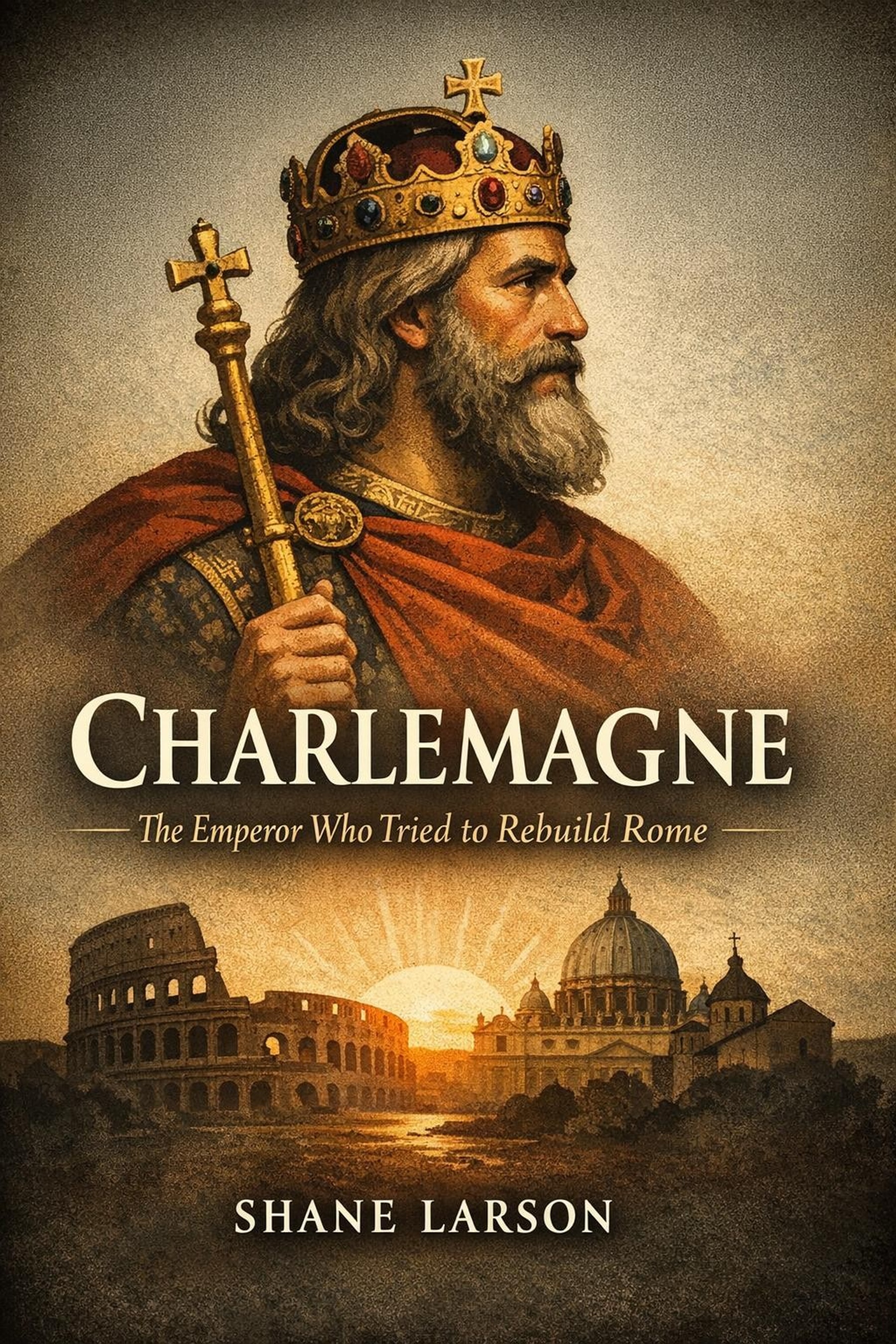
Charlemagne: The Emperor Who Tried to Rebuild Rome is out now on Kindle — $3.99, and free to read in Kindle Unlimited.
Charlemagne
New posts and releases, straight to your inbox. No spam, unsubscribe anytime.