Order Without Law: What the Montana Vigilantes Reveal About Justice
July 9, 2026 · 7 min read
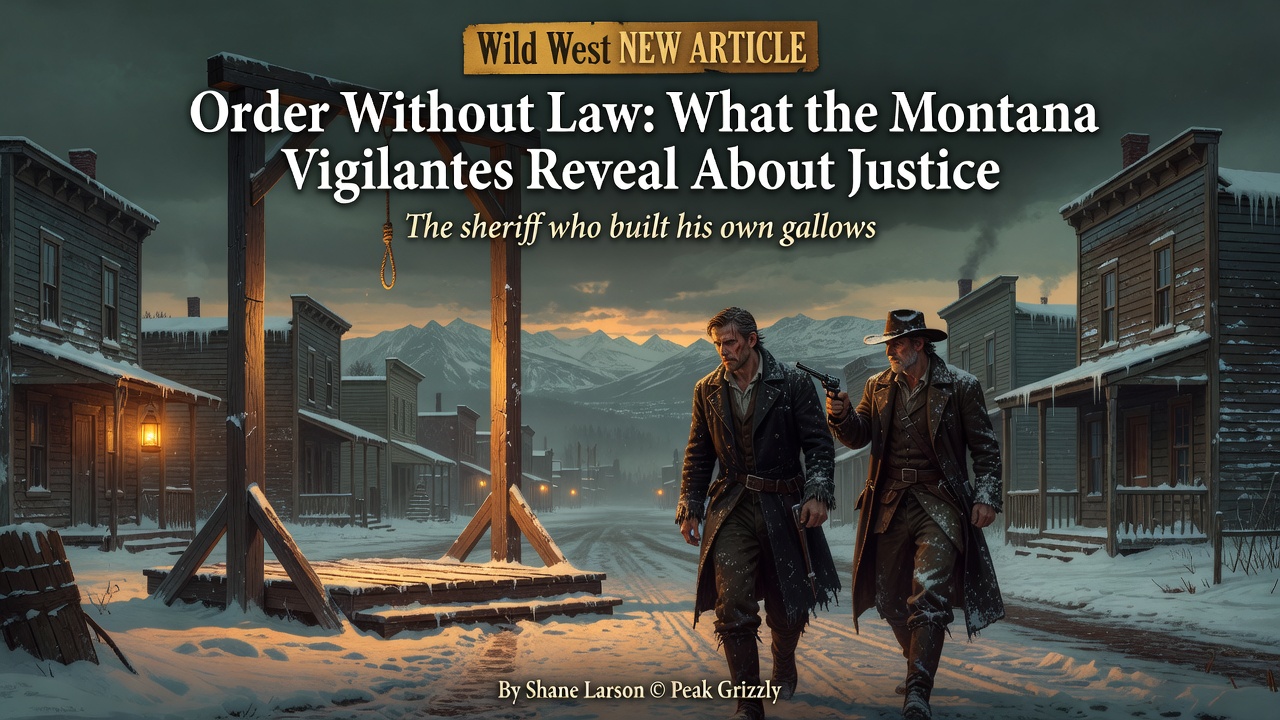
On a brutally cold Sunday afternoon, January 10, 1864, a crowd of armed men marched the elected sheriff of Bannack, Montana, out to a set of gallows. There is a detail in that sentence that should stop you cold: the sheriff had ordered those gallows built himself, only weeks earlier, to hang another man.
His name was Henry Plummer. He was young, handsome, well-spoken, and by every contemporary account charming enough to talk his way into almost anything. That afternoon, the charm failed. He begged for his life. He offered his captors his weight in gold. He asked for time to write a letter to his sister. They gave him none of it. They hauled him up by the neck and let him strangle in the snow, then hanged his two deputies beside him.
No judge had heard a word of evidence. No jury had been empaneled. Sheriff Henry Plummer was dead because a secret committee of private citizens had decided, on their own authority, that he was the hidden chief of a gang of murdering road agents.
That single afternoon contains the whole moral problem of the American frontier — and, if we are honest, a problem that never really went away.
The richest, most lawless ground on earth
To understand how a town comes to hang its own sheriff, you have to understand where they were standing. In 1862, prospectors struck gold at Grasshopper Creek; the camp that grew up around it became Bannack. The next year, an even richer strike at Alder Gulch gave birth to Virginia City. Almost overnight, these places became some of the wealthiest ground on the planet.
Wealth that size, with no institutions around it, is a dangerous thing. Gold dust was the local currency, and it moved out along the trails by the hundredweight, headed for Salt Lake City and points beyond. Along those same trails, travelers were robbed and murdered with terrifying regularity. This was then part of Idaho Territory; the nearest functioning courts were hundreds of miles away across the mountains. There was a sheriff, but the formal machinery of justice — judges, jails, juries, appeals — barely reached the camps at all.
So the camps faced a question that sounds abstract until your neighbor turns up dead in a ravine: who keeps order when there is no functioning law?
Two answers emerged. One wore a badge. The other met in secret.
The man with the easy smile
Henry Plummer is one of the most genuinely ambiguous figures in Western history, and any honest account has to resist the temptation to flatten him.
He arrived in the Montana gold country with a complicated past behind him in the California and Idaho camps — a trail of violent trouble that included killings, jail, and a reputation that followed him. He was not a saint. But he was also capable, intelligent, and likable, and in 1863 the voters of the Bannack district elected him sheriff. He appointed deputies. He confronted, on paper at least, the very real epidemic of robbery on the roads.
And almost immediately, whispers began that the sheriff himself was the secret head of the gang doing the robbing.
This is the heart of the legend that hardened into accepted history: that Plummer was a Jekyll-and-Hyde villain who used his office as cover, secretly captaining a gang called "the Innocents." The gang was eventually blamed for more than a hundred murders. It is a fantastic story. The trouble is where the story comes from.
The committee forms in secret
The spark was a murder. In December 1863, a young man named Nicholas Tbalt was found dead, and a man named George Ives was arrested for it. What followed was an extraordinary open-air trial at Nevada City, with a crowd for a jury, that ended with Ives convicted and hanged before a mass audience.
That trial convinced a group of leading citizens — among them Wilbur Sanders, Paris Pfouts, and Nathaniel Langford — that the camps needed something more organized than a single dramatic hanging. They bound themselves by oath into a Vigilance Committee. It was secret. It had structure. And it moved fast.
The committee captured suspected road agents and extracted confessions. A man called "Dutch John" Wagner talked. So did a dying road agent named Erastus "Red" Yeager, who, with the noose effectively already around his neck, named Henry Plummer as the gang's chief.
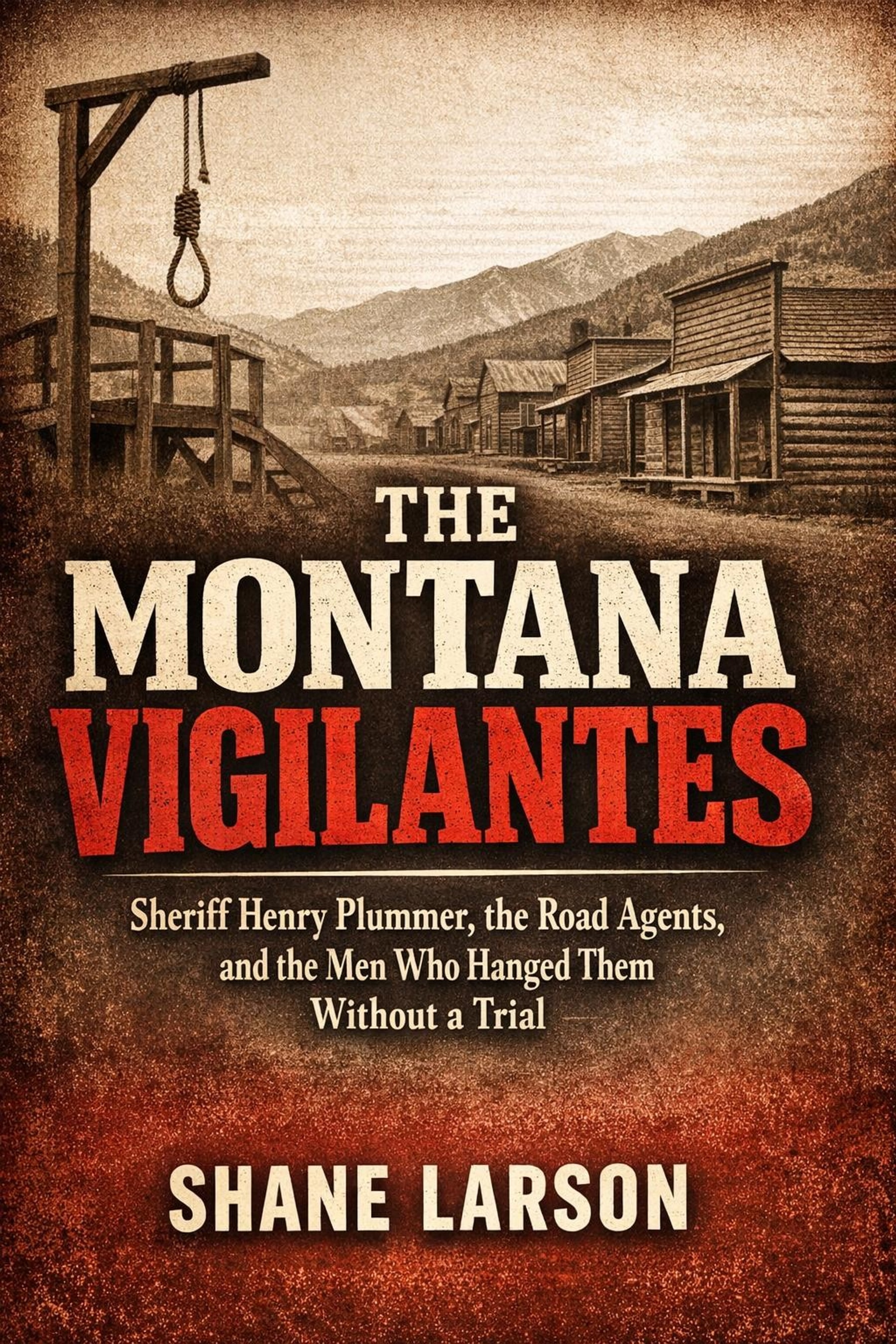
The Montana Vigilantes
That accusation — given by a doomed man, recorded by the men about to hang more people on the strength of it — became the foundation of everything that followed.
Twenty-one men
Once it started, it accelerated. Over a few weeks in the winter of 1864, the committee swept through the camps and hanged some twenty-one men. Plummer was first, on January 10. The notorious Boone Helm died in a mass hanging at Virginia City. Week by week, the bodies accumulated, and the community watched.
Somewhere in this period the vigilantes adopted their eerie signature: 3-7-77. Painted on a tent or a cabin, those numbers were a warning to clear out or die. Historians still argue about what they literally mean — the dimensions of a grave, a stagecoach schedule, a Masonic reference, a deadline in hours and minutes. What is not in dispute is their staying power: the numbers 3-7-77 ride to this day on the shoulder patch of the Montana Highway Patrol. Few symbols of mob justice have ever been so thoroughly absorbed into a state's official identity.
Who writes the history?
Here is where the legend has to be cross-examined.
Almost everything we "know" about Plummer's guilt descends from two sources: Thomas Dimsdale's The Vigilantes of Montana, published in 1866, and Nathaniel Langford's later memoir. Both are vivid. Both are also written by men with an enormous stake in the conclusion. Dimsdale was effectively the movement's house chronicler. Langford was a committee insider. They were not neutral observers reconstructing events; they were participants explaining, after the fact, why the killings had been righteous.
No independent court of inquiry ever examined what the committee did. There was no appeal, no defense, no cross-examination of the confessions — confessions that were, in several cases, extracted from men who knew they were about to die and may have said whatever they thought might buy them mercy or simply end the ordeal.
When you strip the story down to what the documents can actually establish, rather than what they assert, the certainty drains out of it. Plummer had a violent past — that much is real. But "flawed man with a past" is a long way from "secret king of a murder gang." The chain of accusation runs almost entirely through the people who needed him to be guilty.
When the cure becomes the disease
This is not an argument that the camps' terror was imaginary. People really were being robbed and killed, and the fear was real. The honest version of this story refuses both myths: the heroic-vigilante legend and the glib modern verdict that the committee were simply murderers.
But a committee that forms to stop killing and then hangs twenty-one men without trial has crossed a line that is very hard to step back over. Emergency justice has a way of expanding. It accelerates. It develops a taste for its own authority and a reluctance to disband even after formal courts arrive. The same energy that makes vigilantism feel necessary in the moment is exactly what makes it dangerous once the original emergency passes.
That is the question worth sitting with, and it is not a museum piece. Every era invents new spaces — new frontiers, including digital ones — where legitimate authority hasn't arrived yet and people decide to enforce the rules themselves. The badge changes. The temptation doesn't.
The unanswerable question
So: was Henry Plummer the most dangerous outlaw in the West, or one of its most consequential victims of mob rule?
The honest answer, more than 160 years later, is that we cannot say for certain — and that the uncertainty is the point. A society that hangs a man without a trial forfeits the very thing that could have told us whether it was right. The vigilantes didn't just kill Plummer. They killed the only process that could have proven their case. What they left behind was a confession extracted under the noose and a book written by the winners.
That is what order without law actually costs.
The Montana Vigilantes
New posts and releases, straight to your inbox. No spam, unsubscribe anytime.